CERT-In’s 2026 AI Cybersecurity Blueprint: What Every Organisation Must Implement Now
A comprehensive breakdown of CERT-In's latest blueprint for defending digital infrastructure against AI-assisted threats, including Zero Trust controls, modern SOC operations, and rapid vulnerability remediation.
The global threat landscape has entered a highly dangerous era of algorithmic warfare. Cybercriminals are no longer constrained by human physical limits, working hours, or manual scripting. By integrating advanced machine learning pipelines, Large Language Models (LLMs), generative AI, and autonomous agent frameworks, they can automate the entire cyber-attack lifecycle—from initial reconnaissance to active data exfiltration—with unprecedented speed.
Recognizing this rapidly evolving threat landscape, the Indian Computer Emergency Response Team (CERT-In), operating under the Ministry of Electronics and Information Technology (MeitY), Government of India, has released a critical security directive: “Blueprint for Reducing Exposure and Defending against AI-Assisted Vulnerabilities Exploitation in Digital Infrastructure.” This blueprint serves as a mandatory framework for enterprises, critical national infrastructure (CNI), banking and financial services (BFSI), SaaS providers, and cloud operations to immediately transition from a reactive, compliance-first posture to an active, threat-informed, and resilient defensive architecture.
Against AI-assisted attacks, traditional quarterly security audits and 30-day patching windows represent an unacceptable risk. CERT-In's 2026 blueprint establishes a rigorous defensive baseline centered on continuous asset visibility, phishing-resistant hardware MFA, aggressive remediation SLAs, and AI-aware detection mechanisms.
1. The Security Paradigm Reset: Redefining Cyber Defense
Under traditional security models, organizations relied on a "compliance-first" mindset: execute a quarterly vulnerability scan, run a yearly manual penetration test, and remediate critical vulnerabilities inside a standard 30 to 45-day cycle. This baseline assumed that human attackers needed weeks to map target environments, research vulnerabilities, write exploit scripts, and launch attacks.
Against AI-assisted threats, this assumption is completely obsolete. The blueprint makes it clear: because generative models can automate the process of scanning, discovery, and exploit synthesis, the window of exposure has shrunk from weeks to hours. To survive in this environment, organizations must deprecate legacy checkboxes and deploy continuous, behavior-driven security structures.
- • Periodic Assessments: Quarterly vulnerability scans and annual manual penetration tests.
- • Slow Patch Cycles: Remediation timelines extending between 30 to 45 days.
- • Permissive Identity: Basic MFA controls vulnerable to active session proxying/AiTM.
- • Signature Telemetry: Relying on static SIEM correlations and traditional file hashes.
- • Governance Void: No control or logging over corporate uploads to public LLMs.
- • Continuous Exposure: Automated external attack surface management (ASM) & validation.
- • Aggressive Remediation: Exploited flaws patched or shielded within 12 to 24 hours.
- • Hardware-Bound MFA: Hardware token bound FIDO2 authentication standards.
- • AI-Aware SOC Telemetry: Behavioral logging with cross-domain correlation rules.
- • Model Pipeline Auditing: Formally managed LLM prompts, input checks, and output validation filters.
2. Deep-Dive Analysis: The 4 AI Threat Vectors
Adversarial systems utilize generative workflows to scan, target, and exploit corporate systems. Organizations must understand the specific threat mechanisms, technical details, and mandated defenses across these four core vectors:
Threat Vector 1: AI-Enabled Attack Surface Mapping & Automated Reconnaissance
Highly CriticalThe Adversarial Mechanism: Attackers deploy autonomous agent crawlers that scan the entire IPv4 space, parse public DNS registries, crawl social platforms (LinkedIn, GitHub) for developer footprints, and systematically scan open APIs. Instead of looking for single high-severity patches, the AI engine builds an exploit chain—combining three or four low-impact misconfigurations (e.g. an unauthenticated staging API endpoint, a slightly permissive CORS policy, and a legacy remote gateway) to achieve complete administrative compromise at machine speed.
Threat Vector 2: Generative Spear-Phishing & Multi-Turn Deepfake Impersonation
Severe ThreatThe Adversarial Mechanism: Adversaries feed scraped executive communications, public statements, and corporate directories into LLMs to automatically generate flawless, hyper-personalized spear-phishing content. Because these emails carry no grammatical errors, are contextually accurate to the target's current projects, and mimic real team members, traditional spam filters and employee awareness training fail. Concurrently, threat actors use deepfake voice cloning (trained on public audio assets) to bypass internal identity verification protocols during phone calls, initiating fraudulent wire transfers, credential releases, or password resets.
Threat Vector 3: Polymorphic AI-Generated Malware & Automated Obfuscation
High RiskThe Adversarial Mechanism: Threat actors utilize specialized generative AI pipelines to compile malware. The AI engine automatically rewrites code sections, mutates system call functions, changes compiler signatures, and alters file hashes on each compilation cycle. This produces polymorphic payloads that easily bypass traditional, signature-based local gateways and antivirus engines. Even unsophisticated actors can leverage automated AI toolchains to launch highly stealthy, evasive malware campaigns across business infrastructure.
Threat Vector 4: Adversarial Prompt Injection & Corporate LLM Pipeline Hijacking
New VectorThe Adversarial Mechanism: Incorporating generative models (LLMs) into corporate platforms introduces a completely new attack surface. Attackers use Direct Prompt Injection (user input containing jailbreak structures to override safety rules) or Indirect Prompt Injection (malicious semantic payloads placed in files, resumes, web content, or emails processed by the LLM). When the LLM processes this untrusted data, the embedded instructions hijack model parameters. The compromised model then operates as a "confused deputy," executing dangerous system calls, accessing restricted tables, or exfiltrating data.
3. Mandated Vulnerability Remediation Timeline
Given the speed at which AI-assisted attack platforms can weaponise new exploits, traditional patching windows of 30 days are a massive security risk. CERT-In has defined aggressive timelines that organisations must now enforce. This shifts the vulnerability lifecycle from a passive review process into an active containment system.
Vulnerability Remediation Dashboard
Immediate action mandate: Execute instant patch verification, apply virtual shielding at the Web Application Firewall (WAF) tier, or isolate targeted network ports.
Enforce prioritized security patching, restrict administrative interface exposure, and coordinate active credential rotations.
Implement internal network segment boundaries, update domain assets, and isolate high-value active directory objects.
Coordinate systematic package upgrades, run verification code scans, and update local libraries.
4. Building an AI-Aware Security Operations Center (SOC)
Traditional Security Operations Centers (SOCs) depend heavily on signature-based alerts. When threat actors deploy mutating AI structures, these static triggers remain silent. CERT-In mandates that organisations upgrade their monitoring architectures to support active behavioral detection models.
This means streaming security telemetry into an AI-aware SIEM (such as Microsoft Sentinel) and deploying customized analytical models capable of spotting cross-domain anomalies, rapid permission adjustments, or out-of-sequence API invocations. The following KQL correlation query illustrates how security teams can detect automated, rapid API scanning campaigns:
// Detect AI-Assisted Rapid API Scanning & Exfiltration Patterns
SigninLogs
| where TimeGenerated > ago(1h)
| where ResultType == 0 // Successful sign-ins
| join kind=inner (AZWebEventLogs) on UserPrincipalName
| summarize EventCount=count(), IPList=make_set(IPAddress), UniqueAPICalls=dcount(APIEndpoint) by UserPrincipalName, ASN
| where EventCount > 500 and UniqueAPICalls > 50
| where ASN not in (HistoricalUserASNs) // Catches automated proxy jumps
| project TimeGenerated, UserPrincipalName, IPList, EventCount, UniqueAPICalls, ASN
Beyond custom SIEM queries, building an AI-aware SOC requires integrating User and Entity Behavior Analytics (UEBA). Behavioral baseline profiles must be established for every administrative role. Anomalous access attempts (e.g. out-of-sequence API queries, mass data summaries, or rapid authorization updates) must trigger automated isolation tasks while keeping a human analyst in the loop for containment approval.
5. Technical Blueprint: Zero Trust & Identity Hardening
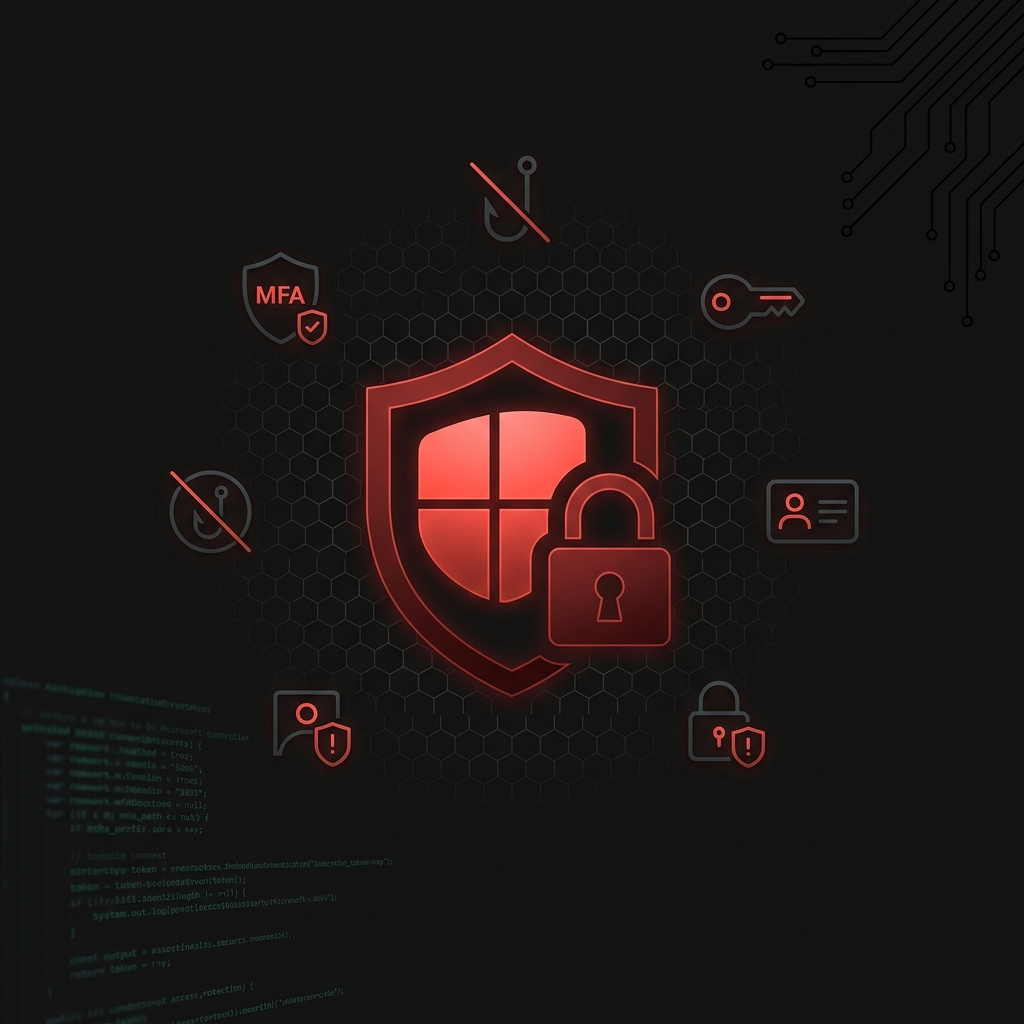
Identity is the ultimate perimeter in modern digital architectures. Attackers utilizing Adversary-in-the-Middle (AiTM) reverse-proxy kits can easily capture active cookies and Primary Refresh Tokens (PRTs) to bypass legacy, push-notification MFA. Organizers must immediately enforce a zero-trust model built upon three core layers:
1. Phishing-Resistant MFA
Deprecate push, SMS, and email OTPs. Enforce hardware-bound FIDO2 security keys, Windows Hello for Business, or device-bound passkeys. Require FIDO2 strengths in Conditional Access for every administrative tier.
2. Continuous Access (CAE)
Implement Continuous Access Evaluation (CAE) tenant-wide. Shorten token lifetime cycles to trigger immediate re-authorization if a device falls out of compliance, location changes, or user risk thresholds are breached.
3. Privileged Access (PIM)
Enforce Zero Standing Access policies. Migrate all Global, Cloud, and Exchange roles to Entra Privileged Identity Management (PIM) with mandatory out-of-band double-approvals and 2-hour lifecycle caps.
6. Secure AI Adoption and Governance Mandates
While organizations focus on protecting their enterprise from external AI attacks, they must also ensure they are not creating internal vulnerabilities through unmonitored AI integration. Employees uploading client files or source code to public LLM platforms (e.g. public instances of ChatGPT or Claude) introduce massive compliance and data leakage risks.
CERT-In mandates the formal establishment of a corporate AI Governance Framework containing the following controls:
- Formulate Explicit AI Policies: Implement clear corporate rules detailing which internal AI platforms are approved. Block unverified external LLM subdomains at the local egress proxy layer.
- Deploy Data Loss Prevention (DLP) for LLMs: Enforce real-time monitoring to inspect data blocks submitted to cloud interfaces. Prevent employees from copying proprietary source code, credentials, or PII into public semantic prompts.
- Implement Prompt Sanitizers: Deploy automated middleware sanitizers to validate, clean, and verify LLM outputs before they are processed by internal systems (preventing indirect injection vectors).
7. CERT-In's Recommended Implementation Roadmap
To help organizations transition to an AI-resilient architecture, CERT-In proposes a structured, phased implementation roadmap:
Immediate Tactical Hardening
-
✓
MFA deployment: Deploy phishing-resistant MFA across all administrative groups and priority services.
-
✓
Vulnerability assessments: Perform immediate, deep vulnerability sweeps of external assets and hot-fix open ports.
-
✓
Critical patching: Patch internet-facing known exploited vulnerabilities within the mandated 12-hour window.
-
✓
Incident reporting readiness: Establish out-of-band lines and templates to meet quick regulatory filing SLAs.
Long-Term Strategic Resiliency
-
✓
SOC strengthening: Deploy behavioral logging, telemetry analytics, and cross-domain correlation rules.
-
✓
Threat hunting: Initiate active memory and credential-hunting exercises on endpoints to identify latent threats.
-
✓
AI governance: Incorporate strict input validation, prompt injection protection filters, and secure AI API bounds.
-
✓
Backup restoration testing: Validate off-line immutable back-ups under active, offline simulation scenarios.
Aligning Your Enterprise with CERT-In Objectives
Deploying a resilient, threat-informed defense against AI-assisted attacks requires specialized expertise. At Adayptus, our team of senior security advisors, incident responders, and AI security specialists help you benchmark, validate, and harden your digital perimeters:
Closing Thoughts: Building a Resilient Digital Empire
In today's volatile digital landscape, hope is not a strategy. Assuming your security operations are effective without objective measurement and aggressive patching cycles is a risk that enterprise leadership can no longer afford to take. CERT-In's AI Cybersecurity Blueprint marks a definitive line in the sand—demanding real-time exposure monitoring, continuous vulnerability verification, and resilient design principles. Organizations must immediately audit their perimeters, establish strict guidelines around generative AI use, and begin implementing the phased controls outlined in this roadmap. Precision cyber resilience is the only viable path forward.
Official Guidance Reference
Source: Indian Computer Emergency Response Team (CERT-In)
Official Advisory Document: Blueprint for Reducing Exposure and Defending against AI-Assisted Vulnerabilities Exploitation in Digital Infrastructure (Ministry of Electronics and Information Technology, Government of India).

Peyush Baranwal
Senior Delivery Manager — Cyber Security, Adayptus
Peyush Baranwal is a Senior Delivery Manager at Adayptus Consulting with 11+ years of experience designing, implementing, and managing enterprise security programmes. His core expertise spans Vulnerability Assessment & Penetration Testing (VAPT), Application Security, and Security Operations — leading web, mobile, API, and infrastructure security assessments for CISOs and security teams across BFSI, healthcare, and SaaS. He focuses on measurable risk reduction, governance maturity, and operationalising detection-and-response capability. Outside work, Peyush is a passionate biker and part-time photographer.
Connect on LinkedInOn This Page
- 1. The Security Paradigm Reset: Redefining Cyber Defense
- 2. Deep-Dive Analysis: The 4 AI Threat Vectors
- 3. Mandated Vulnerability Remediation Timeline
- 4. Building an AI-Aware Security Operations Center (SOC)
- 5. Technical Blueprint: Zero Trust & Identity Hardening
- 6. Secure AI Adoption and Governance Mandates
- 7. CERT-In's Recommended Implementation Roadmap
- Aligning Your Enterprise with CERT-In Objectives
- Closing Thoughts: Building a Resilient Digital Empire