Penetration Testing Through AI: Using OpenClaw as an Autonomous Security Testing Agent
Discover how to securely orchestrate OpenClaw as an autonomous security testing agent. Learn reference architecture, lifecycle use cases, and regulatory mitigations for Indian BFSI & fintech.
The landscape of offensive cybersecurity is undergoing a fundamental paradigm shift. For decades, Vulnerability Assessment and Penetration Testing (VAPT) relied on a stark dichotomy: highly experienced human practitioners performing manual, custom analysis, contrasted against automated, static vulnerability scanners that run structured signature checks. While manual testing provides deep context, it struggles to scale across sprawling, modern enterprise perimeters. Conversely, automated scanners scale efficiently but generate significant noise, lack logical reasoning, and fail to chain complex vulnerabilities.
As we move through 2026, the emergence of agentic AI is bridging this gap. Security teams are increasingly experimenting with AI penetration testing workflows to augment human capabilities. By using LLMs not just as passive chat interfaces, but as active orchestrators that can plan, execute tools, read files, automate browsers, and reason about results, organisations can achieve unprecedented speed and coverage.
This article explores how security teams can leverage OpenClaw, an open-source personal AI agent framework, to orchestrate authorized AI-powered pentesting activities. We will examine the framework’s core architecture, construct a secure, sandboxed reference laboratory, map agent capabilities across the VAPT lifecycle, and honestly dissect the critical security, supply-chain, and governance risks of integrating agentic workflows into offensive security operations.
What is AI-Driven Penetration Testing?
To understand AI-driven security testing, we must distinguish it from legacy automation. Traditional automated security tools, such as Nessus, Qualys, or Burp Suite’s active scanner, operate on a deterministic, rule-based model. They send specific payloads to target ports or endpoints and compare the responses against static signatures. They cannot adapt their behaviour if a target employs custom routing, changes its response structure, or requires multi-step authentication that isn't pre-configured.
Autonomous penetration testing driven by agentic AI changes this dynamic. Instead of executing a static script, the agent is given a high-level goal (e.g., "enumerate exposed services and check for common misconfigurations within the specified IP range"). The agent then enters a loop of observation, reasoning, planning, and action:
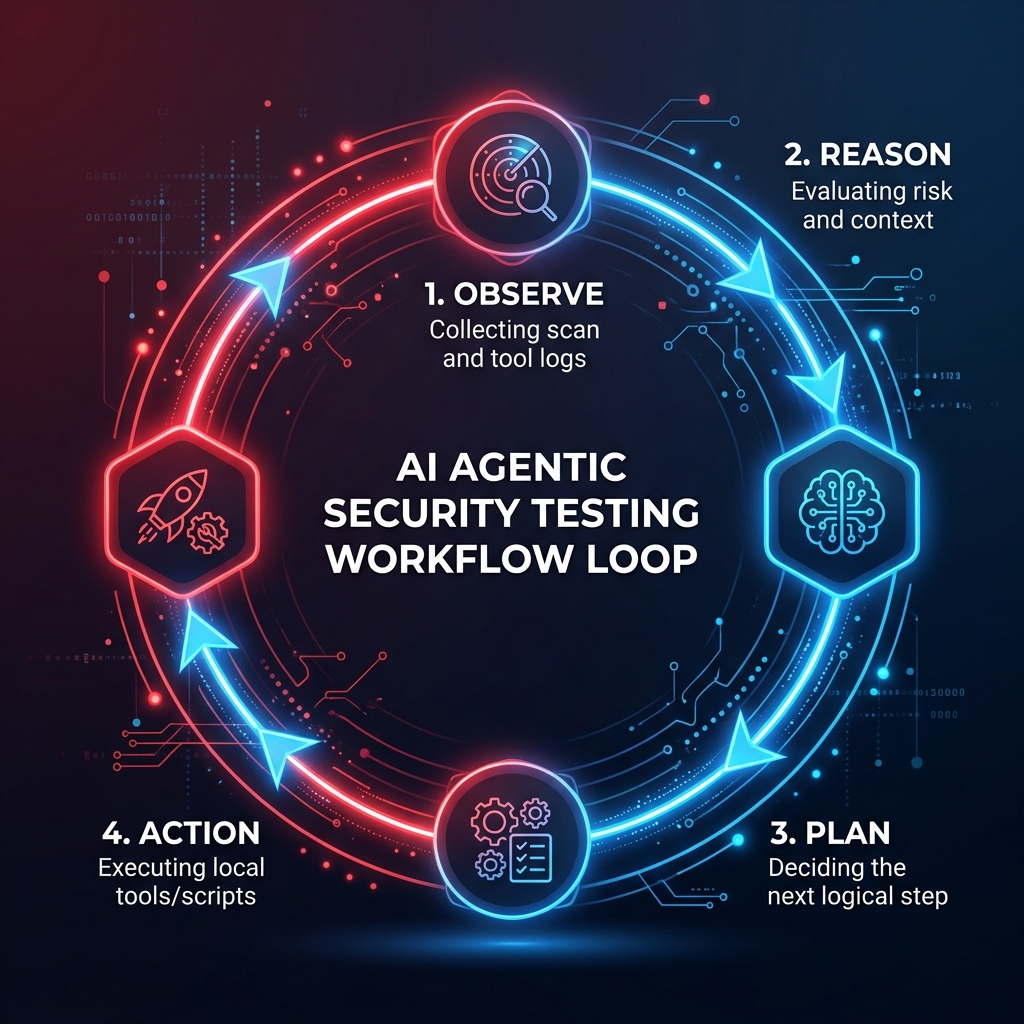
- Observe: Gather output from a tool (e.g., an
nmapXML output file). - Reason: Process the raw text, understand that port 8080 is running an outdated Apache Tomcat instance, and identify potential attack vectors.
- Plan: Formulate the next logical step—such as searching for public CVEs associated with that version or looking for default credential paths.
- Action: Call a tool to execute a directory search or perform a safe, unprivileged test request.
This represents the core of agentic AI security testing. Where traditional tools generate massive lists of isolated alerts, an LLM penetration testing agent can correlate data points. For instance, it can cross-reference leaked credentials found during initial OSINT with an exposed administrative portal found during port scanning, simulating the logical path a human attacker would take.
However, a critical distinction must be maintained: AI is an assistant that augments, rather than replaces, the human tester. While AI excels at rapid recon triage, log parsing, evidence collation, and drafting initial reports, it lacks the deep creative intuition required to discover complex zero-day vulnerabilities, bypass novel business logic, or make ethical risk assessments. In any professional VAPT engagement, the human practitioner remains the ultimate decision-maker, acting as a mandatory review gate before any high-risk action is performed.
What is OpenClaw?
OpenClaw is an open-source personal AI agent framework designed to run locally or in private cloud environments. Created by Peter Steinberger and launched in November 2025, OpenClaw was built to address a core challenge in the AI agent ecosystem: data sovereignty and control. Rather than relying on rigid, cloud-hosted SaaS agent platforms that mandate sending proprietary data to third-party servers, OpenClaw operates as a self-hosted control plane, often referred to as the "Gateway."
The framework is highly flexible, supporting local-first execution on the user’s own hardware. It interacts with the security team through a variety of everyday communication channels—including Slack, Discord, Telegram, WhatsApp, and standard Command Line Interfaces (CLI). This allows a tester to query the agent or receive real-time alerts on their mobile device or workstation.
To understand how to leverage OpenClaw for security testing, we must break down its three core building blocks: Tools, Skills, and Plugins.
1. Tools
Tools are the atomic execution capabilities exposed by the OpenClaw runtime to the LLM. The agent cannot interact with the external world without tools. The core framework provides several default tools: exec (terminal execution), browser (headless navigation), web_search (retrieving web info), file_read / file_write (manipulating local context), and message (sending updates back to the user).
2. Skills
Skills are structured directories containing instructions that define how the agent should perform specific tasks. Every skill must contain a SKILL.md file at its root. This file begins with a YAML frontmatter block declaring the skill’s name and description, followed by Markdown-formatted instructions. OpenClaw automatically discovers and loads skills located in the user's global configuration path or the workspace-local directory (.agents/skills/).
3. Plugins
Plugins are packaged bundles of skills, scripts, auxiliary files, and configurations that extend OpenClaw’s capabilities. Users can publish and download plugins from ClawHub, the official community registry. A major differentiator of the OpenClaw AI assistant is its self-extensibility: when faced with a task for which it has no pre-defined instructions, it can write its own code scripts, save them to its workspace, register them as a new local skill, and execute them dynamically.
Why OpenClaw Fits a Penetration Testing Workflow
Security practitioners are often hesitant to adopt general-purpose AI assistants because of strict operational constraints. OpenClaw, however, is uniquely suited for agentic AI security testing due to several structural design choices:
- On-Premises Data Sovereignty: In a typical enterprise VAPT engagement—especially for banking, financial services, and insurance (BFSI) clients in India—sending IP addresses, source code, internal hostnames, or vulnerability details to an external, multi-tenant AI cloud violates client Non-Disclosure Agreements (NDAs) and regulatory frameworks like the Digital Personal Data Protection (DPDP) Act 2023. OpenClaw allows the LLM orchestration logic, local tools, and workspace data to reside entirely within the consultant’s private environment or virtual private cloud (VPC).
- Native CLI and Tool Integration: Penetration testers rely heavily on CLI-based open-source security tools (e.g.,
nmap,ffuf,nikto). Because OpenClaw’sexectool can run arbitrary terminal commands, it can launch these security tools, capture their standard output, save the output files, and feed the data back to the LLM for analysis. - Headless Browser Automation: Modern single-page applications (SPAs) built on React, Angular, or Vue are difficult for traditional web vulnerability scanners to navigate. OpenClaw's native
browsertool allows the agent to interact with UI components, input text into form fields, click buttons, handle dynamic DOM changes, and take screenshots of target pages to visually verify security configurations. - Persistent Workspace and Memory: OpenClaw maintains a structured local file hierarchy for each session. When performing reconnaissance over several days, the agent does not lose context. It stores target data, scan results, and temporary scratch scripts in its localized workspace directory, allowing it to resume tasks seamlessly.
- Task Scheduling and Crons: With its built-in scheduler, OpenClaw can run recurring security checks (e.g., executing a regression test suite against a staging API every night) and notify the security team only if a change or new vulnerability is detected.
Reference Architecture: An AI-Assisted Pentest Lab
Deploying an autonomous agent with the ability to execute system commands (exec) introduces significant security risks. If the agent is compromised via prompt injection or executes a malformed destructive command, it could damage the testing infrastructure or the target environment. Therefore, security teams must design a safe, sandboxed AI red teaming architecture.
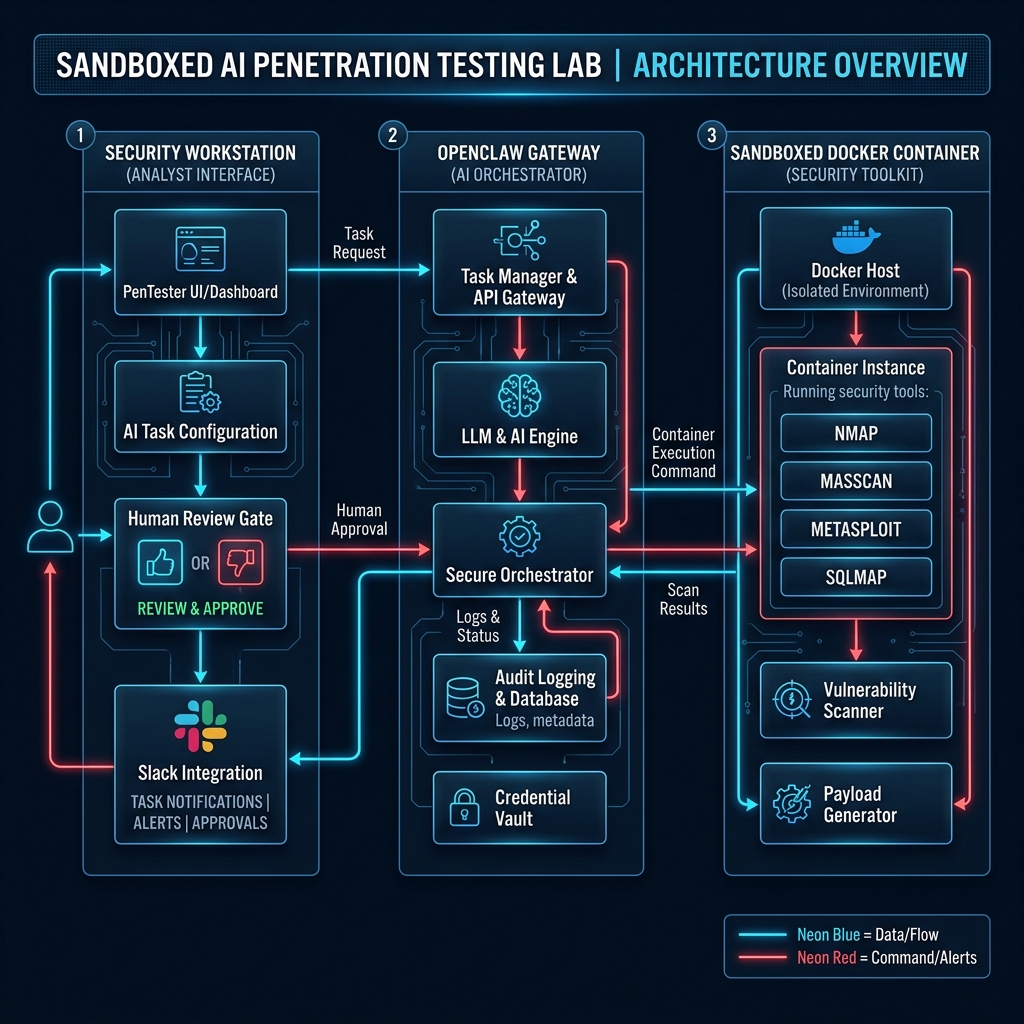
Below is a conceptual architecture for a secure AI-assisted pentesting lab:
Key Architectural Control Points
- Isolation (Host Virtualisation): The OpenClaw Gateway and execution agent must never run directly on a security consultant’s primary physical laptop. It should run inside a hardened Virtual Machine (VM) or a restricted Docker container.
- Strict Whitelisting and Blacklisting: In the agent's configuration, define strict constraints on the
exectool. Blacklist dangerous commands (e.g.,rm,dd,mkfs) and restrict outbound network connections to only target IP addresses defined in the Rules of Engagement (RoE). - The Human-in-the-Loop Gate: For any command that could cause service degradation or modify system state (e.g., active vulnerability exploitation or intense port scanning), OpenClaw must be configured to pause and request operator approval.
- Local Model API Gateways: Use local model servers (like Ollama or vLLM) or private enterprise API endpoints to run the LLMs. This ensures that no prompt data or vulnerability details are used to train public commercial models.
Practical Use Cases Across the VAPT Lifecycle
When deployed within a secure reference architecture, an OpenClaw AI assistant can be mapped to distinct phases of the standard VAPT engagement lifecycle to automate manual operations.
1. Scoping and Reconnaissance Triage
During the reconnaissance phase of an AI-powered pentesting engagement, security teams are flooded with raw data. OpenClaw can orchestrate these reconnaissance tasks. For instance, a custom skill can instruct the agent to run nmap -sV -T4 against an in-scope IP block, parse the results, and present a prioritized table of targets that require manual verification.
2. Evidence and Log Organisation
Using its browser and file_write tools, OpenClaw can navigate to identified web services, capture screenshots of index pages, record SSL certificate details, and write these files to structured folders (e.g., /workspace/evidence/<ip_address>/). This ensures that the evidence is organized and ready for inclusion in the final report.
3. Vulnerability Analysis and CVSS Scoring
OpenClaw can assist the tester by acting as an intelligent research partner. The agent can ingest details of a discovered software version, query vulnerability databases via its web_search tool, pull relevant CVE information, draft a preliminary CVSS v3.1 score, and provide a concise risk explanation mapped to the OWASP Top 10.
4. Regression Re-Testing via Scheduled Jobs
Rather than manually spinning up testing tools, a consultant can define a scheduled OpenClaw cron job. Every night, the agent can launch a targeted validation script against the specific endpoint, check if the vulnerability signature is still present, and send a Slack alert to the security team confirming whether the patch was successful.
5. Automated Report Drafting
OpenClaw can read structured vulnerability data from the workspace and draft comprehensive finding descriptions. Crucially for compliance, the agent can map these findings directly to relevant GRC frameworks—such as the RBI Guidelines on Information Security for Banks, CERT-In advisory directions, ISO 27001 control mappings, and the data confidentiality requirements under the DPDP Act 2023.
Security & Governance Risks of Using AI Agents
While the benefits of AI security automation are substantial, integrating autonomous agents into security operations introduces unique vectors of risk that security leaders must carefully evaluate.
1. ClawHub Supply-Chain Risk
ClawHub is a public, community-contributed registry. Independent security audits of public AI agent marketplaces have revealed that a meaningful share of community-submitted skills and plugins contain insecure code, hidden backdoors, or credential-harvesting payloads. Treat every community skill as untrusted executable code and perform manual source code reviews of all SKILL.md instructions.
2. Indirect Prompt Injection from Tested Targets
Prompt injection is a significant vulnerability in LLM-based systems. In the context of LLM penetration testing, the agent faces *indirect prompt injection*. If a malicious page contains hidden instructions (e.g. instructing the agent to delete all files), the LLM reading this page may interpret these data payloads as direct system instructions. Protect the environment with strict command sandboxing.
3. Data Leakage of Client Information
If an agent sends raw application logs or source code snippets containing personally identifiable information (PII) to an un-vetted external model endpoint, this constitutes a data breach under the Indian DPDP Act 2023, exposing both the security firm and the client to regulatory penalties.
Concrete Governance Mitigations
- Enforce
security.installPolicy: Set OpenClaw’s installation policy tosigned-onlyorlocal-onlyto prevent the execution of unsigned community plugins. - Source Code Audits: Perform manual source code reviews of all
SKILL.mdinstructions and associated helper scripts before deployment. - Disable Outbound Data in Local LLMs: Configure local LLM gateways (such as Ollama) or enter enterprise-grade contracts with cloud model providers that guarantee zero data retention.
- Strict Command Sandboxing: Ensure the agent runs in a non-root environment where filesystem permissions are strictly read-only for system directories.
- Audit-Logging Cron Jobs: Set up independent host-level monitoring to log every command executed by the OpenClaw container.
Getting Started Responsibly
If your security team wants to begin experimenting with OpenClaw penetration testing workflows, it is important to take a structured, phased approach to onboarding.
First, ensure your host machine has Node.js (runtime version 22.19.0 LTS or Node 24 recommended) and Docker installed. Install the OpenClaw CLI globally using npm:
npm install -g @openclaw/cli
Once installed, execute the onboarding script to establish your local configuration files and link your communication channels:
openclaw onboard
Before running any workflows, execute the doctor command to surface potential configuration errors, unsafe tool privileges, or risky Direct Message (DM) execution policies:
openclaw doctor
Define your Rules of Engagement (RoE) in a local SKILL.md, and follow a phased adoption model to gradually progress from passive tasks to active scanning under direct human supervision.
Conclusion & Call to Action
The integration of agentic AI into vulnerability assessment and penetration testing marks a significant step forward in offensive security. When deployed within a secure, local-first architecture and governed by strict human oversight, tools like OpenClaw allow security teams to reduce manual operational overhead, triage reconnaissance data rapidly, and verify patches continuously.
At Adayptus Consulting, we combine advanced technical capabilities with structured compliance frameworks. Our offensive security teams leverage safe, state-of-the-art testing automation to deliver comprehensive VAPT services tailored to the strict security standards of the BFSI and fintech sectors. Whether you need a scoped penetration testing engagement, assistance in establishing a secure internal AI testing lab, or a readiness assessment to secure your own generative AI applications against OWASP Top 10 LLM risks, we are here to help.
Secure Your Infrastructure with Adayptus
Ready to secure your digital infrastructure? Do not wait for an alert to test your resilience. Contact our threat consultants today to schedule a consultation with our offensive security experts.
Frequently Asked Questions
Click any question to expand the answer.
Q How to use AI for penetration testing?
To use AI for penetration testing responsibly, deploy a self-hosted agent framework like OpenClaw in a sandboxed, non-production environment. Create structured skills (SKILL.md) that outline specific, authorized reconnaissance and triage tasks, and configure the framework to require manual human approval (human-in-the-loop) before executing active commands or exploit scripts.
Q Can AI do penetration testing?
AI cannot fully execute a penetration test independently. While agentic AI can automate repetitive tasks like recon parsing, evidence collection, and initial report drafting, it lacks the creative reasoning, contextual understanding, and ethical judgment required to discover complex logic flaws, execute custom exploits safely, and validate findings without false positives.
Q Is OpenClaw safe for security testing?
OpenClaw is safe for security testing only when deployed with strict security configurations. Because it supports community-contributed plugins from ClawHub, you must audit the source code of all external skills before use. Additionally, you should run the runtime within an isolated container, enable strict command sandboxing, and set the installation policy to restrict unsigned plugins.
Q What are the best AI tools for penetration testing 2026?
The best AI tools for penetration testing in 2026 are self-hosted, agentic frameworks that prioritize data sovereignty, including OpenClaw for local command orchestration and browser automation, custom security skills mapped to local LLM engines (like Ollama), and specialized threat-modeling tools that run within secure, private cloud environments.
References & Further Reading
- OpenClaw Official Website
- OpenClaw GitHub Repository
- OpenClaw Documentation - Sandboxing & CLI Configuration
- OWASP Web Security Testing Guide (WSTG)
- CERT-In Advisory and Vulnerability Reporting Directions
- RBI Cyber Security Framework for Banks and NBFCs
- Digital Personal Data Protection Act, 2023 - Ministry of Electronics and IT
Adayptus Consulting Offensive Security Team
Senior Offensive Security Consultants & Technical Content Writers
The Offensive Security Team at Adayptus Consulting specializes in AI security validation, advanced red teaming, threat simulation, and regulatory compliance.
On This Page
- What is AI-Driven Penetration Testing?
- What is OpenClaw?
- Why OpenClaw Fits a Penetration Testing Workflow
- Reference Architecture: An AI-Assisted Pentest Lab
- Practical Use Cases Across the VAPT Lifecycle
- Security & Governance Risks of Using AI Agents
- Getting Started Responsibly
- Conclusion & Call to Action
- Frequently Asked Questions
- References & Further Reading