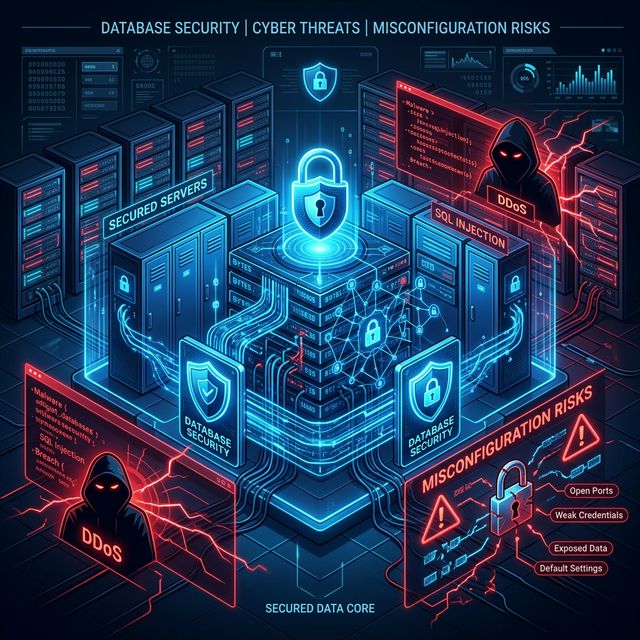
The Silent Threat: How Database Misconfigurations Lead to Billion-Record Breaches
Recent hacks have exposed billions of records due to simple database misconfigurations. Learn why these errors occur, explore high-profile 2024–2026 breaches, and discover actionable best practices for securing your data with Adayptus.
The breaches that expose hundreds of millions of records almost never involve a novel exploit. They involve a database that was reachable from the internet and required no credentials, or one whose backup was copied to storage nobody had reviewed. The technique is not sophisticated. The discovery is automated.
This is what makes database exposure such an unusual risk category. Most security problems require an attacker to do something. Here, the data is simply being served to anyone who asks — and the entire public address space is scanned continuously by infrastructure built for exactly this purpose.
This guide covers how these exposures actually arise, why the copies of your database are often more exposed than the original, what a database security assessment examines, and the controls that prevent recurrence rather than fixing today's instance.
- 01Mass-scale breaches usually come from exposure and configuration, not exotic exploits.
- 02The copies are the problem — backups, replicas and dev refreshes rarely inherit production controls.
- 03Applications routinely connect with far more privilege than they need, usually as an owner or admin.
- 04Encryption at rest does not protect against a valid query — it addresses stolen media, not stolen credentials.
- 05Without query-level audit logging, you cannot tell a regulator what was actually accessed.
How Exposure Actually Happens
Database exposure is rarely a single decision. It is usually the accumulation of several reasonable-seeming ones.
| Exposure | How it arises | Control |
|---|---|---|
| Publicly reachable instance | Bound to all interfaces during setup or a migration; never reverted | Private subnets only, enforced by policy-as-code |
| No or default authentication | Some engines historically shipped open by default; assumed private network | Authentication mandatory; default credentials blocked at deploy |
| Over-privileged application account | Granted owner rights to avoid permission errors during development | Per-application roles scoped to required tables and operations |
| Exposed backups | Dumps written to object storage with broader access than the database | Backups encrypted, access-controlled and externally verified |
| Production data in non-production | Realistic test data copied without masking | Masking or synthetic data as a pipeline step, not a policy |
| No query auditing | Disabled for performance or never enabled | Audit logging on sensitive tables, shipped to a monitored SOC |
The Copies Are the Real Problem
Organisations invest carefully in securing the production database and then leave its copies almost untouched. Yet a backup contains the same records, a read replica answers the same queries, and a development refresh often holds the same personal data as production.
The asymmetry is stark. Production sits behind change control, monitoring and access review. A nightly dump written to object storage inherits none of that — it is protected only by whatever the bucket policy happens to say, and bucket policies drift. Development environments are worse still: broader access, weaker monitoring, and frequently a flat network path from a workstation.
Restoring production data into a development environment is the single most common way sensitive records end up somewhere they should never be. Under the DPDP Act this also carries direct consequence — personal data copied into a development database is still being processed, with the same purpose-limitation and erasure obligations that apply to production.
A question worth asking your team today: where does last night's backup live, who can read it, and when did anyone last verify that from outside the network? In most organisations the honest answers are "object storage", "more people than should", and "never".
What Encryption Does and Does Not Solve
Encryption at rest is frequently offered as the answer to database risk. It is worth having and it satisfies a common audit control, but it is important to be precise about the threat it addresses.
Encryption at rest protects against someone obtaining the underlying storage — a stolen disk, a decommissioned volume, an improperly disposed backup medium. It does not protect against an attacker who has valid credentials or a working application connection, because the database decrypts data transparently for authorised queries. In the exposure scenarios above, the attacker is not reading files off a disk; they are asking the database politely and being answered.
The controls that address that threat are different: least-privilege accounts, network isolation, query auditing, and — for the most sensitive columns — application-level or tokenised encryption where the database itself never holds the plaintext.
What an Assessment Examines
A database security assessment is largely a configuration and access review rather than an exploit hunt, because that is where the risk actually is.
- Network reachability — verified from outside, not from the configuration file. This routinely surfaces instances teams believed were private.
- Authentication and account hygiene — default accounts, shared credentials, accounts belonging to people who left.
- Privilege model — what each application account can actually do, versus what it needs.
- Backup and replica security — where copies live, who can read them, whether they are encrypted.
- Non-production data — whether real personal data exists outside production, and under what controls.
- Audit configuration — whether access to sensitive tables is logged, and whether anyone monitors it.
- Injection paths — reviewed at the application layer, since the database is usually reached through an application. Our web application and API penetration testing covers that surface.
Why You Need Query-Level Auditing
This is the control organisations most regret skipping, and the reason is regulatory rather than technical.
When a database is compromised, the question that determines the scale of your breach notification is not "were we breached" but "what did they actually access". Without query-level audit logging you cannot answer it, which forces you to assume every record was exposed. Under the DPDP Act that means notifying every affected individual rather than the subset genuinely involved, and CERT-In's six-hour reporting window assumes you can characterise the incident at all.
Auditing every query is usually impractical for performance reasons. Auditing access to the tables holding personal or financial data is both achievable and sufficient — and it converts an unbounded notification obligation into a defined one.
- 01Verify from outside your network that no database instance is publicly reachable.
- 02Locate every backup and replica and confirm who can read them.
- 03Replace owner-level application accounts with scoped, per-application roles.
- 04Remove default and shared accounts; move credentials into a managed secrets service.
- 05Enforce masking or synthetic data for non-production as a pipeline step.
- 06Enable audit logging on sensitive tables and route it to a monitored SOC.
- 07Require TLS in transit, not only encryption at rest.
- 08Alert on anomalous query volume — bulk extraction looks nothing like normal use.
How Adayptus Helps
- Database Security — configuration, access and privilege review with externally verified exposure testing.
- Network Penetration Testing — validating that isolation actually holds.
- Web Application and API Penetration Testing — the injection and authorisation paths that reach your data.
- Cloud Security Assessment — where managed database services and storage policies interact.
- DPDP Assessment — where personal data has spread beyond production.
- Managed SOC & MDR — detection on bulk extraction and anomalous access.
Related reading: cloud misconfigurations and vulnerability assessment versus management.
Frequently Asked Questions
Click any question to expand the answer.
QHow do massive database breaches usually happen?
Through exposure and configuration rather than exotic exploits. The recurring pattern is a database reachable from the internet with weak or absent authentication, or a backup written to storage with broader access than the database itself. Neither requires skill to find — the public address space is scanned continuously by automated infrastructure, and a newly exposed database service is typically discovered within minutes.
QDoes encryption at rest protect us from a database breach?
Only from a specific threat: someone obtaining the underlying storage, such as a stolen disk or an improperly disposed backup medium. It does not protect against an attacker with valid credentials or a working application connection, because the database decrypts transparently for authorised queries. In most real breaches the attacker is not reading files off a disk — they are querying the database and being answered. Least privilege, network isolation and query auditing address that threat.
QIs it safe to use production data in development?
No, and it is one of the most common ways sensitive records end up somewhere they should not be. Development environments typically have broader access, weaker monitoring and flatter network paths than production, yet a restored copy holds identical data. Under the DPDP Act that copy is still personal data being processed, carrying the same purpose-limitation and erasure obligations. Use masking or synthetic data, enforced as a pipeline step rather than a policy statement.
QWhy does query-level audit logging matter so much?
Because it determines the scale of your breach notification. Without it you cannot establish what an attacker actually accessed, which forces you to assume every record was exposed — meaning notification to every individual rather than the subset genuinely affected. Auditing every query is often impractical for performance reasons, but auditing access to tables holding personal or financial data is achievable and converts an unbounded obligation into a defined one.
QWhat privileges should an application database account have?
Only the operations it genuinely performs, on only the tables it touches. In practice application accounts are frequently granted owner or administrative rights during development to avoid permission errors, and that is never revisited. The consequence is that an injection flaw or a leaked connection string yields full database control rather than access to a handful of tables. Scoped per-application roles substantially reduce what any single compromise can reach.
QHow do we know our database is not publicly exposed?
Verify from outside your network rather than reading the configuration. Reviewing a security group or a bind address tells you what was intended; attempting the connection from the internet tells you what is true. Exposure frequently arises from a combination nobody reviewed as a whole — a load balancer, a peering route, a legacy rule — and internal review will not surface it. Continuous external attack surface monitoring makes this ongoing rather than a one-off check.
Adayptus Tech Team
Strategic Intelligence Division
Adayptus Consulting is a premier provider of enterprise cybersecurity solutions, specializing in Managed SOC, Penetration Testing, and GRC strategy. Our intelligence division regularly publishes research to help CISOs navigate the evolving threat landscape.