Purple Teaming in Cybersecurity: The Ultimate Guide for Security Leaders
Discover how Purple Teaming breaks down silos between offensive and defensive cybersecurity. Learn the differences between Red, Blue, and Purple teams, and how collaborative attack simulation can dramatically elevate your security operations maturity.
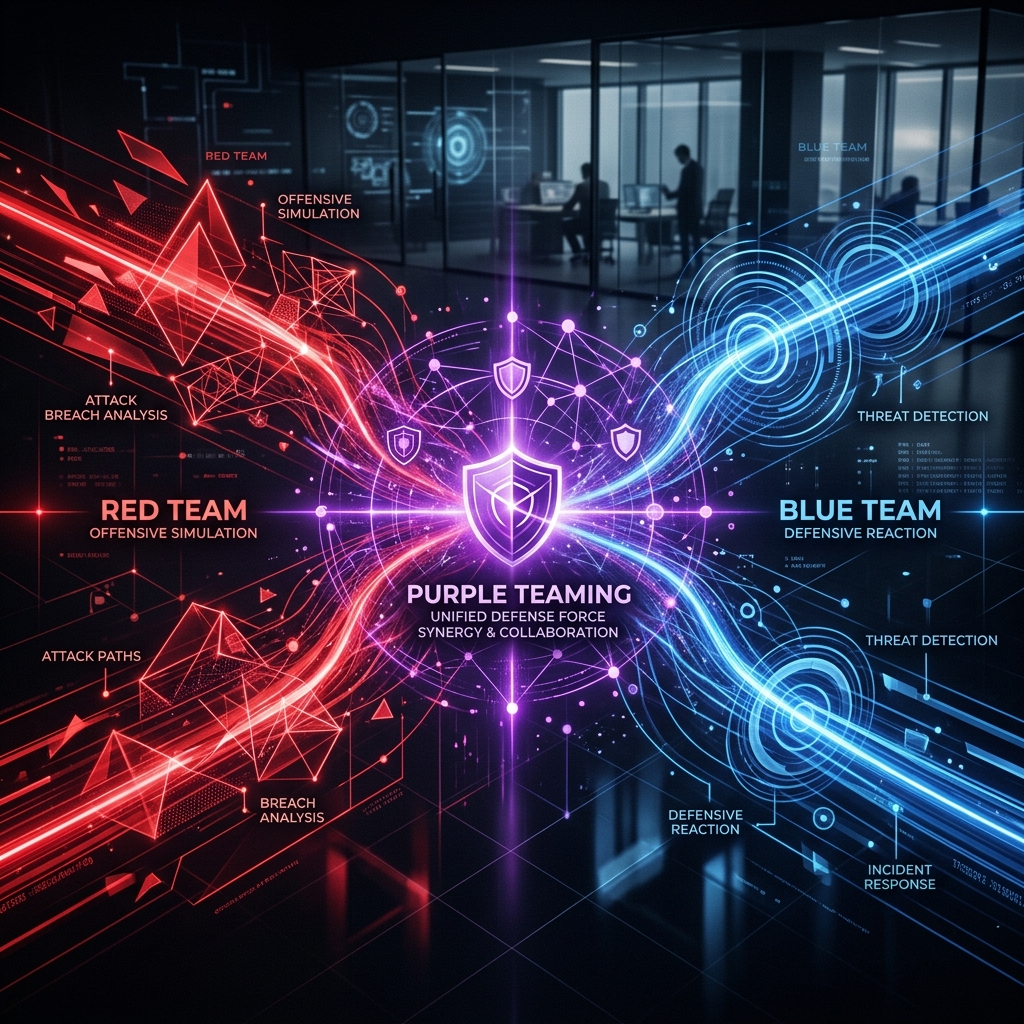
For decades, the cybersecurity industry has operated on a divided front. On one side, the Red Team relentlessly simulates sophisticated cyberattacks, exploiting vulnerabilities and breaching perimeters. On the other side, the Blue Team works tirelessly to defend the organization, analyzing logs, patching systems, and responding to incidents. While both functions are critical, operating them in silos often creates a fundamental disconnect. Red Teams "win" by breaking in, Blue Teams "win" by blocking them, but the organization frequently loses out on the shared intelligence required to actually stop real-world threat actors.
Enter Purple Teaming. A modern, collaborative approach to security validation that is fundamentally reshaping how mature organizations approach threat detection and response. By tearing down the walls between offense and defense, purple teaming in cybersecurity ensures that every simulated attack translates directly into a hardened, measurable defensive capability.
In this comprehensive guide, we will break down exactly what purple teaming is, how it differs from traditional red and blue teaming, the undeniable business benefits it delivers, and how you can implement world-class purple team exercises within your organization to elevate your security operations maturity.
The Evolution of Security Testing: Red Team vs. Blue Team vs. Purple Team
To truly grasp the value of purple teaming, we must first understand the limitations of the traditional Red vs. Blue dynamic.
The Red Team (Offense)
The ethical hackers. Their objective is to simulate adversarial tactics, techniques, and procedures (TTPs) to breach the network undetected. They assess the organization's prevention and detection capabilities from the perspective of an advanced persistent threat (APT). However, their post-engagement reports are often highly technical and thrown "over the wall" to the Blue Team, leading to friction rather than collaboration.
The Blue Team (Defense)
The defenders. Comprising the Security Operations Center (SOC), incident responders, and security engineers. Their job is to identify, contain, and remediate threats. In a traditional setup, the Blue Team only learns about a Red Team's attack vectors weeks later when the report is finalized, severely delaying the tuning of their detection logic (SIEM/EDR).
The Purple Team (Collaboration)
Purple teaming is not necessarily a separate team, but a collaborative methodology. It brings offensive and defensive practitioners into the same room. As the Red Team executes a specific attack technique, the Blue Team watches in real-time to see if their tools generate alerts. If not, they build the detection logic together on the spot. The goal is continuous security validation, not just scoring points.
What is Purple Teaming and How Does It Work?
At its core, purple teaming in cybersecurity is a structured execution of attack simulations designed explicitly to test and improve an organization's threat detection and response capabilities. Rather than a blind "black box" penetration test where defenders are unaware of the simulation, purple team exercises are highly transparent, planned events.
The Lifecycle of a Purple Team Exercise
A successful purple team exercise generally follows a structured methodology closely aligned with the MITRE ATT&CK framework:
- Threat Intelligence & Planning: The team selects a specific threat actor (e.g., APT29) or a specific attack vector (e.g., Ransomware lateral movement) relevant to their industry. They map out the exact TTPs the adversary uses.
- Execution (The Attack): The Red Team manually executes the chosen technique (e.g., dumping credentials from LSASS memory) or uses automated breach and attack simulation (BAS) tools.
- Observation (The Defense): Simultaneously, the Blue Team monitors their SIEM, EDR, and network traffic analysis tools to see if the attack generated a high-fidelity alert, a low-level log, or nothing at all.
- Tuning & Remediation (The Synergy): If the attack bypassed detection, the Red Team explains exactly how the payload functioned. The Blue Team then immediately writes and tests new detection logic. The Red Team re-runs the attack to validate that the new defense holds up.
- Documentation: The exercise yields immediate, actionable metrics (e.g., "We improved detection of credential dumping from 15% to 95%").
The Business Benefits of Purple Teaming
For CISOs and business leaders evaluating security maturity, shifting from traditional penetration testing to purple teaming yields massive strategic advantages. It transforms security spending from a compliance checkbox into a measurable reduction of corporate risk.
Maximized ROI on Existing Security Investments
Many organizations spend millions on enterprise EDR and SIEM solutions, yet deploy them with default, out-of-the-box rules that attackers easily bypass. Purple teaming acts as a tuning mechanism, ensuring you extract the maximum capability from the tools you have already purchased by validating their configuration against real threats.
Accelerated Capability Improvement
Because remediation happens during the exercise rather than weeks later, an organization's defensive posture improves in real-time. This rapid feedback loop drastically reduces the Mean Time to Detect (MTTD) actual breaches.
Fostering a Culture of Collaboration
The adversarial friction between Red and Blue teams is notoriously toxic in many corporate environments. Purple teaming forces empathy. Red teamers learn the immense difficulty of sorting through false positives, and Blue teamers learn how effortlessly advanced attackers can obfuscate payloads. This builds a unified security culture.
Measurable Security Metrics for the Board
"Are we secure?" is an impossible question. Purple teaming changes the narrative to data-driven metrics: "Last quarter, we tested 50 ransomware techniques and detected 20%. After purple teaming, we now reliably detect and block 92% of them." This is the language boards of directors understand.
Common Challenges and Mistakes in Purple Teaming
Despite its immense value, executing a purple team program incorrectly can waste time and resources. Organizations frequently encounter several pitfalls when initiating their first purple team exercises:
-
Lack of Specific Goals Testing "everything" is testing nothing. Attempting to simulate an entire APT campaign in a single afternoon leads to chaos. Exercises must be highly scoped (e.g., focusing strictly on Active Directory privilege escalation for one day).
-
Ego and the "Gotcha" Mentality If the Red Team's primary goal is to humiliate the SOC by proving how easily they bypassed defenses, the exercise has failed. The goal is to build defense, not demonstrate offensive superiority.
-
Testing Too Early in the Maturity Curve If an organization does not yet have centralized logging (a SIEM) or endpoint visibility (EDR), purple teaming is premature. You cannot tune detection logic if the telemetry does not exist in the first place. Basic security hygiene must come first.
Best Practices for a Successful Purple Team Program
To ensure your attack simulation yields maximum defensive improvement, adhere to these foundational best practices:
Map Everything to MITRE ATT&CK
Use the industry-standard MITRE ATT&CK framework as your common language. It provides a structured taxonomy of adversary tactics and techniques, allowing you to quantify your coverage visually via heatmaps.
Start Small, Iterate Often
Do not begin with complex, multi-stage malware execution. Start with fundamental atomic tests—like creating a local admin account or executing an encoded PowerShell command—and build detection rules from the ground up.
Focus on Threat Intelligence
Don't test abstract concepts. Emulate the specific threat actors that actively target your industry vertical (e.g., testing FIN7 tactics if you are in the retail/hospitality sector).
Mandate Documentation
Keep meticulous records of which tests were run, the exact command-line arguments used, whether it was detected, and the precise SPL/KQL query written to catch it next time. This is your ROI.
Frequently Asked Questions (FAQs)
1. Do I need an internal Red Team to run a Purple Team exercise?
No. Many organizations lack dedicated internal red teams due to budget constraints. You can bring in external offensive security consultants (like Adayptus) to act as the Red Team while working collaboratively with your internal Blue Team.
2. How often should we conduct Purple Teaming?
It depends on your security operations maturity. Highly mature organizations run continuous, automated breach and attack simulations weekly. For most enterprises, conducting a structured, manual purple team exercise quarterly provides an excellent cadence for continuous improvement without burning out the SOC.
3. Does Purple Teaming replace Penetration Testing?
No. Penetration testing is designed to identify vulnerabilities in applications and infrastructure (often for compliance). Purple teaming is designed to validate and tune detection and response capabilities. They serve different, complementary purposes.
4. What is the difference between Red, Blue, and Purple teams?
Red teams emulate attackers to test defenses. Blue teams are the defenders actively protecting the network. Purple teams are the deliberate integration of both methodologies to maximize learning and rapidly implement defensive improvements.
5. Is Purple Teaming safe for production environments?
Yes, when properly scoped. Unlike aggressive red teaming which might cause accidental outages, purple team exercises use highly controlled, specific payloads that simulate adversary behavior without destroying data or disrupting business operations.
Elevate Your Defenses with Adayptus Purple Teaming
Stop wondering if your security investments actually work against modern threat actors. At Adayptus, our elite offensive security engineers work shoulder-to-shoulder with your defensive teams to execute highly realistic attack simulations, instantly closing detection gaps and hardening your resilience.
Explore Our Purple Teaming ServicesConclusion
The era of siloed cybersecurity is over. Advanced persistent threats are too fast, too sophisticated, and too well-funded for traditional, disjointed Red and Blue team operations to remain effective. Purple teaming in cybersecurity represents the evolution of security validation—shifting the focus from pointing out flaws to actively building robust, verifiable defenses. By embracing this collaborative methodology, organizations can finally transition from a reactive security posture to a proactive state of continuous resilience.
Adayptus Security Research
Strategic Intelligence Division
Adayptus Consulting is a premier provider of enterprise cybersecurity solutions, specializing in Managed SOC, Penetration Testing, and GRC strategy. Our intelligence division regularly publishes research to help CISOs navigate the evolving threat landscape.
On This Page
- The Evolution of Security Testing: Red Team vs. Blue Team vs. Purple Team
- What is Purple Teaming and How Does It Work?
- The Business Benefits of Purple Teaming
- Common Challenges and Mistakes in Purple Teaming
- Best Practices for a Successful Purple Team Program
- Frequently Asked Questions (FAQs)
- Elevate Your Defenses with Adayptus Purple Teaming
- Conclusion