SOC 2 vs ISO 27001: The Definitive 2026 Comparison Guide
SOC 2 vs ISO 27001 explained: scope, controls, costs, timelines, Trust Services Criteria vs Annex A, and a clear decision framework for 2026.
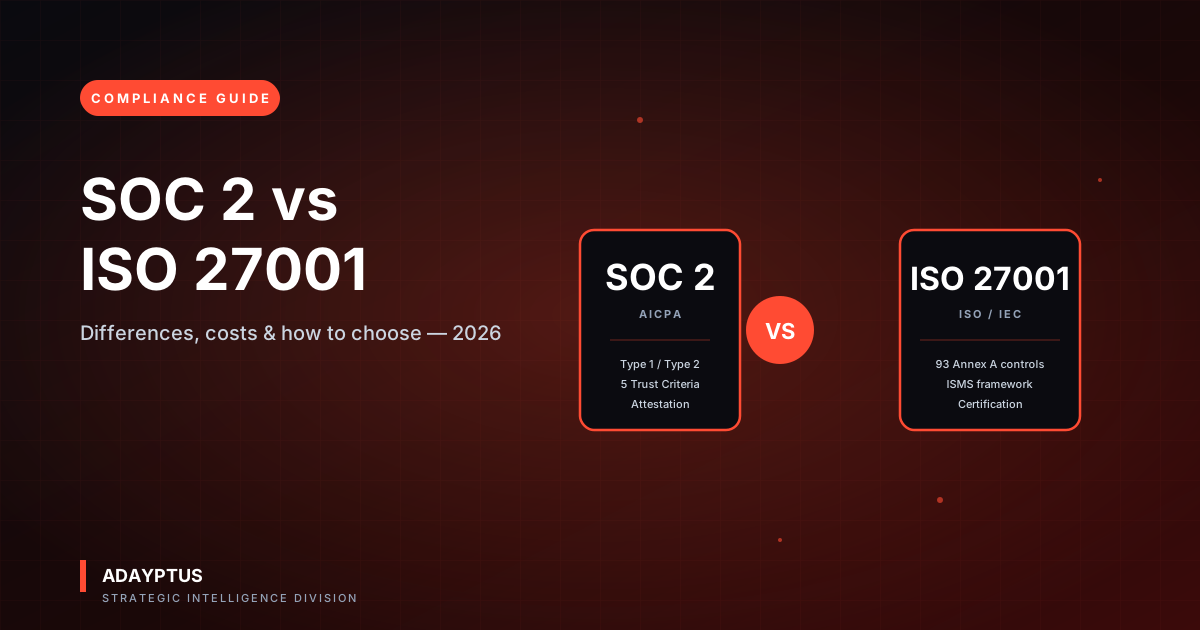
SOC 2 vs ISO 27001 is the question every fast-growing SaaS company, fintech, healthtech, and enterprise vendor eventually faces. Both are gold-standard information security frameworks. Both are demanded by enterprise buyers, regulators, and cyber-insurance underwriters. But they originated on different continents, follow different audit logic, produce different deliverables, and signal different things to your customers.
Choose the wrong framework first and you can burn 6-12 months of effort and a six-figure budget without unlocking the deals you needed. Choose the right one and you accelerate procurement, win larger contracts, and lay the groundwork to add the second framework at a fraction of the incremental cost. The difference between SOC 2 and ISO 27001 is not academic; it is a strategic choice with real revenue consequences.
This definitive guide compares SOC 2 vs ISO 27001 across every dimension that matters in 2026 - scope, controls, audit process, cost, timeline, geographic acceptance, and use cases. We finish with a clear decision framework so CISOs, founders, and compliance leads can pick with confidence, plus a control-mapping reference for organisations that need both.
SOC 2 vs ISO 27001 - The 30-Second Answer
SOC 2 is an American attestation report issued by a CPA firm against the AICPA's Trust Services Criteria. It tells customers "this vendor's controls operate as designed." It is the de facto standard for US SaaS procurement.
ISO 27001 is an internationally recognised certification awarded by an accredited registrar against the ISO/IEC 27001:2022 standard. It tells customers "this vendor operates a certified information security management system (ISMS)." It is the global benchmark for enterprise vendor risk management.
The fast rule: selling primarily to US enterprises and SaaS buyers? Start with SOC 2. Selling globally, into regulated industries, or into Europe / India / APAC? Start with ISO 27001. Selling to both? Sequence them - the controls overlap by ~80%, so the second framework costs a fraction of the first.
What Is SOC 2?
SOC 2 stands for "Service Organization Control 2". It is an attestation framework developed by the American Institute of Certified Public Accountants (AICPA). A licensed CPA firm independently examines a service organisation's controls and issues a SOC 2 report - a detailed, narrative document evaluating those controls against the AICPA's Trust Services Criteria (TSC).
The five Trust Services Criteria are:
- Security (mandatory) - the foundation; covers access control, system operations, change management, and risk mitigation.
- Availability (optional) - performance, recovery, and uptime commitments.
- Processing Integrity (optional) - completeness, validity, accuracy, and authorisation of system processing.
- Confidentiality (optional) - protection of information designated as confidential.
- Privacy (optional) - collection, use, retention, disclosure, and disposal of personal information.
A SOC 2 audit can be scoped to any combination of these criteria - Security is always required; the other four are added when relevant to your service.
SOC 2 Type 1 vs Type 2 - the Critical Distinction
SOC 2 Type 1 reports on the design of controls at a single point in time. It tells the reader "the controls were designed appropriately on date X." Useful as an interim deliverable but rarely accepted by enterprise buyers as a sole assurance.
SOC 2 Type 2 reports on the operating effectiveness of controls over a period (typically 6-12 months). It tells the reader "the controls were designed appropriately AND operated effectively over the observation window." This is what enterprise procurement teams demand. If a customer asks "do you have SOC 2?" without qualifying, they almost always mean Type 2.
What Is ISO 27001?
ISO/IEC 27001 is an internationally recognised standard for information security management systems (ISMS), jointly published by the International Organization for Standardization (ISO) and the International Electrotechnical Commission (IEC). The current edition is ISO/IEC 27001:2022, which superseded the 2013 edition.
ISO 27001 certification is awarded by accredited registrars (certification bodies) following a two-stage external audit. The certificate is valid for three years and is maintained by annual surveillance audits, with full recertification every three years.
The ISMS - the Heart of ISO 27001
ISO 27001 is fundamentally about establishing, implementing, maintaining, and continually improving a documented Information Security Management System. The standard itself - clauses 4-10 - is process-oriented (context, leadership, planning, support, operation, performance evaluation, improvement). The 93 controls in Annex A are a menu of safeguards from which an organisation selects what is applicable, documented in a Statement of Applicability (SoA).
ISO 27001:2022 - the 93 Annex A Controls
The 2022 edition restructured the previous 114 controls into 93 controls grouped into four themes: Organisational (37), People (8), Physical (14), and Technological (34). The restructuring aligned ISO 27001 closer to modern security operations - explicit controls were added for threat intelligence, cloud services, secure coding, data masking, and information deletion.
SOC 2 vs ISO 27001 - The 10 Fundamental Differences
Here is the side-by-side comparison most security and compliance leaders need before making a decision.
| Dimension | SOC 2 | ISO 27001 |
|---|---|---|
| Governing body | AICPA (United States) | ISO + IEC (international) |
| Output | Attestation report (private, narrative) | Certificate (public, single page) |
| Auditor | Licensed CPA firm only | Accredited certification body |
| Control framework | 5 Trust Services Criteria (Security required) | 93 Annex A controls + ISMS clauses 4-10 |
| Audit cycle | Annual; Type 2 covers a 6-12 month window | 3-year cert + annual surveillance + recertification |
| Geographic preference | North America (default for US SaaS) | Global, especially EU / UK / India / APAC |
| Scope flexibility | Per-service / per-system; criteria are pickable | Whole-organisation ISMS scope is required |
| Document philosophy | Evidence-driven; auditor describes controls | Process-driven; you must run an ISMS |
| Typical cost (mid-market) | $30k - $100k Type 2, recurring annually | $25k - $150k initial, lower recurring |
| Time to first audit | 3-6 mo (Type 1) / 6-12 mo (Type 2) | 6-12 mo + 3-month operating evidence |
Audit Process - SOC 2 in Detail
A SOC 2 engagement follows a predictable lifecycle. Adayptus's SOC 2 readiness programme typically operates in four phases:
Scoping & Readiness Assessment
Pick which Trust Services Criteria apply, define the system boundary (which products, environments, sub-service organisations), and run a gap assessment against the AICPA TSC. Output: a remediation plan.
Remediation & Control Implementation
Close the gaps. Deploy MFA, formal change management, vendor risk reviews, encryption, monitoring. Document policies, procedures, and runbooks. Roll out security awareness training.
Operating Window (Type 2 only)
For Type 2, controls must operate effectively over 6-12 months while you collect evidence. Compliance automation tools (Vanta, Drata, Sprinto) reduce evidence-collection burden by 60-80%.
Audit by CPA Firm
A licensed CPA firm executes the formal SOC 2 audit. They sample evidence, interview control owners, and issue the report - typically 60-100 pages - usable in customer security questionnaires.
Audit Process - ISO 27001 in Detail
An ISO 27001 implementation is more programme-shaped than SOC 2. The certification body splits the external audit into two stages.
Gap Assessment & ISMS Design
Map the organisation's context, interested parties, scope, and risk appetite. Run a gap assessment against the 93 Annex A controls and clauses 4-10. Design the ISMS - policies, procedures, roles, and the Statement of Applicability.
ISMS Implementation & Operations
Implement controls, run risk assessment and treatment, deliver awareness training, perform internal audits, and convene a management review. The ISMS must operate for at least 3 months before the external Stage 2 audit.
Stage 1 Audit (Documentation Review)
The certification body reviews ISMS documentation - policies, scope statement, SoA, risk treatment plan, internal audit reports - to confirm the ISMS is ready for the operational audit.
Stage 2 Audit (Operational)
On-site (or remote) verification that the ISMS operates as documented. Auditors test controls, sample evidence, interview staff. On success, the certification body issues a 3-year ISO 27001 certificate.
Decision Framework - SOC 2 vs ISO 27001 by Use Case
There is no universally "better" framework. The right choice is the one that unlocks your next 12 months of revenue with the smallest compliance burden. Use this framework.
Pick SOC 2 first if...
- Your buyers are primarily US enterprises or US-headquartered SaaS.
- You need a compliance signal in 6-12 months.
- Your scope is a single SaaS product, not a whole company.
- Customers ask specifically for "SOC 2 Type 2".
- You want flexible criteria (pick only Security + the relevant TSCs).
Pick ISO 27001 first if...
- You sell into Europe, India, the Middle East, or APAC.
- Your buyers are regulated - banks, insurers, healthcare, government.
- You need a globally portable certification.
- You want one framework covering the whole organisation, not just one product line.
- Procurement teams ask for an "ISMS certificate".
Pursue both if...
- You sell into both US and global enterprise markets.
- You're at Series B+ scale with mature security operations.
- Procurement RFPs explicitly require both.
- You want maximum trust-signal coverage.
Sequence: ISO 27001 first if global, then add SOC 2 in 3-6 months.
Control Mapping - How SOC 2 and ISO 27001 Overlap
The two frameworks share roughly 80% of their underlying control requirements. Access management, change management, incident response, vulnerability management, vendor risk, business continuity, and security awareness training are demanded by both. The differences sit at the edges - ISO 27001 puts more weight on documented ISMS process, while SOC 2 puts more weight on the descriptive narrative around your specific service.
In practice this means: once you have built one, the second framework typically costs 30-50% of the first to add. Most of the effort is gap analysis, evidence re-formatting, and (for SOC 2) a new operating window observation. The hard part - writing policies, deploying controls, training staff, running risk assessments - is reusable.
Cross-walk highlights
- SOC 2 CC6 (Logical & Physical Access) maps to ISO 27001 Annex A.5.15-5.18, A.8.2-8.5.
- SOC 2 CC7 (System Operations) maps to A.8.16, A.8.6, A.8.8.
- SOC 2 CC8 (Change Management) maps to A.8.32.
- SOC 2 CC9 (Risk Mitigation) maps to clauses 6 and 8 plus A.5.7 (threat intelligence).
- The AICPA publishes an official mapping; reusing it cuts dual-framework prep time by 40-60%.
Cost & Timeline - Realistic 2026 Numbers
Pricing varies by company size, environment complexity, and chosen auditor. The figures below reflect mid-market SaaS engagements (50-500 employees, single-product scope) in 2026.
Cost: $15k-$50k
Time to issue: 3-6 months. Includes readiness ($10-25k), audit fee ($10-25k), tooling. No operating window required.
Cost: $30k-$100k+
Time to issue: 6-12 months total. Includes readiness, 6-12 month observation window, audit. Recurring annually.
Cost: $25k-$150k+
Time to certificate: 6-18 months. Includes ISMS implementation, internal audit, Stage 1 + Stage 2 external audit.
Cost: $10k-$30k / year
Annual surveillance audit cost. Full recertification every 3 years (~50-70% of initial audit fee).
Common Misconceptions About SOC 2 vs ISO 27001
"ISO 27001 is harder than SOC 2"
Not really - they're hard in different ways. ISO 27001 is heavier on process and documentation. SOC 2 Type 2 is heavier on operational discipline because every control must hold up across the whole observation window.
"SOC 2 is just for SaaS, ISO 27001 is for everyone"
SOC 2 was designed for service organisations broadly - data centres, payroll providers, MSPs. SaaS is the largest user base but not the only one. ISO 27001 is genuinely framework-agnostic and applies to any organisation that handles information.
"SOC 2 is cheaper than ISO 27001"
Initial costs can be similar. The recurring cost story is different: SOC 2 audits annually, full audit each year. ISO 27001 has annual surveillance (cheaper) and full recertification only once every 3 years. Over 3 years, ISO can be ~30-40% cheaper for the same scope.
"Once I have SOC 2, ISO 27001 is automatic"
Wrong. ~80% of underlying controls map across, but ISO 27001 demands a documented ISMS - context analysis, interested parties, formal risk assessment methodology, internal audit programme, management review - that SOC 2 does not require. Plan for 3-6 months of incremental effort.
Frequently Asked Questions
Click any question to expand the answer.
Q Is SOC 2 the same as ISO 27001?
No. SOC 2 is an American attestation report issued by a CPA firm against the AICPA's Trust Services Criteria, scoped to a specific service. ISO 27001 is an internationally recognised certification awarded by an accredited registrar against the ISO/IEC 27001:2022 standard, scoped to a whole information security management system. They share roughly 80% of underlying controls but are fundamentally different deliverables.
Q Which is better, SOC 2 or ISO 27001?
Neither is universally "better". SOC 2 is the right first step for SaaS companies selling primarily to US enterprise customers. ISO 27001 is the right first step for organisations selling globally, into regulated industries, or running an enterprise-wide security programme. Mature companies serving both markets typically pursue both, sequencing one then the other to capture the ~80% control overlap.
Q Can SOC 2 evidence be reused for ISO 27001?
Yes, extensively. Roughly 80% of the underlying technical and procedural evidence transfers across - access reviews, change management, incident response, vendor risk assessments, vulnerability scans, awareness training records. The gap is mostly in formal ISMS artefacts (Statement of Applicability, internal audit programme, management review minutes, risk treatment plan) which ISO 27001 demands and SOC 2 does not.
Q How long does SOC 2 vs ISO 27001 take?
SOC 2 Type 1 typically takes 3-6 months (readiness + audit). SOC 2 Type 2 takes 6-12 months because the controls must demonstrably operate over a window. ISO 27001 typically takes 6-18 months for first-time certification - longer if the ISMS is being built from scratch, faster if existing security operations are mature. The ISMS must operate for at least 3 months before the Stage 2 audit can be scheduled.
Q Is SOC 2 accepted globally or only in the US?
SOC 2 is globally recognised but globally preferred only in North America. European, UK, Indian, and APAC procurement teams will accept SOC 2 reports as evidence but typically also ask for ISO 27001 certification, which they treat as the international benchmark. If your buyer base is non-US, expect ISO 27001 to be the question that gets asked first.
Q Do regulators in India require SOC 2 or ISO 27001?
Indian regulators - RBI, SEBI, IRDA, MeitY - explicitly reference ISO 27001 in cyber security guidance for banks, NBFCs, financial market intermediaries, and government data fiduciaries. The Digital Personal Data Protection (DPDP) Act expects "reasonable security safeguards" which ISO 27001 satisfies cleanly. SOC 2 is not specifically mandated by Indian regulators but is commonly demanded by Indian SaaS exporters selling to US customers.
Q Can a small startup realistically pursue ISO 27001?
Yes. With modern compliance automation tooling and a tightly scoped ISMS, a 20-50 person startup can achieve ISO 27001 in 6-9 months at a total cost of $25-60k. The key is scoping the ISMS narrowly to the core product and a small employee population, then expanding scope at recertification. Many seed-stage companies certify before raising Series B specifically to unlock enterprise procurement.
How Adayptus Helps with SOC 2 and ISO 27001
Adayptus runs SOC 2 readiness and ISO 27001 implementation programmes for SaaS companies, fintechs, healthtechs, and global enterprises. Whether you need a single framework, both, or a control-mapping shortcut between them, our compliance team has done it before.
Dual-framework readiness
A single integrated programme that delivers SOC 2 Type 2 and ISO 27001 certification with one set of controls, evidence, and policies - cutting dual-certification cost by 40-60%.
Auditor-ready evidence
We work backwards from your chosen CPA firm or registrar's evidence schedule. Policies, runbooks, control narratives, and SoA built to pass first time.
Compliance automation integration
Vanta, Drata, Sprinto, Secureframe, AuditBoard - we deploy and tune the platform that fits your stack and your buyers' expectations, reducing evidence collection 60-80%.
India regulator alignment
Map ISO 27001 controls to RBI, SEBI, IRDA, and DPDP requirements in one programme. One ISMS, every Indian regulator's questionnaire answered.
Virtual CISO leadership
Our vCISO service chairs the management review, owns the risk register, and represents you in audit interviews - so your engineering team can keep shipping.
Recertification & surveillance
Continuous improvement support across SOC 2 annual audits and ISO 27001 surveillance + 3-year recertification cycles. No first-time effort wasted.
Pick the right framework. Skip the false starts.
Get a 30-minute scoping call with our compliance team. We will tell you exactly which framework to start with, what it will cost, and how fast you can be in front of an auditor.
Conclusion: Stop Stalling, Start Scoping
SOC 2 and ISO 27001 are not competitors - they are complementary trust signals optimised for different markets. Pick the one that unlocks your next twelve months of revenue. Build the controls, document the policies, run the audit, and get the deliverable in front of your buyers. Then, when expansion demands it, layer the second framework on top of the same control set at a fraction of the cost.
The biggest mistake we see is teams debating the choice for months while procurement deals stall. The second-biggest is treating compliance as a one-off project rather than a continually-improving programme. Avoid both. Pick a framework, ship it on a tight timeline, and build the muscle memory you will need for the next one. If you want help deciding - or running the whole programme - that is exactly what our GRC team does, every day.
Adayptus GRC Advisory
Strategic Intelligence Division
Adayptus Consulting is a premier provider of enterprise cybersecurity solutions, specializing in Managed SOC, Penetration Testing, and GRC strategy. Our intelligence division regularly publishes research to help CISOs navigate the evolving threat landscape.
On This Page
- SOC 2 vs ISO 27001 - The 30-Second Answer
- What Is SOC 2?
- What Is ISO 27001?
- SOC 2 vs ISO 27001 - The 10 Fundamental Differences
- Audit Process - SOC 2 in Detail
- Audit Process - ISO 27001 in Detail
- Decision Framework - SOC 2 vs ISO 27001 by Use Case
- Control Mapping - How SOC 2 and ISO 27001 Overlap
- Cost & Timeline - Realistic 2026 Numbers
- Common Misconceptions About SOC 2 vs ISO 27001
- Frequently Asked Questions
- How Adayptus Helps with SOC 2 and ISO 27001
- Conclusion: Stop Stalling, Start Scoping