The Death of ChromeOS: Why Google’s New "Aluminium OS" Changes Everything
Google is quietly phasing out ChromeOS in favor of "Aluminium OS," a massive, unified Android-for-desktop platform. Discover why this AI-powered shift is happening and what it means for millions of Chromebook owners.
For over a decade, the Chromebook has been the undisputed king of the classroom and the budget laptop market. It was simple, it was cheap, and it was entirely built around the web browser.
Thanks to a flurry of recent leaks and confirmations from MWC 2026, we now know that Google is preparing its biggest operating system shift in a decade. They are quietly phasing out ChromeOS in favor of a massive, unified Android-for-desktop platform internally codenamed "Aluminium OS." Here is everything you need to know about Google’s ambitious plan to put Android on your PC, and why millions of current Chromebook owners might be left behind.
1 What is Aluminium OS?
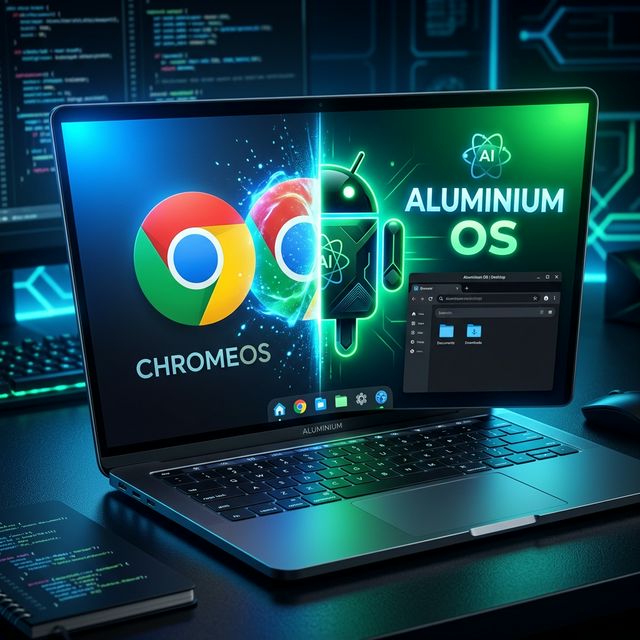
Simply put, Aluminium OS is the long-awaited fusion of Android and ChromeOS. Instead of running Android apps in a clunky, separated container like current Chromebooks do, Aluminium OS is an entirely Android-based system (specifically, built on the upcoming Android 16 and 17 architecture) optimized for laptop and desktop screens.
A recent accidental leak on the Chromium Issue Tracker gave us our first glimpse of the OS running on an HP Elite Dragonfly Chromebook. The footage revealed:
-
True Desktop Multitasking: Resizable windows, a modernized bottom dock, and split-screen snapping that feels much closer to Windows or macOS.
-
A Familiar Face: A status bar with Android-style Wi-Fi and battery indicators, but scaled appropriately for a large display.
-
Native App Power: Full, native access to the Google Play Store without the severe performance bottlenecks of traditional ChromeOS emulation.
2 Why Kill ChromeOS Now?
You might be wondering: If ChromeOS is so popular, why replace it? It comes down to two massive shifts in the tech landscape: Artificial Intelligence and Ecosystem Continuity.
The AI Hardware Problem
ChromeOS was built to be lightweight and cloud-dependent. But in 2026, AI is running locally. Aluminium OS is built from the ground up with Google's Gemini AI at its core. This requires serious on-device computing power (NPUs) and deep system-level integration that the legacy ChromeOS architecture simply wasn't designed for.
The "MacBook Neo" Effect
Apple's ecosystem is famously sticky. You can copy text on an iPhone and paste it on a Mac. Google wants that same magic. By transitioning laptops to an Android foundation, Google can finally offer true, seamless cross-device continuity, directly rivaling Apple's tight-knit macOS/iOS ecosystem.
3 The Catch: The "ChromeOS Classic" Graveyard
Here is where the transition gets messy.
While Google’s Android Ecosystem President recently confirmed that Aluminium OS is on track for a late 2026 release, he also made it clear that ChromeOS isn't vanishing overnight. In fact, it's being rebranded internally as "ChromeOS Classic."
Why? Because most current Chromebooks aren't powerful enough to run Aluminium OS.
If you bought a budget Chromebook with 4GB of RAM and an older Celeron processor, you are not getting the upgrade. Google has promised to support these older devices with security updates until the mid-2030s, but they will effectively be relegated to "legacy mode."
For individual users, this is annoying. For school districts that bought thousands of Chromebooks expecting them to last a decade, it is a massive, forced hardware refresh cycle arriving years ahead of schedule.
The Takeaway
Google's Aluminium OS is exactly what power users have been begging for: a fast, native, AI-powered Android desktop experience. But the transition is going to split the Google laptop ecosystem right down the middle.
If you are in the market for a new laptop today, you might want to hold off. Buying a high-end ChromeOS device right now is a bit like buying a horse and buggy right before the Model T rolls off the assembly line. The future of Google's desktop is Android—and it arrives later this year.
References & Resources
Adayptus Tech Team
Strategic Intelligence Division
Adayptus Consulting is a premier provider of enterprise cybersecurity solutions, specializing in Managed SOC, Penetration Testing, and GRC strategy. Our intelligence division regularly publishes research to help CISOs navigate the evolving threat landscape.