Red Team vs Penetration Testing: When to Use Which (2026)
Red Team vs Penetration Testing explained: scope, cost, MITRE ATT&CK depth, regulator fit (TIBER-EU, CBEST, RBI), and a clear decision framework for 2026.
Red Team vs Penetration Testing is the wrong question. The right question — the one procurement, the CISO, and the board actually need answered — is "which test should we buy this quarter, against which scope, to answer which risk?" Get that wrong and you spend six figures on the wrong assurance, miss the threat that actually breaches you, and walk into the next regulator audit defending a control gap you should have closed.
Most online comparisons answer the surface question and stop there. They list five differences, conclude "red team is more comprehensive", and leave you no closer to a decision. This guide takes the harder route. We frame the choice as a procurement decision, plot the offensive-security toolkit on a single 2D quadrant, walk through when each test type genuinely fails to deliver value, and tie everything to the regulators who actually mandate threat-led testing in 2026 — TIBER-EU, CBEST, RBI's Master Direction, SEBI's CSCRF, DORA, and NIS2.
By the end you will have a defensible answer to "Red Team or Pen Test?" sized to your organisation's maturity, regulatory exposure, and budget — not your vendor's quota.
Red Team vs Penetration Testing — The 30-Second Answer
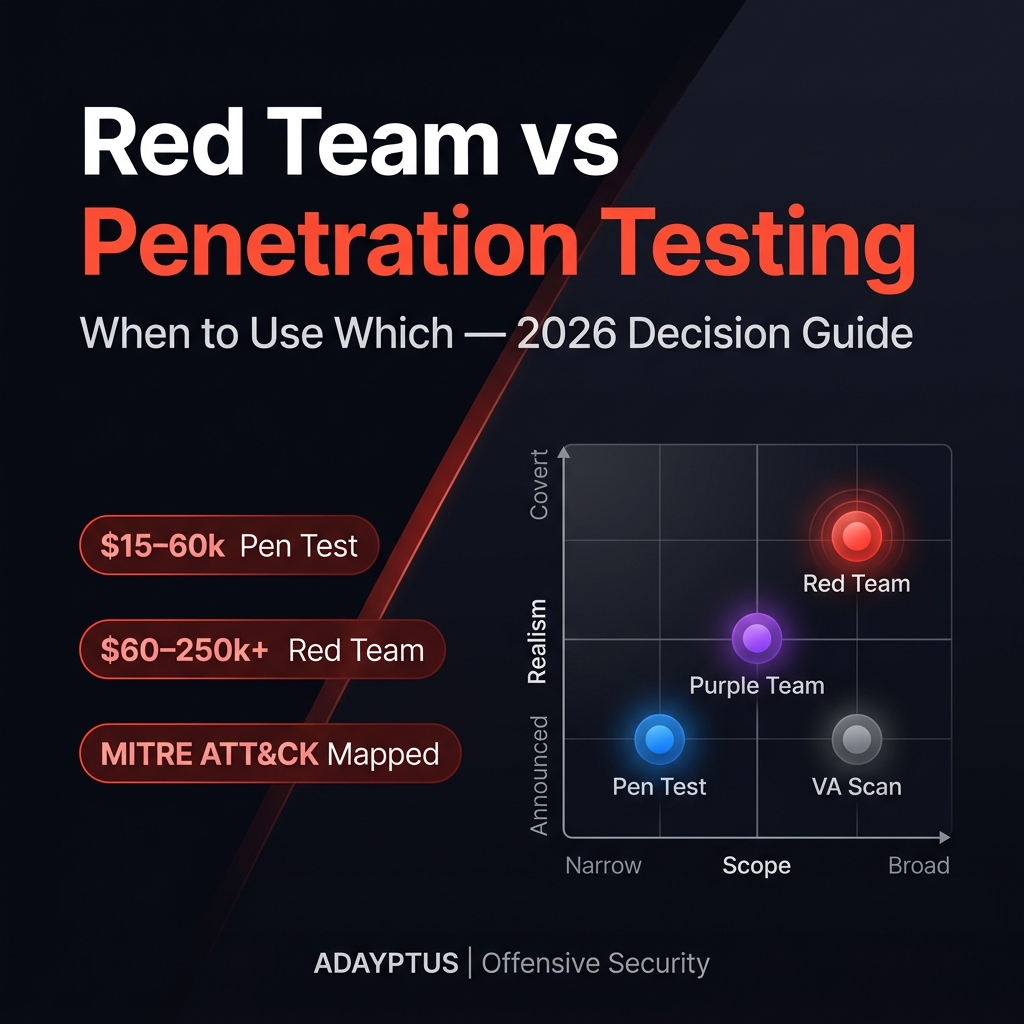
A penetration test is a scoped, time-boxed assessment of "can these specific assets be exploited?" Outcome: a validated list of vulnerabilities with proof-of-concept exploits and remediation guidance. Typical duration 1–3 weeks. Typical cost $15k–$60k.
A red team engagement is a covert, objective-driven simulation of a real adversary's full attack chain — answering "if a determined APT operator targeted this business today, would we detect, contain, and evict them in time?" Outcome: an ATT&CK-mapped detection-coverage report tied to a business-impact objective. Typical duration 4–12 weeks. Typical cost $60k–$250k+.
The fast rule: if you don't know whether your application can be hacked, run a penetration test. If you already know your controls exist but want to know whether they actually work against a real attacker, run a red team. If you cannot answer "do our controls exist?" with confidence, you are not ready for either — start with a vulnerability assessment.
What Is a Penetration Test?
A penetration test (often "pen test" or "ethical hacking") is a focused, asset-scoped assessment in which testers attempt to exploit weaknesses inside a clearly defined target — a web application, a mobile app, an API, an internal network, a cloud account, an Active Directory domain. The defending team typically knows the test is happening; the goal is technical validation, not stealth.
A pen test answers a tightly scoped question: "For this asset, in its current configuration, what can an attacker actually achieve?"
Common penetration testing types
- Web Application Pen Test — OWASP Top 10, business-logic abuse, auth flaws, IDORs, SSRF, injection.
- API Pen Test — REST, GraphQL, OWASP API Top 10, BOLA, broken authentication, rate-limit bypass.
- Mobile Pen Test — iOS/Android, SSL pinning, insecure storage, IPC abuse, jailbreak detection bypass.
- Network / Internal Pen Test — perimeter, internal pivot, credential abuse, mis-configurations.
- Cloud Pen Test — AWS/Azure/GCP IAM abuse, escape paths, S3/Blob exposure, cross-account compromise.
- AD Pen Test — Kerberoasting, AD CS abuse, BloodHound graph paths, delegation chains.
Black-box, grey-box, white-box
A pen test can be run with zero prior knowledge (black-box), with limited credentials and partial knowledge (grey-box), or with full credentials, source code, and architecture diagrams (white-box). Grey-box is the most common — it gives testers enough context to focus on real risk without spending the whole budget on reconnaissance the defender has already mapped internally.
What Is a Red Team Engagement?
A red team engagement is an end-to-end adversary simulation. Instead of testing whether a specific asset can be hacked, it tests whether a determined human attacker — emulating a specific named threat actor like FIN7, APT29, Lazarus, or Volt Typhoon — can achieve a defined business-impact objective starting from outside the perimeter, using whatever entry vector works.
A red team answers a much harder, broader question: "If a real APT operator targeted us today, would we detect, contain, and evict them before they exfiltrate the crown jewels?" The defending team (the "blue team") usually does not know the engagement is happening. Detection is part of the test.
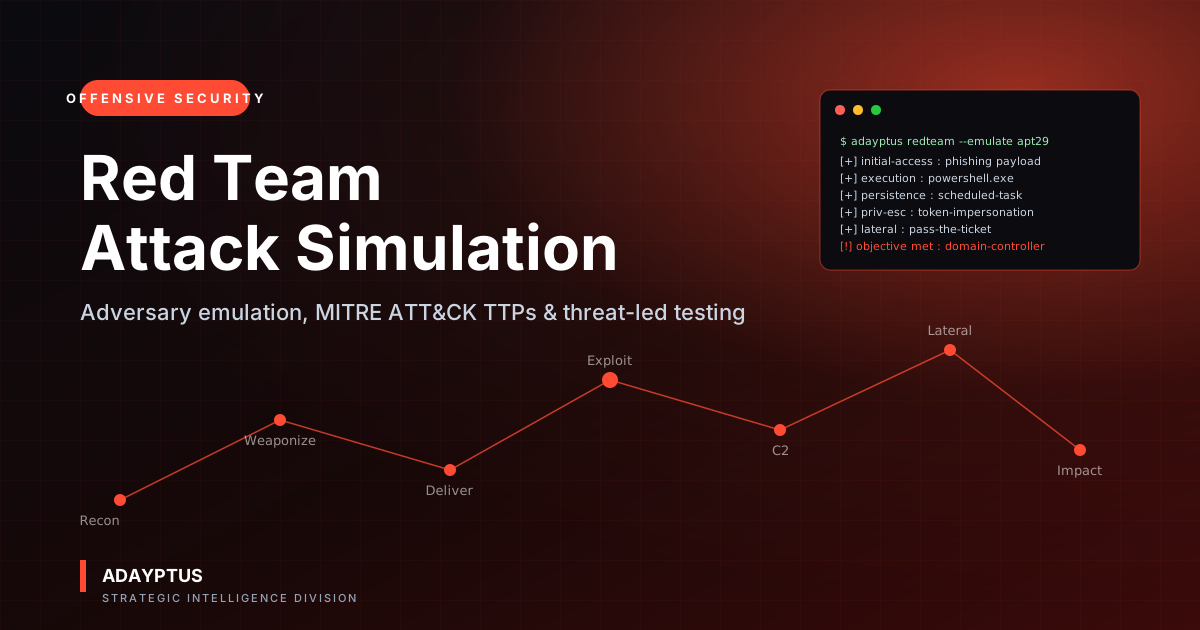
A red team operation traverses the full kill chain — initial access, execution, persistence, privilege escalation, lateral movement, command and control, actions on objective — and is mapped end-to-end against the MITRE ATT&CK framework. The resulting deliverable is not a vulnerability list; it is a detection-coverage heatmap, a dwell-time measurement, and an honest read on how the SOC, IR, and identity teams perform under realistic pressure.
For a deeper technical walkthrough of the lifecycle, see our Red Team Attack Simulation guide. The rest of this article focuses on the comparison and the decision.
Red Team vs Penetration Testing — The 10 Differences That Matter
Here is the side-by-side comparison the rest of the internet only half-finishes. Differences are real, but most matter only in the context of what you are trying to learn.
| Dimension | Penetration Test | Red Team |
|---|---|---|
| Question answered | Can this asset be exploited? | Can a real adversary achieve a business objective? |
| Scope | Asset-bounded (1 app, 1 network slice) | Objective-bounded (the whole enterprise is fair game) |
| Stealth | Announced; blue team is aware | Covert; only a handful of trusted agents know |
| Tests people & process | No | Yes — phishing, social engineering, IR runbooks |
| Adversary emulation | Generic exploit techniques | Faithful TTPs of a named threat actor |
| Duration | 1–3 weeks | 4–12 weeks (operations) + planning + reporting |
| Typical cost (mid-market) | $15k – $60k per asset | $60k – $250k+ per engagement |
| Deliverable | Vulnerability list + PoC + remediation guide | ATT&CK heatmap + dwell-time + detection gaps + IR after-action |
| Primary audience | Engineering / AppSec team | CISO / board / regulator / SOC |
| Frequency | Per release, quarterly, or annual | Annual or biennial; supplemented by purple team |
The Test Selection Quadrant — A Decision Framework
Every offensive-security test type sits somewhere on a 2D plane. The Y-axis is realism (announced ↔ covert). The X-axis is scope breadth (narrow ↔ broad). Plotting the toolkit on this single diagram makes the choice obvious.
Penetration Testing
Validate whether a specific application, API, or network segment can be exploited. Best for release-gating, compliance evidence, and finding concrete bugs to fix.
Vulnerability Assessment / Continuous Scanning
Coverage-first, depth-second. Best for inventory hygiene, patch prioritisation, and feeding the vulnerability management programme. Not a substitute for either pen test or red team.
Purple Team Exercise
Operators and defenders sit in the same room replaying specific TTPs and tuning detections in real time. Best after a red team has identified gaps and the SOC needs to close them.
Red Team Engagement
End-to-end adversary emulation against the whole enterprise. Best for testing detection and response under realistic pressure — the only test type that genuinely validates the SOC.
Breach & Attack Simulation (BAS) sits as the automated, regression-oriented bridge between these — best used continuously between formal engagements to make sure detection gaps that were closed yesterday have not regressed today.
When to Use a Penetration Test
Pick a pen test when the question is technical and asset-bounded. Concrete signals:
- You are about to ship a major release of a customer-facing application or API.
- A regulator demands annual penetration testing against a specific scope (PCI-DSS Requirement 11, ISO 27001 Annex A, SOC 2 CC4.1, HIPAA).
- You want a concrete remediation backlog for engineering — line-item bugs, exploitability proof, severity ratings.
- You are migrating to a new cloud platform and need an architecture-and-IAM specific assessment.
- You have just acquired a company and need a quick technical read on inherited risk before integrating systems.
A pen test gives engineering a clear, ranked list of things to fix. It does not tell you whether your SOC would have detected the attacker on the way in — that is a different question entirely.
When to Use a Red Team Engagement
Pick a red team when the question is about detection and response under realistic pressure. Concrete signals:
- Your SOC has matured beyond Tier 1 alert triage and you need to know whether it actually performs against a hands-on-keyboard adversary.
- You need regulatory evidence of threat-led testing — TIBER-EU (European banking), CBEST (UK financial market infrastructure), DORA, or India's RBI Master Direction expectations on threat-led penetration testing.
- The board is asking "are we resilient to a ransomware attack?" and you need an answer grounded in actual operational performance, not control inventory.
- You have a peer or competitor that suffered a public breach and want to validate that your controls would have stopped the same actor.
- You are an enterprise systemically important to a sector (BFSI, healthcare, critical infrastructure, OT) and your insurer or regulator is asking for adversary emulation evidence.
A red team produces a board-ready answer to "would a real attacker get away with it?" — but it produces almost nothing usable for engineering's bug backlog. The two outputs serve completely different stakeholders.
When You Should Run Neither — Yet
Most "Red Team vs Pen Test" comparisons assume the buyer is ready for one or the other. They often are not. Here is the honest checklist:
Buy a vulnerability assessment first if…
You do not have a current asset inventory, you have not patched in months, and you do not know which servers are internet-facing. Pen testing this estate is paying $40k for a cosmetic answer to a question your scanner could answer for $4k. Sort the inventory and the patch hygiene first.
Defer the red team if…
Your SIEM has fewer than 50 deployed detections, your SOC is fewer than four full-time analysts, or you do not have a documented incident response runbook. A red team will succeed in five days and you will learn nothing actionable — because the gap is not "can the attacker get in?" but "can we operate at all?". Run a SOC Maturity Assessment first.
Run a purple team instead if…
You have the controls and the SOC, but you have not yet proven they work against specific TTPs you care about. Purple team gets you 70% of the red team learning at 30% of the cost — and you keep your operators in-room with your defenders, which is where institutional knowledge actually transfers.
Failure Modes — When Each Test Type Disappoints
Both test types fail in predictable ways. Knowing the failure modes is the difference between a test that drives change and one that becomes a shelf-ware report.
Where penetration tests fail
- Scoped too narrowly — testers cannot follow the chain that real attackers exploit (web → API → identity → cloud).
- Generated under deadline pressure — last-second pen tests for a SOC 2 audit produce shallow output and engineering ignores them.
- Tested against a non-prod environment that does not match production configuration.
- Reported in CVSS-only format with no exploitability or business-impact ranking — engineering cannot prioritise.
- Same testers every cycle — they re-find the same surface and miss new attack classes.
Where red teams fail
- Run before the SOC is ready — operators succeed in 48 hours, blue team learns nothing actionable.
- No deconfliction protocol — a real intrusion happens during the test and nobody can tell red from black.
- Objectives too vague ("get domain admin") — sounds impressive, doesn't translate to business risk.
- No purple-team handover — gaps are listed, not closed; same engagement next year produces the same findings.
- Operators emulate generic "advanced attacker" instead of a sector-relevant named actor — the result does not map to your actual threat model.
Cost & Engagement Frequency in 2026
Realistic 2026 numbers for mid-market enterprises. Cost varies with target complexity, environment maturity, and chosen actor profile. India-anchored engagements are typically 30–45% lower on labour but identical on tooling.
$15k–$40k
2-3 week engagement, 1-2 testers, OWASP Top 10 + business logic. Per-app pricing.
$25k–$60k
3-4 weeks, includes AD attack paths and pivot. Larger estates scale linearly.
$60k–$150k
6-8 week operations + planning + reporting + purple-team handover. One named actor.
$150k–$250k+
12-week TIBER-EU / CBEST / RBI threat-led engagement. Threat-intel-led actor profiling.
Sensible cadence for mature programmes: quarterly pen tests on flagship apps, annual external + internal network pen tests, annual red team, quarterly purple team weeks, continuous BAS in between.
Regulatory Drivers — Who Mandates Which
In 2026, the choice between pen test and red team is increasingly made by your regulator, not your CISO. Selected mandates:
- TIBER-EU (European Central Bank): threat-intel-led red team operations for systemic European banks. Effectively a red team requirement.
- CBEST (Bank of England): UK financial market infrastructure threat-led penetration testing. Red team in everything but name.
- DORA (EU Digital Operational Resilience Act): mandates threat-led penetration testing for ICT-critical financial entities, applicable from January 2025.
- RBI Master Direction on Cyber Resilience & Digital Payment Security: explicitly references threat-led penetration testing for Indian banks and NBFCs.
- SEBI Cybersecurity & Cyber Resilience Framework (CSCRF): requires regular VAPT for capital-market intermediaries; red team for systemically important entities.
- PCI-DSS v4.0: requires penetration testing (Requirement 11.4) but does not mandate red team. PCI-DSS pen test is a pen test, not a red team.
- ISO 27001 Annex A.8.29 / SOC 2 CC4.1: control-effectiveness validation; pen test typically suffices.
For Indian enterprises, the practical pattern in 2026 is: annual pen tests for compliance evidence, annual red team for systemically important entities, supplemented by purple team and BAS. Our regulatory compliance practice maps the test programme to your specific regulator's expectations.
Frequently Asked Questions
Click any question to expand the answer.
Q Is a Red Team just a "bigger" Penetration Test?
No — they answer fundamentally different questions. A pen test asks "can this asset be exploited?" and produces a vulnerability list for engineering. A red team asks "if a real adversary attacked us, would we detect and stop them?" and produces a detection-coverage and dwell-time report for the SOC and the board. A larger pen test scope does not become a red team; covertness and adversary emulation are the defining criteria, not size.
Q If I run a Red Team, do I still need Pen Tests?
Yes. A red team validates whether your detection-and-response chain holds against a real adversary; it deliberately does not exhaustively test individual assets. Engineering still needs per-release pen tests on flagship applications and APIs, plus regulator-driven pen tests for PCI-DSS, ISO 27001, SOC 2, and similar frameworks. The two are complementary, not substitutes.
Q My SOC is small. Can we still benefit from a Red Team?
If your SOC is fewer than four full-time analysts and you do not yet run a documented IR runbook, the honest answer is no. The red team will achieve its objective in days and the only learning will be "we have no SOC". Run a SOC Maturity Assessment and a purple team exercise first; the cost-per-learning ratio is far better at that stage.
Q What is "threat-led penetration testing" — pen test or red team?
Functionally, threat-led penetration testing (TLPT) is a red team. The label exists because European and UK regulators (TIBER-EU, CBEST, DORA) wanted a regulatory framework that mandates the methodology — covert operations, threat-intelligence-led actor selection, full kill-chain emulation — without using "red team" as a procurement term. If a regulator asks for TLPT, what you scope is a red team engagement.
Q How often should we run pen tests vs red team operations?
A mature programme runs pen tests against flagship applications quarterly (or per major release), annual external and internal network pen tests, and one full red team engagement per year. Highly regulated or systemically important entities run two red team engagements emulating different actor profiles. Continuous BAS and quarterly purple team exercises fill the gaps between formal engagements.
Q Will a Red Team break our production systems?
A professional red team operates under strict Rules of Engagement signed by an executive sponsor. Destructive techniques (ransomware encryption, data destruction) are only ever simulated against synthetic data in pre-approved lanes. Stop conditions and a 24x7 trusted-agent line ensure any unintended impact can be reverted immediately. Operational safety is non-negotiable.
Q Is a Pen Test enough for ISO 27001 or SOC 2?
For most organisations, yes. ISO 27001:2022 Annex A and SOC 2's Common Criteria expect evidence that controls have been technically validated; an annual penetration test against the in-scope environment satisfies that. Red team is rarely demanded by these certifications themselves, although your largest enterprise customers may ask for it during vendor due diligence beyond the certification report.
Q Does AI change Red Team and Pen Test in 2026?
Substantially, yes. Pen testers use LLMs to accelerate code review, payload generation, and report drafting — output volume per analyst is materially higher. Red teams use AI for hyper-targeted spear-phishing pretexts, voice-cloned vishing, and automated reconnaissance. The threat side has industrialised the same capabilities. A modern engagement that ignores AI-augmented tradecraft is not modelling 2026 reality.
How Adayptus Helps with the Build-vs-Buy Decision
Adayptus runs offensive-security engagements across the full quadrant — focused pen tests, full red team operations, purple team weeks, and continuous breach-and-attack simulation. We do not sell you the test that fits our quota; we recommend the test that fits your maturity, your regulator, and your specific risk register.
Penetration Testing Programme
Web, mobile, API, network, cloud, and Active Directory pen tests sized to release cadence and regulator expectations. Reports map to OWASP, MITRE ATT&CK, and your control framework.
Red Team Operations
Threat-intelligence-led adversary emulation aligned to TIBER-EU, CBEST, DORA, and RBI threat-led testing. ATT&CK-mapped reporting, dwell-time benchmarking, IR after-action.
Purple Team Weeks
Bridge between pen test and red team — operators replay specific TTPs while your SOC tunes detections in real time. 70% of red-team learning at 30% of the cost.
Breach & Attack Simulation
Continuous regression-style validation between formal engagements. Detection gaps that closed last quarter stay closed this quarter. Automated, ATT&CK-aligned.
SOC Maturity Assessment
Independent evaluation of detection coverage, IR readiness, and team capability — the honest pre-flight check before commissioning a red team.
Regulator-Ready Evidence
Outputs aligned to RBI, SEBI, IRDA, DPDP, DORA, NIS2, TIBER-EU, CBEST, PCI-DSS, ISO 27001, SOC 2. Built for auditors, not just engineers.
Pick the right test. Skip the expensive theatre.
A 30-minute scoping call with our offensive-security architects. We will sit on the same side of the table as you, evaluate your current programme, and recommend the engagement type that actually moves your security posture this quarter.
Conclusion: Frame the Decision Around the Question, Not the Label
Red Team vs Penetration Testing is not a debate you win — it is a tool selection you make against a specific question. Pen tests answer "is this asset exploitable?". Red teams answer "would we survive a real adversary?". Vulnerability assessments, purple teams, and breach-and-attack simulation each fill a slot the other two leave empty. None of them is automatically better; the wrong test for the wrong question is always worse than no test, because it gives you a false answer at full price.
If you take only one thing from this guide, take this: the maturity of your defenders is the variable that decides which offensive engagement actually creates value. A red team against an immature SOC is theatre. A pen test against an estate with no patch hygiene is paperwork. Match the test to the maturity, the maturity to the regulator, and the regulator to the actual business risk — in that order. If you would like a second opinion on which test fits this quarter, our offensive security team writes that recommendation in plain language, on our letterhead, every day.

Peyush Baranwal
Senior Delivery Manager — Cyber Security, Adayptus
Peyush Baranwal is a Senior Delivery Manager at Adayptus Consulting with 11+ years of experience designing, implementing, and managing enterprise security programmes. His core expertise spans Vulnerability Assessment & Penetration Testing (VAPT), Application Security, and Security Operations — leading web, mobile, API, and infrastructure security assessments for CISOs and security teams across BFSI, healthcare, and SaaS. He focuses on measurable risk reduction, governance maturity, and operationalising detection-and-response capability. Outside work, Peyush is a passionate biker and part-time photographer.
Connect on LinkedInOn This Page
- Red Team vs Penetration Testing
- What Is a Penetration Test?
- What Is a Red Team Engagement?
- Red Team vs Penetration Testing — The 10 Differences That Matter
- The Test Selection Quadrant — A Decision Framework
- When to Use a Penetration Test
- When to Use a Red Team Engagement
- When You Should Run Neither — Yet
- Failure Modes — When Each Test Type Disappoints
- Cost & Engagement Frequency in 2026
- Regulatory Drivers — Who Mandates Which
- Frequently Asked Questions
- How Adayptus Helps with the Build-vs-Buy Decision
- Conclusion: Frame the Decision Around the Question, Not the Label