Red Team Attack Simulation: The Definitive 2026 Guide to Adversary Emulation
Master Red Team Attack Simulation in 2026. Learn adversary emulation, MITRE ATT&CK TTPs, and how strategic Red Teaming exposes real enterprise cyber risk.
In 2026, defenders no longer get points for finding vulnerabilities. They get points for surviving the kill chain. Red Team Attack Simulation has emerged as the most decisive way to measure whether an enterprise can detect, contain, and evict a determined human adversary, not just a noisy scanner. Where a vulnerability assessment asks "what is broken?", a red team engagement asks the harder question: "if a real APT operator landed inside your perimeter today, would your SOC even notice in time?"
As ransomware crews adopt living-off-the-land tradecraft, identity-first attack paths, and AI-accelerated reconnaissance, the gap between control existence and control effectiveness has never been wider. Boards are being asked to sign off on cyber resilience claims that have never been stress-tested. Red team adversary emulation closes that gap by replaying the exact tactics, techniques, and procedures (TTPs) of real-world threat actors against your live production environment, under controlled rules of engagement.
This definitive guide walks security leaders, CISOs, and SOC architects through everything that matters about modern Red Team Attack Simulation: the methodology, the kill chain, MITRE ATT&CK mapping, tooling, scope design, KPIs, and how it differs from penetration testing, breach and attack simulation (BAS), and purple teaming. By the end, you will have a clear blueprint for commissioning, executing, and extracting strategic value from a red team engagement in 2026.
What Is Red Team Attack Simulation?
Red Team Attack Simulation is a goal-oriented, threat-intelligence-driven exercise in which a team of offensive operators emulates a specific adversary, or class of adversaries, to test the people, processes, and technology of a defending organization (the "blue team"). Unlike a penetration test, which is scoped around assets and looks for vulnerabilities, a red team is scoped around objectives and looks for impact.
A red team operation is rarely about finding "a bug". It is about answering business-critical questions such as:
- Can an attacker exfiltrate the crown-jewel customer database starting from a single phished employee?
- How long does our SOC take to detect, contain, and evict a hands-on-keyboard adversary?
- Are our EDR, SIEM, identity, and email security controls actually working together, or only individually?
- If an APT compromised a domain admin tomorrow, how would our incident response runbook actually perform?
A mature engagement leans heavily on adversary emulation: the operators select a real-world threat actor whose interests, sectors, and TTPs match the client's threat model, and faithfully replay their tradecraft. For a regulated bank, that may mean emulating FIN7 or Lazarus. For a manufacturer, it might be APT41 or Sandworm. The closer the emulation, the more directly the test result maps to real-world risk.
Red Team vs Penetration Testing vs Vulnerability Assessment
These three terms are routinely conflated in procurement documents, often leading to wasted budget and false assurance. They are complementary, not interchangeable.
| Dimension | Vulnerability Assessment | Penetration Test | Red Team Simulation |
|---|---|---|---|
| Primary Question | What weaknesses exist? | Can these weaknesses be exploited? | Can a real adversary achieve a business impact? |
| Scope | Broad, asset-based. | Application or network slice. | Objective-based, often the entire enterprise. |
| Stealth | None - announced. | Some - announced. | High - covert, blue team unaware. |
| Targets People & Process | No. | Rarely. | Yes - phishing, social engineering, IR drills. |
| Output | CVE list with CVSS. | Exploit chain & remediation. | Detection & response gap analysis tied to ATT&CK. |
| Duration | Days. | 1-3 weeks. | 4-12 weeks. |
In short: a vulnerability assessment tells you what could go wrong. A red team engagement shows you exactly what will go wrong, who will notice, and how long it will take to stop.
The Red Team Attack Simulation Lifecycle
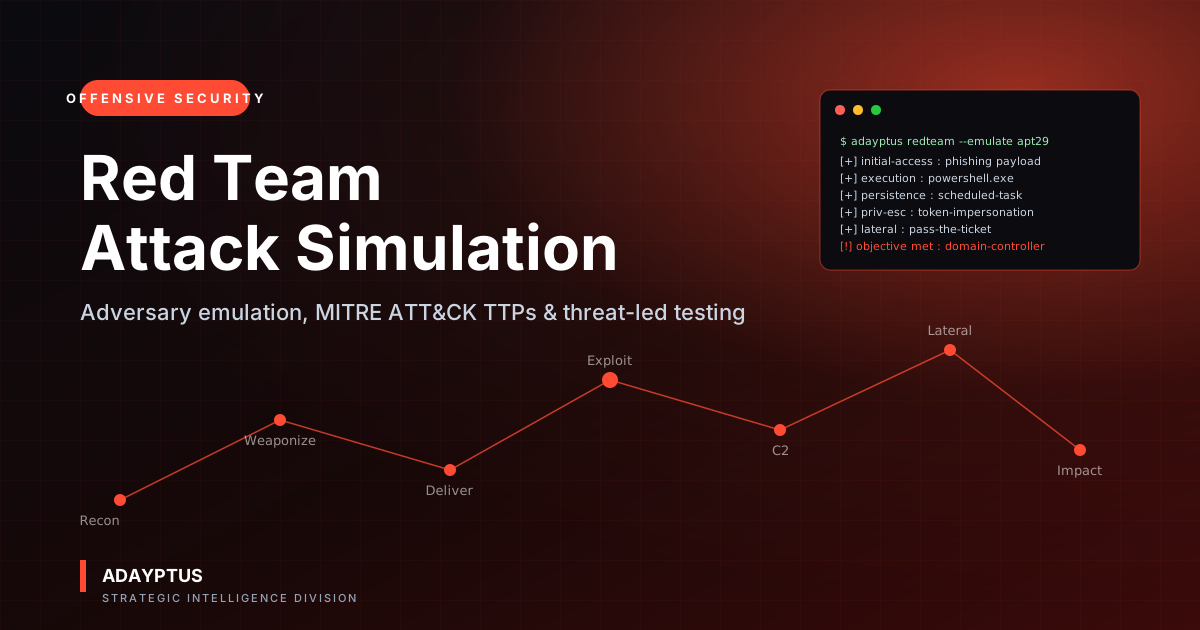
A professional red team engagement follows a disciplined lifecycle that mirrors the Lockheed Martin Cyber Kill Chain and the MITRE ATT&CK matrix. Below is the simulation flow Adayptus uses for enterprise engagements.
Threat Modeling & Rules of Engagement
Define crown jewels, select an actor profile aligned to your sector, agree out-of-scope systems, and appoint a trusted agent. Deconfliction protocols ensure red vs real attacker can be distinguished if a genuine intrusion occurs mid-engagement.
Reconnaissance & Initial Access
Passive OSINT and active recon feed initial-access tradecraft: targeted spear-phishing, edge-device exploitation, cloud misconfiguration abuse, or third-party identity compromise. Goal: a single, low-and-slow foothold.
Foothold, Execution & Persistence
Reliable C2 over domain-fronted HTTPS, DoH beacons, or trusted cloud services. Persistence via scheduled tasks, WMI subscriptions, OAuth refresh tokens, or golden SAML. Defender artefacts minimised through process injection and AMSI bypasses.
Privilege Escalation & Lateral Movement
BloodHound graph analysis, kerberoasting, AD CS abuse (ESC1-ESC8), delegation abuse. In hybrid estates, lateral movement traverses identity: on-prem AD → Entra ID → SaaS → cloud admin. Validates AD security tiering under pressure.
Actions on Objective
Operators attempt the agreed objective: exfiltrate a synthetic crown-jewel dataset, simulate ransomware against a sandboxed share, manipulate a controlled financial transaction, or seize an OT system. Dwell time is recorded as the headline KPI for SOC effectiveness.
Mapping Adversary Behaviour with MITRE ATT&CK
Every credible red team report in 2026 is anchored to MITRE ATT&CK. The framework provides a globally agreed taxonomy of 14 tactics and several hundred techniques and sub-techniques used by real-world threat actors. Mapping each step of the simulation to ATT&CK does three things at once:
1. Translates tradecraft into a language the SOC understands
Detection engineers can immediately correlate "T1078.004 - Valid Accounts: Cloud Accounts" to their existing SIEM use cases, rather than parsing prose narratives.
2. Produces a measurable detection coverage heatmap
For each technique used in the simulation, the report records whether the blue team detected, contained, or missed it, producing a defensible coverage map for the next planning cycle.
3. Enables threat-informed defence
Combined with threat intelligence on which techniques the most relevant threat actors prefer, ATT&CK mapping lets CISOs prioritise control investment against the techniques most likely to be used against them, not against generic risk lists.
Modern Red Team Techniques and Tooling in 2026
The 2026 offensive toolchain has evolved dramatically. Three trends dominate modern red team operations:
Identity-First Attack Paths
The modern perimeter is identity. Token theft, OAuth consent phishing, primary refresh token extraction, AD CS abuse, and federated trust manipulation dominate engagement time. Trust manipulation is the new lateral movement.
Living-Off-The-Land Tradecraft
Custom malware is avoided. Operators chain LOLBAS binaries, PowerShell, WMI, MSBuild, certutil and trusted cloud services. Modern C2 frameworks - Mythic, Sliver, Havoc - ship with built-in evasions for top-tier EDR.
AI-Augmented Tradecraft
Gen-AI industrialised social engineering. Hyper-targeted spear-phishing, voice-cloned vishing, and LLM-accelerated code generation are now baseline. Phishing simulation and awareness training are non-negotiable companions.
Red Team vs Purple Team vs Breach and Attack Simulation
Mature security programmes layer all three. Each answers a different question and is appropriate at a different maturity level.
Red Team
Measures whether your detection and response programme can find a hands-on-keyboard adversary you do not know is there. Tests the full kill chain end-to-end against your live SOC.
Purple Team
Upskills the SOC. Operators and defenders sit in the same room, replay specific TTPs, and tune detections in real time. Ideal after a red team has identified the gaps that need closing.
Breach & Attack Sim
Continuous, regression-style validation that closed detection gaps stay closed. Excellent between full red team engagements - but no substitute for human creativity and chained tradecraft.
Why Boards Now Mandate Red Team Simulations
Regulators and insurers no longer accept "we have controls" as an answer. DORA, NIS2, the SEC cyber disclosure rules, RBI cyber resilience guidelines, and most large cyber-insurance underwriters now expect evidence of threat-led penetration testing and red team validation at least annually for systemic organisations.
The strategic value to the board is unambiguous: a red team simulation produces a single, defensible answer to the question every director privately asks - "if a real attacker was inside us right now, would we know?" No control framework on its own can answer that question. Only adversary emulation can.
How to Plan a Red Team Engagement
Use this checklist when commissioning a red team simulation. Skipping any of these steps materially reduces the value of the engagement.
- Define crown jewels. Which 3-5 outcomes would constitute material business impact? Make these the win conditions, not "get domain admin".
- Pick a relevant threat actor. Use threat intelligence to choose actors who actually target your sector and geography. Emulate their TTPs faithfully.
- Set rules of engagement. Document scope, out-of-scope systems, time windows, escalation contacts, and deconfliction protocols.
- Assign a trusted agent. A small group inside the client (typically CISO, internal audit, executive sponsor) knows the engagement is happening. The SOC does not.
- Agree on stop conditions. What constitutes "objective achieved"? What event triggers an immediate pause (e.g. SOC successful isolation)?
- Plan for purple-team handover. The most valuable engagement does not end with a report. It rolls into a purple team week where every gap is replayed and detections are tuned.
Measuring Success: Red Team KPIs and Outcomes
Avoid vanity metrics like "number of vulnerabilities found". A red team simulation should be measured against detection and response performance:
Mean Time to Detect
Measured across each ATT&CK tactic. Reveals which kill-chain phases are blind spots.
Mean Time to Respond
First alert to verified containment. The hard test of your runbooks under pressure.
Detection Coverage
Heatmap mapped to the ATT&CK techniques actually executed during the engagement.
Identity Blast Radius
From initial access to highest-privilege role obtained across on-prem and cloud.
Objectives Achieved
Crown-jewel objectives reached vs total agreed in the rules of engagement.
Timeline Reconstruction
Quality of the incident timeline the SOC reconstructs after the operation is revealed.
Frequently Asked Questions
Click any question to expand the answer.
Q How long does a typical red team engagement take?
A focused enterprise red team simulation typically runs 4 to 8 weeks of active operations, plus 1-2 weeks of planning and 2-3 weeks of reporting and purple team handover. Highly regulated or critical-infrastructure engagements can extend to 12 weeks or more.
Q What is the difference between red teaming and adversary emulation?
Adversary emulation is a methodology used inside red teaming. A red team can be generic ("act like a skilled attacker"), but adversary emulation is specific - the operators replay the documented TTPs of a named threat actor (for example FIN11, APT29, or Volt Typhoon) to test exactly the controls relevant to that actor.
Q How often should we run red team simulations?
Mature programmes run a full red team simulation annually, supplement it with quarterly purple team exercises, and maintain continuous breach and attack simulation in between. Highly targeted or systemic organisations often run two full red teams per year emulating different actor profiles.
Q Is red teaming legal?
Yes, when performed under a written authorisation letter signed by an executive with the legal authority to grant it, with clearly defined rules of engagement, and within agreed scope. Adayptus engagements are always preceded by a formal authorisation pack and deconfliction protocol.
Q Will red teaming break our production systems?
A professional red team prioritises operational safety. Destructive techniques such as ransomware encryption are only ever simulated against synthetic data in pre-approved lanes. Stop conditions and a 24x7 trusted-agent line ensure that any unintended impact can be reverted immediately.
How Adayptus Helps You Run a World-Class Red Team Programme
Adayptus runs threat-led red team engagements for banks, NBFCs, healthcare, manufacturing, SaaS platforms, and critical-infrastructure operators. Every operation is anchored to MITRE ATT&CK, conducted under strict rules of engagement, and concluded with a purple team handover that turns findings into permanent detection improvements. Here is what working with our offensive security division looks like.
Threat-Led Adversary Emulation
We map your sector, geography and crown-jewel posture to a relevant actor profile - FIN7, APT29, Lazarus, Volt Typhoon - and faithfully replay their TTPs. No generic checklists.
ATT&CK-Anchored Reporting
Every finding is mapped to the exact MITRE ATT&CK technique, with detection coverage, MTTD/MTTR metrics, and a board-ready executive summary you can take straight to the audit committee.
Strict Rules of Engagement
Written executive authorisation, defined scope, agreed stop conditions, and a 24x7 trusted-agent line. Destructive techniques are only ever simulated against synthetic data in pre-approved lanes.
Purple Team Handover Built In
Every engagement closes with a collaborative purple team week where each missed technique is replayed and detection logic is tuned with your SOC, in your SIEM, on your data.
Regulator-Ready Evidence
Outputs aligned to RBI cyber resilience guidelines, DORA TLPT requirements, NIS2, and major cyber-insurance underwriter expectations. Built for auditors, not just engineers.
Continuous Validation
Between full simulations, our Breach & Attack Simulation and Threat Hunting services keep regression in check and detection coverage trending the right way.
Find out how your defences actually perform against a determined adversary.
Our offensive security operators have run threat-led engagements across BFSI, healthcare, OT, and hyperscale SaaS. We will scope a programme that maps to your regulator's expectations, your insurer's questionnaire, and your CISO's roadmap - and deliver evidence your board can act on.
Conclusion: From Compliance to Cyber Resilience
In a threat environment shaped by AI-accelerated attackers, identity-first compromise, and zero-day weaponisation in hours rather than weeks, no defender can afford to confuse control existence with control effectiveness. Red Team Attack Simulation is the only discipline that decisively closes that gap. It treats the enterprise as the adversary sees it, exposes the lived experience of your SOC under realistic pressure, and produces an evidence base that boards, regulators, and insurers can actually act on. Demand visibility. Insist on adversary emulation. Earn cyber resilience.
Adayptus Security Research
Strategic Intelligence Division
Adayptus Consulting is a premier provider of enterprise cybersecurity solutions, specializing in Managed SOC, Penetration Testing, and GRC strategy. Our intelligence division regularly publishes research to help CISOs navigate the evolving threat landscape.
On This Page
- What Is Red Team Attack Simulation?
- Red Team vs Penetration Testing vs Vulnerability Assessment
- The Red Team Attack Simulation Lifecycle
- Mapping Adversary Behaviour with MITRE ATT&CK
- Modern Red Team Techniques and Tooling in 2026
- Red Team vs Purple Team vs Breach and Attack Simulation
- Why Boards Now Mandate Red Team Simulations
- How to Plan a Red Team Engagement
- Measuring Success: Red Team KPIs and Outcomes
- Frequently Asked Questions
- How Adayptus Helps You Run a World-Class Red Team Programme
- Conclusion: From Compliance to Cyber Resilience