Inside an ADA Assessment: What the Laboratory Does
What an authorised laboratory actually does, phase by phase: the checks it must make before taking your money, the evidence standard behind every verdict, the independent reviewer who can withhold your report, and what happens when the lab gets it wrong.
App Defense Alliance
The full walkthrough of a laboratory engagement, from the checks a lab must make before accepting your money to what happens to the records afterwards.
In short. This article explains the laboratory side in detail. If you are buying an assessment, understanding this makes you a much harder customer to short-change, and lets you tell a well-run lab from a badly-run one before you sign.
What is this?
When somebody says an independent laboratory assessed our app, that phrase is doing a lot of hidden work. Behind it sits a defined process with mandatory controls, and a laboratory that skips them is not entitled to issue the report.
ADA does not test apps itself. It publishes the requirements, then authorises independent laboratories to do the testing. A lab has to earn that authorisation, and part of earning it is holding accreditation to ISO/IEC 17025, the international standard for testing laboratories. The point of the arrangement is that the people judging your app have no commercial interest in the answer.
The controls exist because independence is not a matter of good intentions. A lab wants your repeat business. Its salespeople want you happy. Left to itself, that pressure bends verdicts. The process described below is what stops it, and every part of it is auditable by the lab's accreditation body.
Who is required to follow this?
Every laboratory authorised by ADA. It is not optional and it is not a matter of house style. An accreditation body inspects the lab against ISO/IEC 17025 and against the ADA requirements, samples real engagements, and can suspend or withdraw the lab's accreditation.
As the customer you are not required to follow any of it, but you are entitled to see that it happened. Section headings below double as a list of things you may reasonably ask about.
Which assurance level this describes
What follows describes a laboratory engagement at AL2, where the laboratory does the testing. Most of it applies at AL1 too, but the division of labour changes: at AL1 you run the test procedures and produce the evidence, and the laboratory's work is to judge whether that evidence is complete and sufficient. The acceptance checks, the independent review, the records and the dispute process are the same either way.
If you are working at AL1, read the evidence standard section particularly closely, because at that level the evidence is your deliverable rather than the laboratory's.
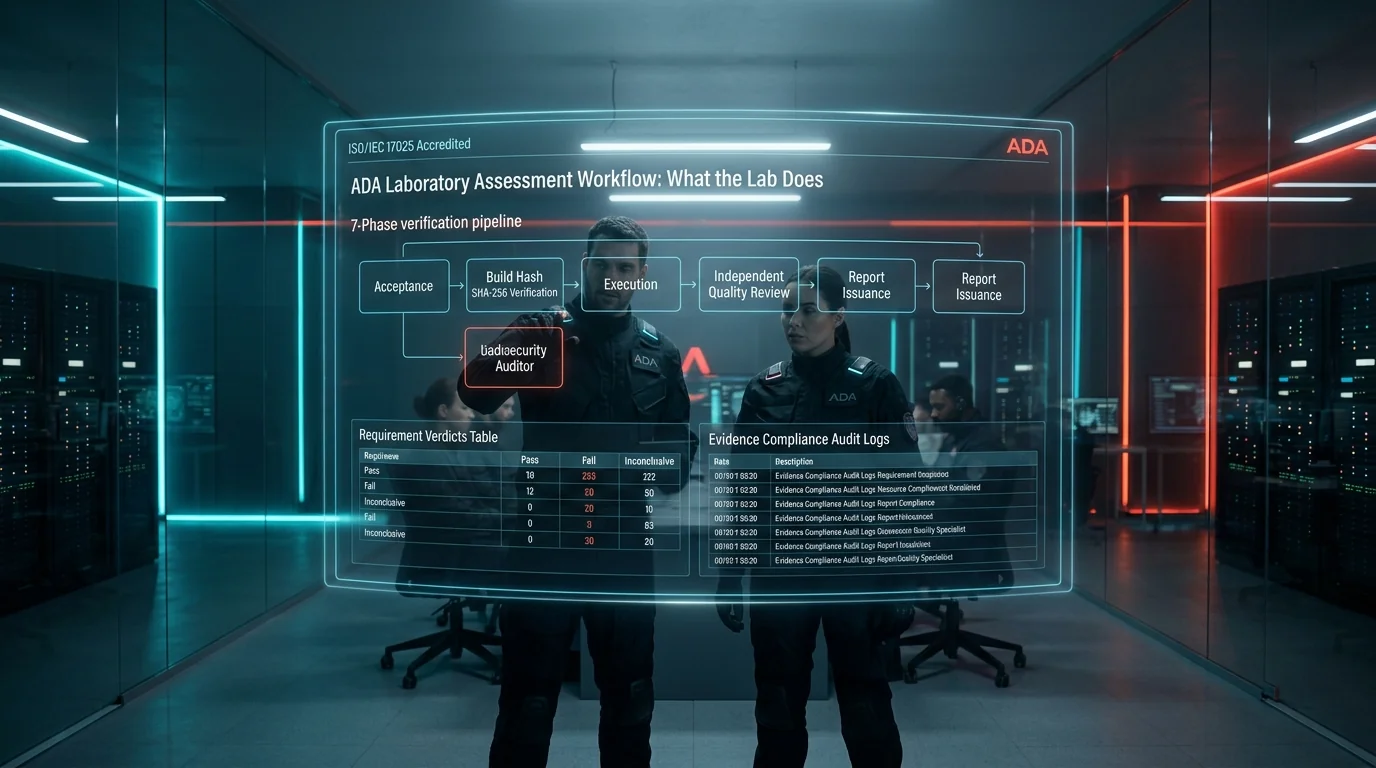
The seven phases
An engagement moves through phases, and each has a gate that has to be passed before the next begins. The gate is not a formality; it is a record that has to exist.
| Phase | What happens | The gate |
|---|---|---|
| 1 — Acceptance | Scope agreed, conflicts checked, competence confirmed, roles named | Engagement accepted in writing, with an independent reviewer identified |
| 2 — Preparation | Your software or environment received, hashed and recorded; test environment built; tools checked | Hash recorded, environment recorded, pre-use tool check passed |
| 3 — Execution | The actual testing, requirement by requirement | Every requirement in scope carries a verdict with evidence behind it |
| 4 — Conclusion | Verdicts settled, remediation guidance drafted, report assembled | Draft report complete and the record set complete |
| 5 — Review | Independent quality control review | The reviewer authorises release, or does not |
| 6 — Issue | Report issued to you and submitted to the programme | Issue recorded, with date and recipient |
| 7 — Closure | Environment destroyed, your material disposed of, records retained | Teardown recorded and records exported |
Phase 1: what a lab must check before taking your money
This is the phase customers know least about and it is where the most important protections live.
- Competence for your assessment type. ADA specifies the certifications the engagement team must hold, per assessment type. The lab has to confirm the people assigned to you actually hold current ones. A lapsed certification does not count, and a lab should suspend somebody's authorisation automatically on the expiry date.
- Authorisation, which is not the same as certification. Holding a certificate does not entitle somebody to work on your engagement. The lab has to have formally authorised that individual for that specific activity. This distinction catches a lot of laboratories out at audit.
- A conflict of interest check. Performed before acceptance and recorded. A lab that built, advised on or previously assessed your application cannot validate it. Neither can a lab where somebody on the team has a financial or family interest in your company, unless that person is formally recused and it is written down.
- An available independent reviewer. Somebody who will take no part in the testing. If the lab has only one person qualified for your assessment type, it cannot separate the tester from the reviewer, and it should decline the engagement rather than fudge it.
- Capability and capacity. The right tools, an approved test environment standard, and enough time. A lab is expected to decline work it cannot do properly.
- Method verification. The lab must already have demonstrated and recorded that it can properly perform the assessment method for your specific assessment type. Verification for mobile is not evidence of capability for web.
Worth asking. Ask to see the conflict of interest clearance for your engagement, and ask who your reviewer is and why they are independent. Both should exist as records before testing starts. A lab that cannot produce them on request either has not done them or does not record them, and both are problems.
Phase 2: how your software is handled
- The public build is preferred. For app-store software the lab will normally obtain the store version rather than one you send, because that proves it tested what your users actually get. If it uses a build you supplied instead, the reason has to be recorded.
- A hash is taken on receipt. A cryptographic fingerprint of exactly what arrived. This protects both sides: you cannot be assessed on the wrong build, and the lab cannot be accused of it.
- An environment is built for you alone. Isolated from other clients' engagements and from the lab's own corporate network. Your data must not be reachable from anybody else's engagement.
- The environment configuration is recorded. Operating system version, platform, tool versions, privileged access state. Not the configuration intended, the configuration actually built.
- Tools are checked before use. Each tool is confirmed to be at the qualified version and to produce the expected result on a known input. A tool that fails is not used on your engagement.
- Deviations are recorded and disclosed. If the lab has to depart from its standard approach, that requires approval and appears in your report as a deviation from method.
Phase 3: the evidence standard
This is the single biggest difference between a laboratory report and a consultancy report, and it is worth reading carefully because it determines what your report is actually worth.
For every requirement, the assessor must record evidence sufficient that a different competent assessor could repeat the work and reach the same conclusion. In practice that means each piece of evidence has to show:
| Element | What it means in practice |
|---|---|
| The input | What was sent, entered or done. A screenshot of a result without the request that produced it is not sufficient for a Fail. |
| The action | What the assessor did, precisely enough to repeat. |
| The observed result | What actually happened, captured at the time rather than described afterwards. |
| Attribution | Which assessor, and when. Recorded as the work happens. |
| Environment | Which environment and which tool versions were in force, by reference to the environment record. |
| Binding | Which engagement, which requirement, which attempt. So nothing can be confused with another engagement. |
Two protections follow for you. A lab cannot record a Fail on a hunch, because a finding has to be shown rather than asserted. And a lab cannot record a Pass because you assured them something works: your own statements are recorded as your statements, and the report has to disclose which requirements were self-attested rather than validated.
In short. That second point protects you more than it looks. It means nobody can later claim the laboratory verified something it merely took your word for. If a customer or regulator asks later, the report itself draws the line.
Phase 4: how a verdict is decided
| Verdict | Recorded when | Not to be used when |
|---|---|---|
| Pass | The evidence demonstrates the requirement is met for the version tested | The requirement was not examined; or the only basis is your own assertion; or the assessor could not complete the procedure |
| Fail | The evidence demonstrates the requirement is not met | The assessor suspects a problem but has no supporting evidence |
| Inconclusive | The requirement was examined but could not be determined, and the report says why | The evidence would support a Fail; or the requirement was simply excluded from scope, which is reported as an exclusion instead |
There is no partial credit and no aggregate score that conceals the detail. If the programme defines an overall outcome, it is derived from the individual verdicts and reported in addition to them, never instead of them.
Three situations get confused constantly and must be reported distinctly: a requirement examined but undetermined is Inconclusive; a requirement you self-attested that the lab did not validate is disclosed as self-attested; a requirement excluded from scope is disclosed as not evaluated. None of the three may be reported as a Pass.
Phase 5: the independent review
The reviewer is the control that does the most work, and the one customers least expect. They are not proofreading. They re-examine the evidence and reach their own view.
A properly run review works through, at minimum:
- whether the build tested matches the build received, by hash;
- whether the approved environment and qualified tools were actually used, and whether the pre-use check was done;
- whether every verdict is supported by contemporaneous evidence meeting the standard above;
- whether any Inconclusive verdict is standing in for a Fail the evidence would support;
- whether self-attested and excluded requirements are properly disclosed;
- whether remediation guidance is specific to your application rather than a restatement of the requirement;
- whether the statement of conformity and the decision rule are correctly expressed;
- whether the record set is complete;
- whether the impartiality clearance is on file and nobody recused took part.
The reviewer can authorise release, send it back for correction, or withhold the report entirely. Their determination stands. If the engagement partner disagrees, the disagreement is recorded but the report is not released against the reviewer's decision, and the lab may not simply appoint a more agreeable reviewer.
Two hard rules protect that authority: the reviewer's pay cannot depend on the verdict or on engagement margin, and no commercial function of the lab may alter, delay or suppress a finding.
The review record is retained whether or not it changed anything. A review that found nothing is evidence the control was operating; a missing review record is evidence it was not.
What happens if the laboratory gets it wrong
This is a real process, not an embarrassed silence. If a lab discovers that something it released may be wrong, it is required to:
Step 1 — Stop and record it
The problem is recorded with a risk classification. Where a released result may be affected, that is the highest classification and reaches the lab's director within a working day.
Step 2 — Work out how far it reaches
An impact analysis reasoning from the cause rather than the instance. If a tool was at an unqualified version, every engagement since that version changed is in scope, not just yours.
Step 3 — Decide whether the result still stands
A technical judgement about validity. Commercial consequence and customer relationship are explicitly not grounds for deciding a problem is acceptable.
Step 4 — Tell you
If your result is affected or may be affected, you are notified: what was found, which results are affected, what is being done and by when. Notification is not deferred until the lab has a complete explanation.
Step 5 — Recall if necessary
You are asked in writing not to rely on the report, it is marked as recalled in the records, and a corrected report is issued. The original is retained, not deleted.
Step 6 — Fix the cause
A separate process addresses why it happened and whether the control that should have caught it failed. Closing the instance without addressing the cause does not close the matter.
Disputes
If you disagree with a verdict, finding or report content, you can dispute it, and the lab must have a documented process. The important features:
- The decision-maker is independent. The person who recorded the verdict does not decide the dispute, and neither does your engagement partner.
- The evidence is re-examined, not defended. The question is what the evidence supports, not whether the original assessor was reasonable.
- You get to make your case. Your representations are recorded and addressed in the decision, not merely received.
- The programme is told either way. On resolution the lab either provides an updated report to the ADA certification body or informs it that the dispute is resolved. That notification is a record.
- A verdict change triggers more than a correction. If a released verdict was wrong, the lab's nonconforming work process runs too, because something in its own controls let it through.
Ask for the dispute process in writing before you engage a lab, not when you need it.
What happens to your records afterwards
The lab keeps the whole record set, not just the report: every verdict and its evidence, the environment configuration, the tool versions, the review record, every version of the report, and every attempt including any that failed.
Retention is typically at least two years after your certificate expires, and often longer under the lab's own policy. That exists so a question arising later can actually be answered.
It also means history cannot be quietly revised. If a lab suggests a failed attempt can be made to disappear, that is a serious problem with that lab and worth walking away from.
Your material is treated differently from the records. Build artefacts, credentials and test data not needed as evidence are destroyed at the end of the engagement. Ask what is destroyed, what is retained and for how long.
Frequently Asked Questions
Click any question to expand the answer.
QIs all of this actually required, or is it best practice?
Required. It comes from ISO/IEC 17025 and the ADA laboratory requirements, and an accreditation body samples real engagements to check it happened. A lab that treats it as optional risks its accreditation, which means its ADA authorisation.
QHow does knowing this help us?
It turns you into an informed buyer. You can ask for the conflict clearance, the reviewer's independence basis and the dispute process, and judge a lab by whether those questions are easy or awkward for them. It also tells you what your report should contain so you can tell a thorough one from a thin one.
QDoes this happen every time, even for a renewal?
Yes. A renewal is a fresh engagement with its own acceptance checks, its own evidence and its own independent review. Retests within an engagement are also reviewed in full, not waved through because the first attempt was reviewed.
QCan we watch the testing?
Ask. Some labs will walk you through findings as they emerge, which is genuinely useful. What a lab should not do is let you influence a verdict during testing, so expect a boundary around observation versus participation.
QCan we see the raw evidence behind a finding?
Yes, and you should look at it for anything you intend to dispute or anything expensive to fix. The evidence exists precisely so it can be examined.
QWho inside the lab can see our application?
Only people assigned to your engagement, on a business-need basis, and every grant of access should be recorded with a justification. Everybody with access is bound by a signed confidentiality undertaking that survives them leaving the lab.
QWhat stops a lab passing us to keep our business?
Several things layered together: the independent reviewer's authority, the prohibition on outcome-dependent fees and pay, the evidence requirement behind every verdict, the retained record set, and external audit by the accreditation body sampling real engagements. No single one of those would be enough on its own.
QDo we need to understand all this to buy an assessment?
No, but the parts worth knowing are short: ask who your reviewer is, ask for the conflict clearance, ask for the dispute process, confirm no fee depends on the outcome, and read the Inconclusive verdicts on your report as carefully as the Fails.
QWho actually sees the result?
That depends on the programme. Some results appear as a badge or a note on an app store listing that your users can see. Others are shared with the platform that asked you to get assessed, and are not public. Ask the lab what will be published before you start, and get it in writing. A good lab will not publish anything about your app without your written consent.
QWhat if we disagree with a finding?
You can dispute it. An authorised lab has to have a documented dispute process, and the person who decides your dispute must not be the person who made the finding. If the verdict changes, the lab has to update the report with ADA. Ask to see the dispute process before you engage a lab.
QDoes a pass mean our app is secure?
No, and be careful of anyone who tells you it does. A pass means your app met the requirements that were tested, in the version that was tested, on the date it was tested. It is not a guarantee. It is a meaningful, independently checked baseline, which is a different and more honest thing.
QCan we use our own internal security team instead?
Not for the formal validation. The whole value of these programmes is that the tester is independent of the developer. Your internal team is exactly the right people to do the preparation work and the fixing, but the validation itself has to come from an authorised lab.
QCan the lab help us fix the problems it found?
It can tell you what to change, and it should: specific remediation guidance for each failed requirement is a programme requirement, not a favour. What it must not do is implement the fix for you, because then it would be validating its own work. Advice yes, hands on your codebase no.
Related reading
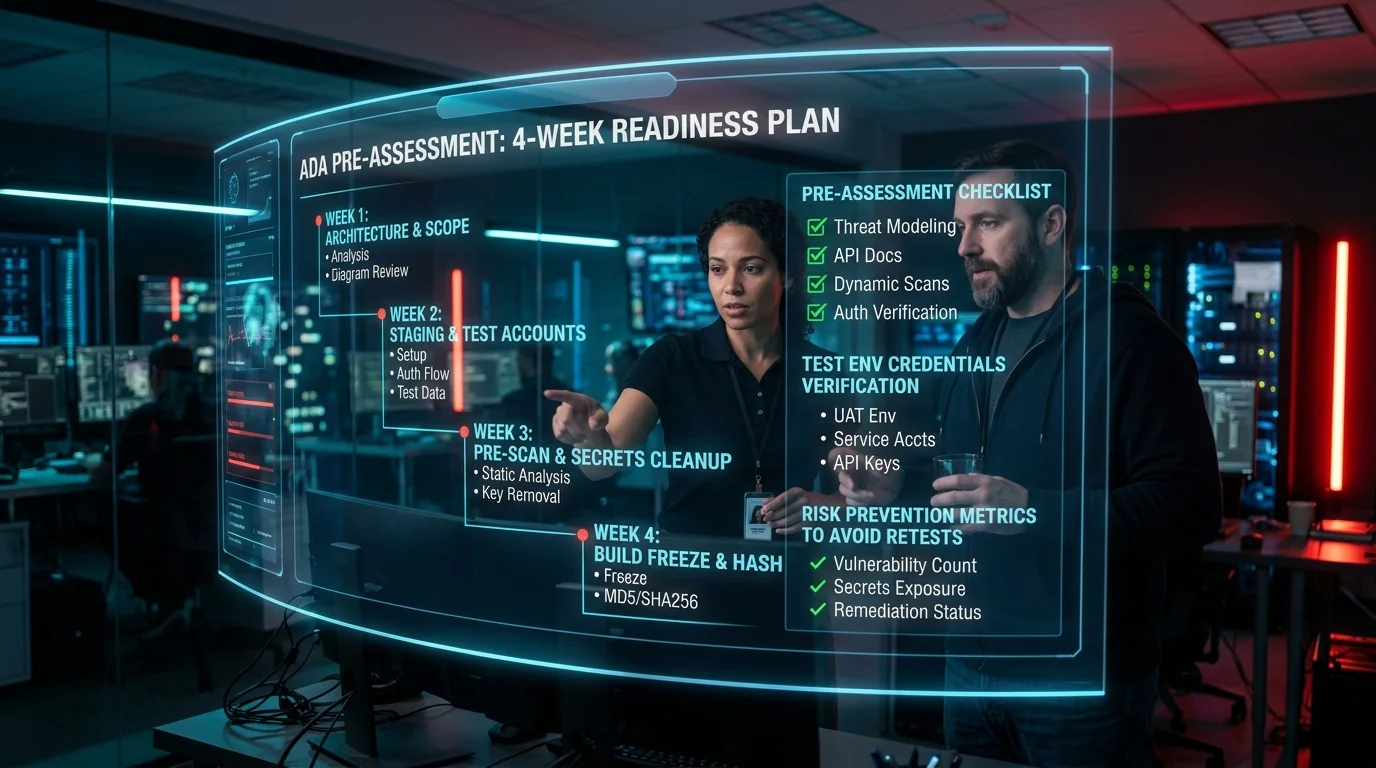
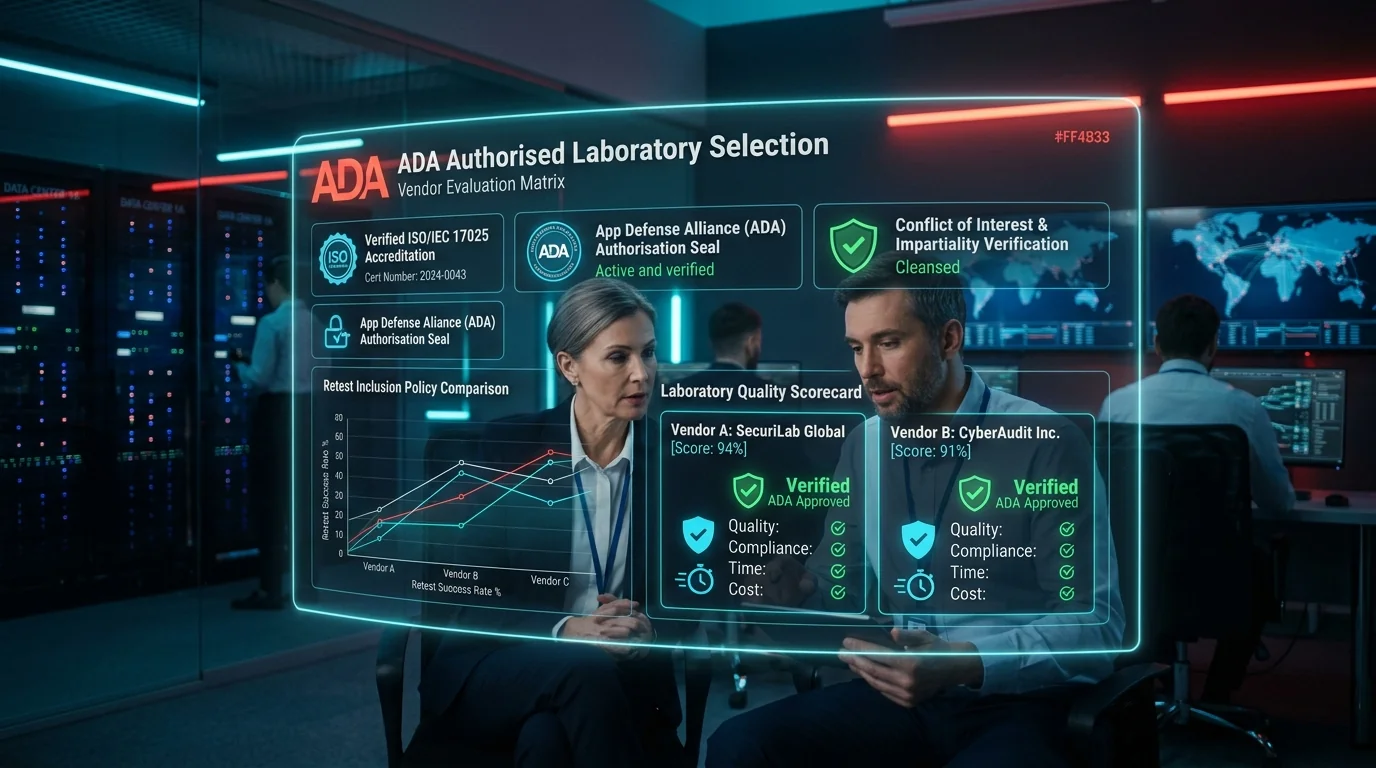
If this walkthrough is useful, the two decisions either side of it are covered separately: how to prepare for your first ADA assessment covers the four weeks before a lab starts, and how to choose an ADA authorised laboratory turns the sections above into questions you can actually ask.
For the requirement sets themselves, see CASA for web applications and APIs, DASA for desktop and server software, and the Cloud App and Config Profile for the infrastructure underneath.
About Adayptus
Adayptus Consulting Private Limited is an application security testing firm based in Noida, India. We have been doing web, mobile and cloud security testing since 2018.
We are currently building our laboratory management system to ISO/IEC 17025:2017 and working towards authorisation as an App Defense Alliance Security Test Laboratory. We are not an ADA-authorised laboratory today. We will say so plainly on this page until that changes, because you should be able to trust what a security firm tells you about itself.
What we can do for you right now:
- Readiness testing. We test your app against the relevant requirement set and tell you what would fail, before you pay for a formal validation. Finding out early is much cheaper than failing late. That is web application, API or cloud configuration work depending on the profile.
- Fixing what we find. We give you guidance specific to your application, pointing at the actual component and the actual change needed, not a link to a general guideline. Where the cause sits in the code, secure code review is usually the faster route.
- Evidence preparation. We help you assemble the documentation, architecture information and test accounts an authorised lab will ask for, so your validation does not stall on paperwork.
Please note. One thing we will tell you up front: if we do your readiness work, we cannot later be the lab that performs your formal ADA validation. Our impartiality rules stop us from validating an application we have already advised on. We would rather you knew that at the beginning than after you had paid us. If your priority is the formal validation, we will point you at an authorised lab and stay out of the way.
Attribution and source
Requirement identifiers, domain names and profile names in this article are drawn from material published by the App Defense Alliance in the ASA-WG repository at github.com/appdefensealliance/ASA-WG, licensed under Creative Commons Attribution-ShareAlike 4.0 International. The explanations and remediation advice are our own.
Programme requirements are versioned and they change. Before you rely on any specific detail in this article, check the current published requirements in the App Defense Alliance repository and its releases page, and the certification information on the App Defense Alliance website. Where this article describes how a process generally works, that shape is stable. Where it would matter to you whether a number or a version is exactly right, confirm it at the source.
Adayptus Consulting
Application Security Testing, Adayptus
Adayptus Consulting Private Limited is an application security testing firm based in Noida, India, working across web, mobile and cloud security testing since 2018. The firm is building its laboratory management system to ISO/IEC 17025:2017 and working towards authorisation as an App Defense Alliance Security Test Laboratory; it is not an ADA-authorised laboratory today.
On This Page
- What is this?
- Who is required to follow this?
- Which assurance level this describes
- The seven phases
- Phase 1: what a lab must check before taking your money
- Phase 2: how your software is handled
- Phase 3: the evidence standard
- Phase 4: how a verdict is decided
- Phase 5: the independent review
- What happens if the laboratory gets it wrong
- Disputes
- What happens to your records afterwards
- Frequently Asked Questions
- Related reading
- About Adayptus
- Attribution and source