Top 10 Cybersecurity Threats Facing Indian Enterprises in 2025–26
India's digital economy is booming — and so is the threat landscape. From AI-powered ransomware to DPDP non-compliance risks, here are the ten most dangerous cybersecurity threats Indian enterprises must prepare for in 2025–26, with actionable mitigation strategies.
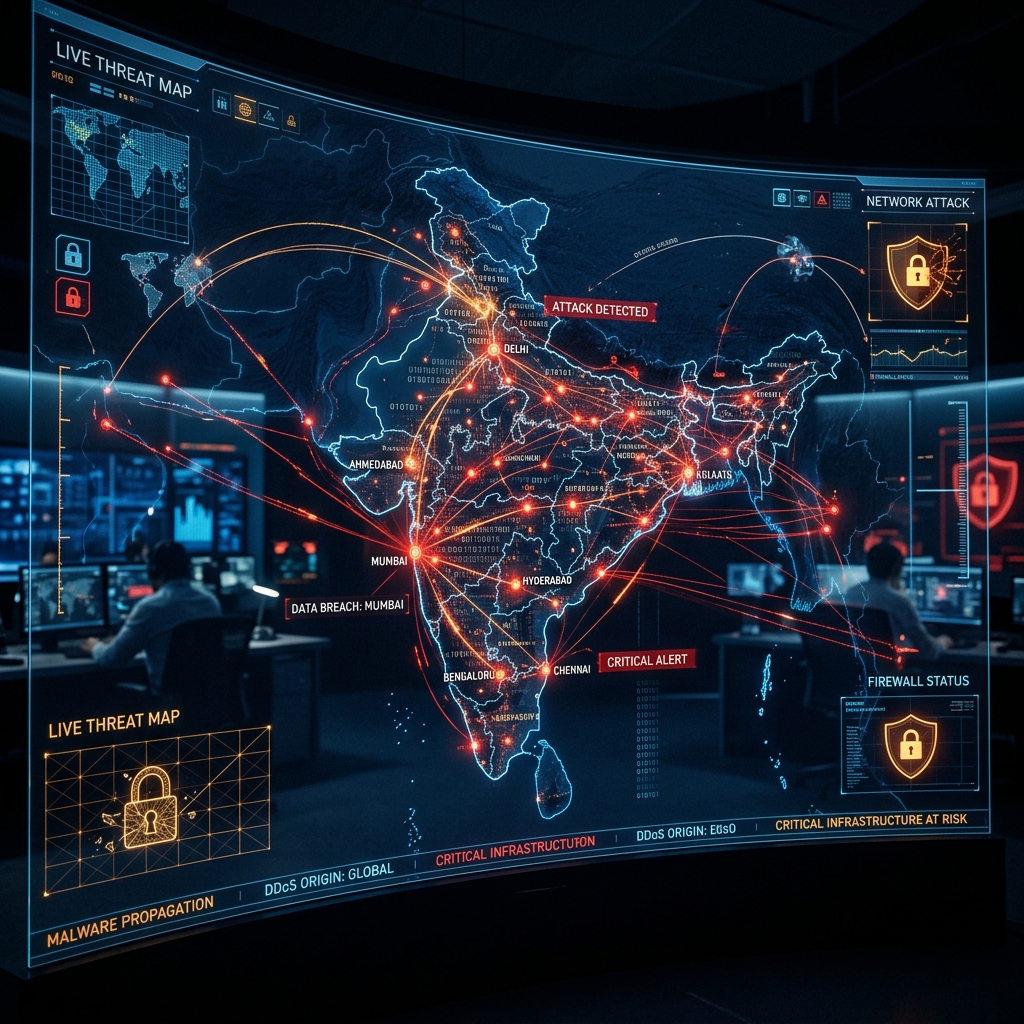
India is now the world's third-largest digital economy — and that distinction comes with a price. In 2024–25, India ranked among the top five most-targeted nations globally for cyberattacks, with losses to cybercrime estimated at over ₹1.7 lakh crore annually. As we move deeper into 2025–26, the threat landscape is not just growing — it is evolving in sophistication, speed, and scale.
For CISOs, CROs, and enterprise security leaders, understanding the specific threats targeting Indian industries is no longer optional — it is a board-level imperative. This guide breaks down the Top 10 cybersecurity threats facing Indian enterprises in 2025–26, with real context, risk impact, and mitigation strategies tailored to the Indian business environment.
📊 Key Statistics — India Cyber Threat Landscape 2025
- India witnessed a 92% increase in cyberattacks against critical infrastructure in 2024 (CERT-In)
- Average cost of a data breach in India reached ₹19.5 crore (IBM Cost of a Data Breach Report 2024)
- BFSI, healthcare, and manufacturing sectors accounted for 61% of all attacks
- Ransomware incidents in India grew by 55% year-over-year
- Only 31% of Indian enterprises have a formal incident response plan (PwC India)
1AI-Augmented Ransomware & Double Extortion
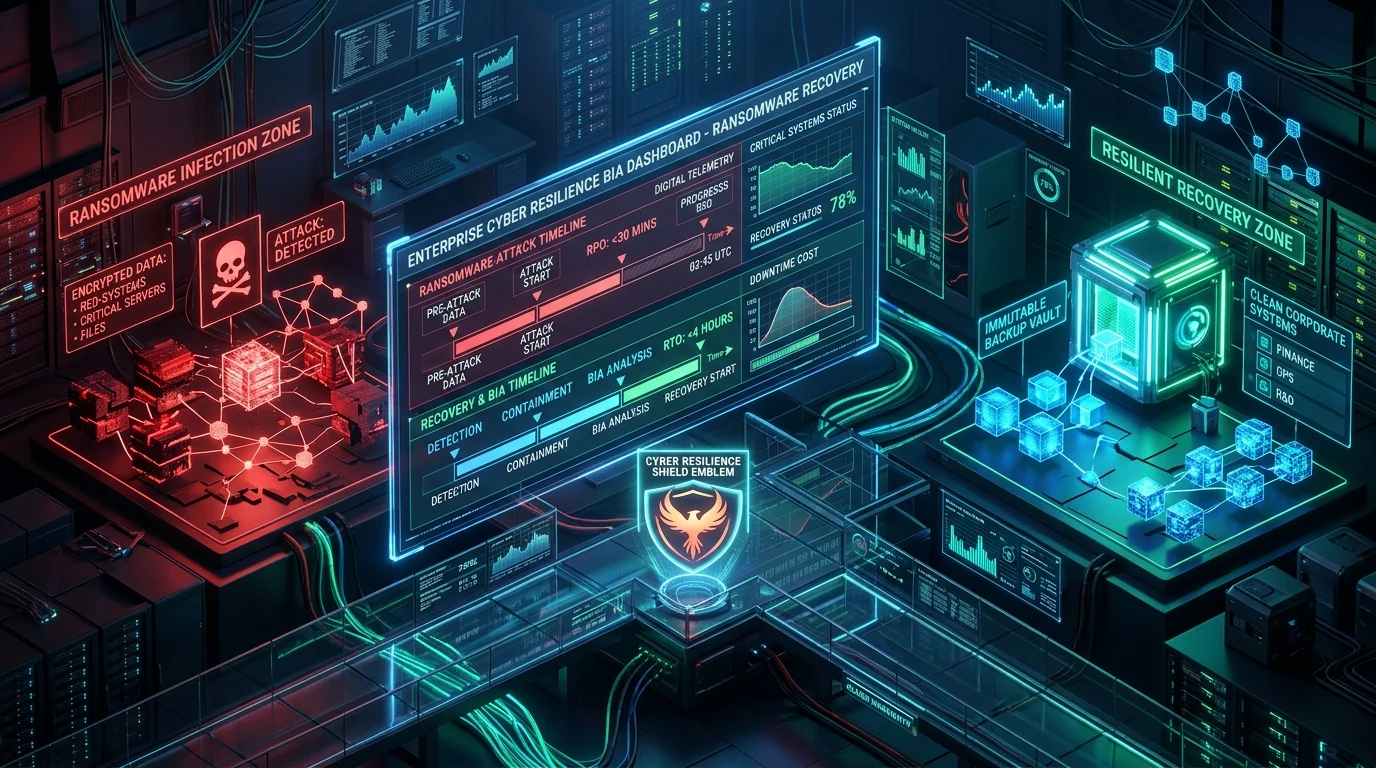
Ransomware in 2025 is not your 2019 ransomware. Modern ransomware groups — including LockBit, ALPHV/BlackCat, and Indian-targeting groups like RansomEXX — now deploy AI to automate target reconnaissance, accelerate lateral movement, and personalize phishing lures at scale. The result: faster attacks that evade legacy defenses and cause far greater damage.
Double extortion — encrypting data and threatening to leak it publicly — has become the default model. Indian enterprises in pharma, manufacturing, and BFSI are prime targets due to high-value IP and regulatory sensitivity.
🛡️ Mitigation Strategy
- Deploy immutable, air-gapped backups with regular restoration testing
- Implement EDR/XDR with behavioral AI-based detection
- Subscribe to a Ransomware Readiness Assessment to measure resilience before an attack occurs
- Establish a documented Incident Response plan with ransom decision-making frameworks
2Supply Chain & Third-Party Vendor Attacks
The SolarWinds and MOVEit incidents globally demonstrated that the weakest link is often a trusted vendor. In India, this risk is amplified by the dense IT outsourcing ecosystem — thousands of enterprises rely on shared MSSP platforms, cloud vendors, and SaaS providers with deep system access.
CERT-In and the RBI have both flagged third-party vendor risk as a top priority. Attackers compromise one vendor to reach hundreds of downstream enterprises simultaneously — maximizing ROI per intrusion.
🛡️ Mitigation Strategy
- Conduct formal Third-Party Risk Assessments for all critical vendors
- Enforce least-privilege access and just-in-time provisioning for vendor accounts
- Require vendors to submit SOC 2 Type II or ISO 27001 reports annually
- Monitor vendor access continuously with PAM (Privileged Access Management) tools
3Advanced Phishing & Business Email Compromise (BEC)
AI-generated phishing emails are now indistinguishable from legitimate communications. Voice phishing (vishing) using deepfake audio of CXOs is actively targeting Indian enterprises — attackers impersonate CFOs to authorize fraudulent wire transfers. The FBI estimates BEC has caused $55 billion in global losses, with India emerging as one of the highest-victimized regions in Asia-Pacific.
Spear phishing campaigns targeting Indian IT, BFSI, and government contractors have seen a 210% increase in 2024–25. These are no longer mass-spam campaigns — they are targeted, researched, and devastatingly convincing.
🛡️ Mitigation Strategy
- Deploy DMARC, DKIM, and SPF to prevent email spoofing
- Run quarterly phishing simulation programs across all business units
- Establish out-of-band verification protocols for all financial transactions above a defined threshold
- Implement MFA on all email and financial systems — passwords alone are insufficient
4Cloud Misconfigurations & Unsecured Cloud Storage
India's cloud adoption has outpaced cloud security maturity. Gartner estimates 99% of cloud security failures through 2025 will be the customer's fault — not the cloud provider's. Improperly configured S3 buckets, overly permissive IAM roles, publicly exposed databases, and unencrypted sensitive data are alarmingly common in Indian enterprises undergoing rapid cloud migration.
CERT-In has issued multiple advisories on cloud infrastructure exposures affecting government agencies and large private sector enterprises. The DPDP Act additionally creates legal liability for data exposed via cloud misconfigurations.
🛡️ Mitigation Strategy
- Deploy a Cloud Security Posture Management (CSPM) tool for continuous configuration auditing
- Conduct regular cloud security assessments for AWS, Azure, and GCP environments
- Enforce encryption at rest and in transit for all cloud-stored data
- Implement strict IAM policies with regular access reviews and privilege de-escalation
5State-Sponsored APT (Advanced Persistent Threat) Attacks
India faces persistent cyberattacks from state-linked threat actors — most notably groups attributed to neighboring nation-state adversaries. Groups like SideWinder (APT-C-17), Transparent Tribe (APT36), and newly emerging actors specifically target Indian defense contractors, energy infrastructure, telecommunications networks, and government agencies.
Unlike financially-motivated cybercriminals, APT actors operate with virtually unlimited resources, patience measured in years, and objectives centered on espionage, disruption, and intellectual property theft. Their TTPs (Tactics, Techniques, and Procedures) are sophisticated and often bypass traditional signature-based defenses entirely.
🛡️ Mitigation Strategy
- Deploy a 24/7 Managed SOC with MITRE ATT&CK-aligned detection rules
- Conduct regular threat hunting to proactively identify persistent footholds
- Implement network segmentation and microsegmentation to limit lateral movement
- Subscribe to threat intelligence feeds specific to India-targeting APT groups
6DPDP Act Non-Compliance & Regulatory Penalties
The Digital Personal Data Protection (DPDP) Act, 2023 is now in active enforcement mode. The Data Protection Board of India has begun accepting complaints, and enterprises that have not implemented mandatory controls — consent management, data minimization, breach notification within 72 hours, and Data Principal rights fulfillment — face penalties up to ₹250 crore per violation.
Beyond penalties, the reputational damage of a publicly disclosed DPDP violation can devastate customer trust, partner relationships, and stock valuation. For enterprises handling sensitive consumer data — fintech, healthcare, e-commerce, telecom — this is not a future risk. It is a present one.
🛡️ Mitigation Strategy
- Commission a DPDP Readiness Assessment to identify gaps against all 36+ DPDP obligations
- Implement a consent management platform (CMP) with granular audit trails
- Establish a Data Breach Response Procedure with the 72-hour notification SLA embedded
- Appoint a Data Protection Officer (DPO) with clear accountability and board access
7Insider Threats & Privilege Abuse
Insider threats — whether malicious or negligent — are among the costliest and hardest-to-detect attack vectors. In India's high-attrition IT sector, departing employees represent a significant data exfiltration risk. A 2024 Ponemon Institute study found that insider-related incidents take an average of 85 days to contain — three months of unrestricted access for a malicious insider.
The rapid growth of remote and hybrid work in India has expanded the insider threat surface dramatically. Employees accessing sensitive systems from unmanaged personal devices and home networks represent monitoring blind spots that traditional perimeter security cannot address.
🛡️ Mitigation Strategy
- Deploy User and Entity Behavior Analytics (UEBA) to baseline normal and detect anomalous activity
- Implement a Zero Trust Architecture — verify every user, every request, every time
- Enforce strict off-boarding procedures including immediate access revocation, device wipe, and data audit
- Classify and DLP-protect sensitive data — know where your crown jewels are and who touches them
8Web Application Vulnerabilities & API Security Gaps
India's booming fintech, healthtech, and edtech sectors have created an explosion of public-facing web applications and APIs — many built at startup speed without embedded security. OWASP API Security Top 10 vulnerabilities — broken object-level authorization, broken authentication, excessive data exposure — are rampant in Indian-developed applications.
CERT-In reported a significant surge in web application attacks in 2024, including SQL injection, XSS, and API abuse campaigns. UPI-integrated fintech applications and hospital management systems have been specifically targeted, with attackers exfiltrating financial and health records at scale.
🛡️ Mitigation Strategy
- Commission annual web application penetration testing and dedicated API security testing
- Integrate SAST/DAST tools into your CI/CD pipeline for continuous vulnerability detection
- Deploy a Web Application Firewall (WAF) with OWASP ruleset enforcement
- Implement API gateways with rate limiting, authentication enforcement, and request validation
9Critical Infrastructure & OT/ICS Attacks
India's power grids, water treatment plants, oil pipelines, and railway networks are increasingly connected to IT systems — creating bridges that attackers are actively exploiting. The 2021 Mumbai power outage, linked to suspected Chinese cyberattack, was a stark warning that critical infrastructure attacks in India are not theoretical — they are happening.
In 2025–26, OT/ICS environments remain woefully underprotected. Many operational technology systems run legacy SCADA software — often Windows XP-era — that cannot be patched, monitored traditionally, or isolated easily from corporate IT networks.
🛡️ Mitigation Strategy
- Conduct an IT/OT convergence security assessment to identify exposure points
- Implement network segmentation between IT and OT environments — air-gap where feasible
- Deploy OT-aware security monitoring solutions (Claroty, Dragos, or Nozomi)
- Develop OT-specific incident response playbooks independent of IT IR plans
10AI-Powered Attacks & Adversarial Machine Learning
The same AI capabilities that are transforming Indian businesses are being weaponized by adversaries. In 2025–26, AI is enabling autonomous vulnerability scanning, polymorphic malware that rewrites itself to evade detection, AI-generated deepfake identities for fraud, and adversarial machine learning attacks that manipulate AI-based fraud detection systems.
For Indian enterprises deploying AI in critical business processes — credit scoring, fraud detection, medical diagnosis, recruitment — the integrity of these AI systems is itself an attack surface. Adversarial inputs can cause AI models to make catastrophically wrong decisions while appearing perfectly confident.
🛡️ Mitigation Strategy
- Commission an AI Security Assessment to evaluate the robustness of your AI/ML models
- Conduct LLM red-teaming if your organization is deploying generative AI systems
- Implement AI governance frameworks aligned with emerging ISO/IEC 42001 requirements
- Treat AI model poisoning as a formal threat in your threat modeling exercises
📊 Threat Priority Matrix for Indian Enterprises
| Threat | Likelihood | Business Impact | Priority |
|---|---|---|---|
| AI-Augmented Ransomware | Very High | Critical | P1 — Immediate |
| Supply Chain Attacks | Very High | Critical | P1 — Immediate |
| Phishing / BEC | Very High | High | P1 — Immediate |
| Cloud Misconfiguration | High | Critical | P2 — 30 Days |
| APT / State-Sponsored | High | Critical | P2 — 30 Days |
| DPDP Non-Compliance | Very High | High | P2 — 30 Days |
| Insider Threats | High | High | P3 — 60 Days |
| Web App / API Attacks | Very High | High | P3 — 60 Days |
| OT / ICS Attacks | High | Critical | P3 — 60 Days |
| AI-Powered Attacks | High | High | P4 — 90 Days |
Where Indian Enterprises Must Focus in 2025–26
The common thread across all ten threats is this: reactive cybersecurity is no longer sustainable. Waiting for an incident to expose gaps is a strategy that costs crores and careers. The enterprises that will navigate 2025–26 successfully are those building proactive, intelligence-led, resilience-first security programs.
Detect
Deploy 24/7 monitoring. A Managed SOC with threat intelligence provides the eyes you need around the clock.
How Adayptus Can Help
Adayptus Consulting is India's specialized cybersecurity firm helping enterprises understand, quantify, and reduce their exposure to every threat on this list. From penetration testing and managed SOC to DPDP compliance and AI security, our services are purpose-built for the Indian threat landscape.
Penetration Testing & VAPT
Web, Network, API, Mobile, Cloud
24/7 Managed SOC
Real-time detection & response
DPDP Compliance
Gap assessment & implementation
AI Security Assessment
LLM red-teaming & AI governance
Manish Kumar
Strategic Intelligence Division
Adayptus Consulting is a premier provider of enterprise cybersecurity solutions, specializing in Managed SOC, Penetration Testing, and GRC strategy. Our intelligence division regularly publishes research to help CISOs navigate the evolving threat landscape.