Building a Safe AI-Assisted Pentesting Agent
The control loop, tool contracts and enforcement points behind an agent-driven pentesting workflow — and why safety is architecture, not a prompt.
Most conversations about AI in offensive security are stuck between two unserious positions: that autonomous agents are about to replace penetration testers, and that they are a party trick. Neither survives contact with a real engagement. What is actually happening is narrower and more interesting — the orchestration layer of a penetration test is becoming programmable, and the firms that treat that as an engineering problem will pull ahead of the ones waiting to buy it as a product.
This is an account of how we think about building that layer: the control loop, the tool contracts, the enforcement points, and the evaluation harness that tells us whether any of it is working. It is deliberately light on offensive technique and heavy on architecture, because the technique is not the hard part. The hard part is building something that is useful enough to change delivery and constrained enough to put in front of a regulated client.
One framing to establish up front, because everything else follows from it: safety in an agentic offensive workflow is an architectural property, not a prompt. If your scope enforcement lives in an instruction to the model, you do not have scope enforcement. You have a suggestion.
- 01The value is in the orchestration layer, not in the model doing exploitation.
- 02Scope must be enforced at the tool boundary, where it is deterministic — never in the prompt.
- 03Agents raise recall and destroy precision. Adjudication is the load-bearing stage.
- 04Nothing reaches a client report without human reproduction of the finding.
- 05If you cannot evaluate the agent, you are not engineering it — you are hoping.
What "Agent-Driven" Actually Means
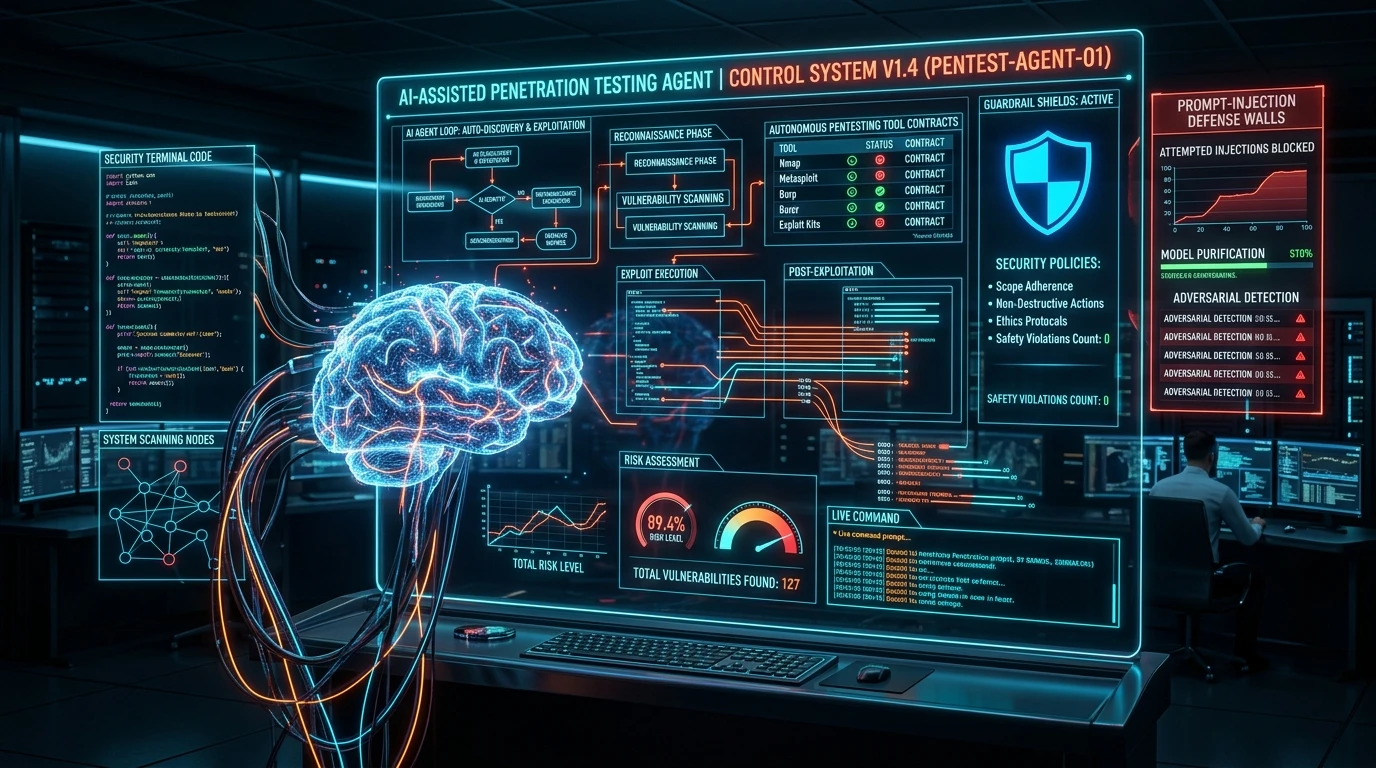
The word "agent" has been stretched until it means almost nothing, so it is worth being precise. A scanner runs a fixed sequence of checks. A chatbot answers questions about output you paste into it. An agent is neither: it is a loop in which a model proposes an action, a runtime executes that action against real tools, the result is fed back as new state, and the loop repeats until a stopping condition is met.
That loop — plan, act, observe, judge — is the entire mechanism. Everything that makes it valuable or dangerous follows from one property: the model chooses the next action based on what it just learned. That is what a scanner cannot do, and it is also why an unconstrained agent is unacceptable in a client environment.
The specific capability this unlocks in testing is not exploitation. It is traversal. A web application with two hundred endpoints, four roles and a dozen state transitions has a combinatorial space no human works through exhaustively inside a two-week engagement. A loop that can enumerate that space, keep track of what it has already tried, and reason about which unexplored branch looks most anomalous is doing something genuinely new — and it is doing it in the least glamorous part of the job, which is exactly where the time goes.
The distinction that matters commercially. "AI-assisted" and "autonomous" are not points on the same scale — they are different liability models. An assisted workflow keeps a named consultant accountable for every finding that reaches the client. An autonomous one does not, and no framework we work under currently contemplates that. We build the former deliberately, not as a stepping stone to the latter.
Why Build Rather Than Buy
The honest case against building is real, and worth stating before the case for it. Building means you own the failure modes, the maintenance, the model-version churn and the security of the harness itself. A vendor product amortises that across a customer base. If your differentiation is not methodology, buying is the correct answer.
Three arguments outweigh that for us.
Methodology is the product. A penetration test is not a list of vulnerabilities; it is a judgement about which weaknesses matter in a specific business context. That judgement is the thing clients pay for, and it lives in how a team decides what to chase. Outsourcing the orchestration layer to a black box means outsourcing the methodology, and then competing on price against everyone else running the same box.
Constraint requirements are client-specific. A BFSI client under RBI supervision, a healthcare client handling patient data, and a SaaS startup have materially different tolerances for what an automated process may touch and where data may be processed. Those constraints have to be expressible in the harness. Generic products expose a scope field; they rarely expose "this tool may run against this subnet only during this window, and nothing from this class of action may execute at all without a second human approval."
Evaluation is impossible from the outside. If you cannot see the agent's action trace, you cannot measure its false-positive rate, and you cannot improve it. You are left grading the vendor on their own marking scheme. We would not accept that from a scanner, and an agent has far more ways to be confidently wrong.
The Architecture
Five components, with the boundaries between them doing most of the work.
| Component | Responsibility | Why it is separate |
|---|---|---|
| Orchestrator | Runs the loop, manages budget and stopping conditions | Must be able to halt the model, not ask it to stop |
| Tool layer | Typed, capability-declared wrappers around real tooling | This is where scope is enforced deterministically |
| Engagement record | Signed authorisation: targets, windows, exclusions | Single source of truth; the model never edits it |
| Evidence store | Append-only record of every action and its output | Provenance for findings; non-repudiation for disputes |
| Adjudicator | Decides what is a finding, and what a human must see | Separating discovery from judgement is the precision fix |
The critical design decision is that the model never talks to a tool directly. It emits a structured request for a declared capability, and the runtime decides whether to honour it. This is the same reasoning behind typed tool interfaces in protocols such as the Model Context Protocol: once the interface is a schema rather than a shell string, it becomes something you can validate, log and refuse.
A tool contract in this design carries more than a signature. It declares what the tool can do, so the runtime can reason about it without understanding the tool:
Tool contract — illustrative
{
  "name": "http_request",
  "capabilities": ["network.egress", "target.read"],
  "mutating": false,
  "blast_radius": "single_request",
  "requires_approval": false,
  "parameters": {
    "url":    { "type": "string", "constraint": "in_engagement_scope" },
    "method": { "type": "string", "enum": ["GET", "HEAD", "POST"] }
  },
  "rate_limit": { "per_minute": 120, "burst": 20 },
  "evidence": ["request", "response_headers", "status", "timing"]
}
Note mutating, blast_radius and requires_approval. Those three fields let the orchestrator apply policy to a tool it has never seen, which is what makes the design extensible without re-auditing the whole system every time a capability is added.
Safety Is an Enforcement Point, Not an Instruction
This is the section that matters most, and it is the one most discussions skip.
A model instructed to "only test hosts in scope" will usually comply. Usually is not a control. Models misread scope, follow injected instructions embedded in the content they are analysing, and generalise from an example in ways nobody intended. Prompt injection is not an exotic risk here — it is the expected condition, because an offensive agent's entire job is to read attacker-adjacent and untrusted content. The OWASP Top 10 for LLM Applications lists prompt injection first for good reason, and an agent with tool access converts that from an output-integrity issue into an action-integrity one.
So every constraint that matters is implemented where a model cannot argue with it.
Enforcement point — illustrative
def authorise(request, engagement, tool):
    # The engagement record is signed and immutable for the run.
    # Nothing the model emits can widen it.
    if not engagement.covers(request.target):
        return Deny("target outside signed scope")

    if not engagement.window.contains(now()):
        return Deny("outside agreed testing window")

    if request.target in engagement.exclusions:
        return Deny("explicitly excluded asset")

    if tool.mutating and engagement.environment == "production":
        return RequireApproval(reviewer="lead_consultant")

    if tool.blast_radius in ("service", "tenant"):
        return RequireApproval(reviewer="lead_consultant")

    if budget.exhausted(request.capability):
        return Deny("capability budget exhausted")

    return Allow(record=evidence.open(request))
Several properties of that function are deliberate. It is deny-by-default: a capability with no matching rule does not fall through to allow. It is synchronous: nothing executes while approval is pending. It is outside the model's context, so no amount of injected text reaches it. And it opens an evidence record before the action runs, so an action that crashes the harness still leaves a trace.
Around that sit four further controls that we treat as non-negotiable:
- 01Network egress allow-listing. The runtime can reach the engagement scope and the model provider. Not the internet. An agent that cannot reach an arbitrary host cannot exfiltrate to one, whatever it decides to do.
- 02Destructive-class prohibition. Some actions are not gated behind approval, they are absent from the tool registry entirely: anything targeting availability, anything that writes to production data stores, anything that modifies authentication state for a real user.
- 03Hard budgets and a kill switch. Every run has a ceiling on actions, wall-clock and spend, plus an out-of-band stop that terminates the runtime rather than asking the loop to wind down.
- 04Client data stays where it was agreed. What crosses the boundary to a model provider is a policy decision made per engagement and written into the contract — including retention and training-use terms — not a default inherited from an SDK.
That last point deserves emphasis in an Indian context. Under the DPDP Act a client remains the Data Fiduciary; a testing partner processing personal data on their behalf inherits obligations that do not disappear because a model provider is in the path. The correct answer is usually that production personal data never enters the loop at all — and if that constrains what the agent can test, that is a constraint we accept rather than engineer around. We cover the wider governance framing in our note on ISO/IEC 42001 and the NIST AI RMF.
Where the Model Genuinely Helps — and Where It Does Not
Being specific here is what separates a defensible position from marketing.
| Task | Agent fit | Why |
|---|---|---|
| Recon correlation | Strong | Volume, cross-source joining, no judgement required |
| Endpoint and parameter traversal | Strong | Combinatorial, tedious, state-tracked |
| Access-control matrix testing | Strong | Mechanical once roles and routes are known |
| Reading unfamiliar code and configuration | Good | Fast comprehension; needs verification |
| Regression against prior findings | Good | The expected result is already known |
| Business-logic abuse | Weak | Requires knowing what the business considers loss |
| Novel exploitation and chaining | Weak | Long-horizon reasoning under partial information |
| Risk rating and client narrative | Poor | Context the model does not have and should not guess |
The trajectory on the "weak" rows is worth watching rather than dismissing. Google's Project Zero published its Naptime work in 2024 and then reported, in the follow-on Big Sleep effort, a model-discovered memory-safety flaw in real software — a genuine result, in a narrow domain, with substantial scaffolding. DARPA's AI Cyber Challenge pushed the same question at scale for vulnerability discovery and automated repair in open-source code. Neither says agents can run a penetration test. Both say the ceiling on the mechanical half of vulnerability research is rising faster than most delivery teams have priced in.
The rows that will not move are the bottom two, and not because the models are weak. Whether an authorisation gap is critical or cosmetic depends on what the organisation loses when it is abused — and that is information the model was never given. We wrote about this capability boundary at more length in the future of offensive security in the age of AI.
Recall Went Up. Precision Fell Off a Cliff.
This is the practical finding that shaped our design more than any other, and it is the opposite of what the marketing suggests.
An agentic loop surfaces far more candidate issues than a human working the same scope in the same time. That is the recall gain, and it is real. But a large share of those candidates are wrong in a specific and dangerous way: they are plausible. A model that has read a thousand vulnerability reports writes an excellent description of a vulnerability that is not there. The failure mode is not noise you can filter on confidence — it is well-argued, correctly formatted, internally consistent fiction.
A scanner's false positives are cheap to dismiss because they are obviously mechanical. An agent's are expensive, because triaging one requires the same effort as investigating a real finding. Left unmanaged, that erases the time saving completely — and if any of them reach the client, it costs something worse than time.
So discovery and judgement are separated, and the adjudication stage is deliberately hostile to its own input:
- 01Evidence or it did not happen. A candidate with no stored request, response and differential is discarded without review. The model's account of what it saw is not evidence; the transcript is.
- 02Deterministic replay. The recorded action sequence is re-executed independently of the model. If the result does not reproduce, it is not a finding.
- 03Adversarial second pass. A separate model instance is given the evidence and asked to refute the finding, with refutation as the default. Discovery and verification are never the same context.
- 04Human reproduction before delivery. A consultant reproduces every surviving finding by hand. Nothing is written into a client report on the agent's authority alone.
Gate four is where the "assisted" in AI-assisted stops being a hedge and becomes the accountability model. A named consultant signs the report, and they can only sign what they have seen work.
How You Know It Is Working
An agent you cannot measure is not an engineered system. The evaluation harness is genuinely harder to build than the agent, and it is the part nobody demos.
Ours rests on a regression corpus: deliberately vulnerable applications alongside sanitised reconstructions of previously-closed findings, each with a known ground truth. Every change to prompts, models, tools or policy is run against it before it touches an engagement. Treating a model upgrade as a deployment requiring regression testing — rather than a free improvement — is one of the more consequential habits to build early.
| Metric | What it tells you | Failure it catches |
|---|---|---|
| Recall on known-planted issues | Coverage of the mechanical layer | A change that quietly narrows exploration |
| Precision after adjudication | Whether the gates are holding | Plausible fiction reaching consultants |
| Human minutes per confirmed finding | The only honest efficiency measure | Triage cost cancelling the recall gain |
| Policy denials per run | How often the agent tries to leave scope | Drift, and successful prompt injection |
| Replay reproduction rate | Determinism of recorded actions | Findings that depend on transient state |
The fourth row is a security metric, not a quality one, and it is the one we watch most closely. A rise in policy denials is the earliest signal that something in the target environment is manipulating the loop — the agentic equivalent of an IDS alert on your own tooling. Public work on measuring model behaviour in security contexts, such as Meta's CyberSecEval suite within PurpleLlama, is a useful reference point for anyone assembling this kind of harness from scratch.
The Authorisation Question Nobody Wants to Ask
Standard penetration testing authorisation was written for humans exercising judgement. It does not cleanly cover a process that decides its own next action, and pretending otherwise is where this field will get into trouble.
Four questions we settle in writing before a run:
Does the client know? Automated and agent-assisted testing is disclosed explicitly in the rules of engagement, including which categories of tooling are used and what data leaves the environment. A client discovering this from a report is a trust failure regardless of how well the system performed.
Who authorised the assets? Scope in a shared-tenancy or third-party-hosted environment frequently includes infrastructure the client does not own. A human tester notices and stops. An agent will not, unless the exclusion is encoded in the engagement record — which is why that record is signed and machine-readable rather than a paragraph in a PDF.
Who is accountable for the action? Every action carries the identity of the authorising consultant, not the agent. There is no meaningful sense in which a model is responsible for an out-of-scope request, and any framing that suggests otherwise is a liability-laundering exercise.
What happens when something breaks? If an action causes an outage, the evidence store must be able to reconstruct exactly what ran, when, under whose authorisation, and what the runtime returned. For Indian clients this connects directly to incident reporting timelines — the same reconstruction problem we discussed in the context of CERT-In's six-hour reporting requirement.
None of this is exotic. It is the discipline already expected under NIST SP 800-115 and PTES, applied to a component that acts faster than a person and does not get tired of trying things.
Where This Is Heading
Three predictions we would be willing to be judged on.
The point-in-time penetration test becomes harder to justify. Once the mechanical layer is cheap to re-run, testing a quarterly snapshot of a system that deploys twice a week looks increasingly like a compliance artefact rather than a security control. The engagement shape that survives is continuous coverage of the mechanical layer plus scheduled deep human work on logic, chaining and business context.
The differentiator moves from finding to judgement. When breadth is commoditised, what a client is buying is the decision about which of four hundred issues actually threatens them, and the ability to defend that decision to a board or a regulator. That was always the valuable part; it is about to become the only scarce part.
The offensive harness becomes an audited asset. A system holding signed engagement records, client evidence and privileged network position is a high-value target. Firms building this will be asked — correctly — to demonstrate its security, its data handling and its access controls. We would expect that scrutiny to arrive before regulation does, driven by client procurement rather than statute.
The uncomfortable version of all three: none of them requires the model to get much better. They follow from capabilities that already exist, applied with more engineering discipline than the field has shown so far. The constraint is not model capability. It is willingness to build the boring parts — the enforcement points, the evidence store, the evaluation harness — that make the capable parts safe to use.
If You Are Building This Yourself
- 01Build the evidence store and the enforcement point first, before any agent logic. Retrofitting either into a working loop is significantly harder than it sounds.
- 02Make the engagement record signed, machine-readable and immutable for the duration of a run.
- 03Start with read-only capabilities in non-production. You will learn more from recon and traversal than from anything that writes.
- 04Assume the content your agent reads is adversarial, because on a real engagement it sometimes will be.
- 05Build the regression corpus before the agent, so you can tell improvement from a good day.
- 06Measure human minutes per confirmed finding, not findings produced. The second number is easy to inflate and means nothing.
- 07Threat-model the harness itself. It holds client evidence, credentials and privileged network position — treat it as production.
How Adayptus Helps
- Penetration Testing & VAPT — consultant-led testing across web, API, mobile, network and cloud, with every finding reproduced by hand before it reaches your report.
- Red Teaming and Purple Teaming — objective-driven simulation where judgement, not breadth, is the deliverable.
- Continuous Security Validation and Attack Surface Management — continuous coverage of the mechanical layer between deep engagements.
- AI & LLM Security Assessment and LLM Security Testing — for the other side of this coin: the agentic systems you are deploying are themselves attack surface.
- AI Governance & Compliance — ISO/IEC 42001 and NIST AI RMF alignment for organisations putting AI systems into regulated processes.
- Threat Modelling and Secure Code Review — the work that does not commoditise, because it depends on knowing what your business loses.
Related reading: AI-driven penetration testing with autonomous agents, advanced LLM security testing techniques, and anatomy of an AWS cloud misconfiguration in BFSI.
Frequently Asked Questions
Click any question to expand the answer.
QDoes an AI agent replace the penetration tester?
No, and the framing misunderstands where the effort goes. An agentic loop is strong at traversal, correlation and regression — the mechanical layer that consumes most of an engagement's hours. It is weak at business-logic abuse, novel chaining and risk rating, because those require knowing what the organisation actually loses when something is abused. That context is not in the model. The realistic effect is that consultants spend less time on enumeration and more on judgement, which is the part clients are paying for.
QHow do you stop an agent from testing something out of scope?
Not by telling it not to. Scope is enforced in the runtime that executes tool calls, outside the model's context, checked against a signed engagement record the model cannot modify. It is deny-by-default, synchronous, and it logs every denial. Instruction-based scope control fails because models misread constraints and because untrusted content the agent reads can contain injected instructions — which is the expected condition when the agent's job is reading attacker-adjacent material.
QDo AI-assisted tests produce more false positives?
Before adjudication, yes — substantially. And they are a worse kind of false positive than a scanner's, because they are plausible rather than obviously mechanical, which makes each one as expensive to triage as a real finding. That is why discovery and judgement are separated: candidates without stored evidence are discarded, surviving ones are replayed deterministically without the model, a second model instance is asked to refute them, and a consultant reproduces anything that gets through before it is written up. What reaches the client should have a lower false-positive rate than a conventional test, not a higher one.
QDoes our data go to a model provider during testing?
That is a per-engagement decision written into the contract, not a default. Under the DPDP Act the client remains the Data Fiduciary, and obligations do not lapse because a model provider sits in the processing path. The usual answer is that production personal data never enters the loop — testing runs against non-production data or sanitised equivalents, and where that constrains what can be assessed, we accept the constraint and say so rather than engineering around it. Retention and training-use terms are agreed explicitly.
QIs agent-assisted testing accepted for compliance purposes?
Frameworks such as NIST SP 800-115 and PTES describe testing rigour and evidence, not which tools produce it, so tool assistance is not itself a problem. What auditors and regulators care about is that a competent, accountable human stands behind the findings and that the work is evidenced and reproducible. That is precisely why the human reproduction gate exists and why every action is recorded with the authorising consultant's identity. An autonomous process signing its own findings would be a different question, and not one we think is currently answerable.
QShould we build our own offensive agent or buy a product?
If testing methodology is not your differentiator, buy. Building means owning the failure modes, the maintenance and the security of the harness itself, which holds client evidence and privileged network position. Building makes sense when your constraints are client-specific enough that a generic scope field cannot express them, or when you need the action trace to measure and improve false-positive rates — something you cannot do from outside a closed product. Either way, budget more effort for the evaluation harness than for the agent.
References & Further Reading
- NIST SP 800-115 — Technical Guide to Information Security Testing and Assessment
- Penetration Testing Execution Standard (PTES)
- OWASP Web Security Testing Guide (WSTG)
- OWASP Top 10 for Large Language Model Applications
- OWASP GenAI Security Project — Agentic AI: Threats and Mitigations
- NIST AI Risk Management Framework (AI RMF 1.0)
- NIST AI 100-1 — AI RMF full text (PDF)
- NIST SP 800-218 — Secure Software Development Framework (SSDF)
- MITRE ATT&CK
- MITRE ATLAS — Adversarial Threat Landscape for AI Systems
- MITRE Caldera — automated adversary emulation
- Google Project Zero — Project Naptime: Evaluating Offensive Security Capabilities of Large Language Models
- Google Project Zero — From Naptime to Big Sleep
- DARPA AI Cyber Challenge (AIxCC)
- Meta PurpleLlama — CyberSecEval benchmarks
- Model Context Protocol — typed tool interfaces for model runtimes
- FIRST — CVSS v4.0 Specification
- CWE Top 25 Most Dangerous Software Weaknesses
- OWASP Application Security Verification Standard (ASVS)
- ISO/IEC 42001:2023 — Artificial Intelligence Management Systems
- CERT-In — Directions and Advisories
- CREST — Penetration Testing Standards and Accreditation
- Anthropic — Responsible Scaling Policy

Peyush Baranwal
Senior Delivery Manager — Cyber Security, Adayptus
Peyush Baranwal is a Senior Delivery Manager at Adayptus Consulting with 11+ years of experience designing, implementing, and managing enterprise security programmes. His core expertise spans Vulnerability Assessment & Penetration Testing (VAPT), Application Security, and Security Operations — leading web, mobile, API, and infrastructure security assessments for CISOs and security teams across BFSI, healthcare, and SaaS. He focuses on measurable risk reduction, governance maturity, and operationalising detection-and-response capability. Outside work, Peyush is a passionate biker and part-time photographer.
Connect on LinkedInOn This Page
- What "Agent-Driven" Actually Means
- Why Build Rather Than Buy
- The Architecture
- Safety Is an Enforcement Point, Not an Instruction
- Where the Model Genuinely Helps — and Where It Does Not
- Recall Went Up. Precision Fell Off a Cliff.
- How You Know It Is Working
- The Authorisation Question Nobody Wants to Ask
- Where This Is Heading
- If You Are Building This Yourself
- How Adayptus Helps
- Frequently Asked Questions
- References & Further Reading