Data Protection Impact Assessment (DPIA): A Practical Guide for Organizations
What a DPIA covers, when India DPDP Act Section 10 requires one, and how to run a Data Protection Impact Assessment that changes design, not paperwork.
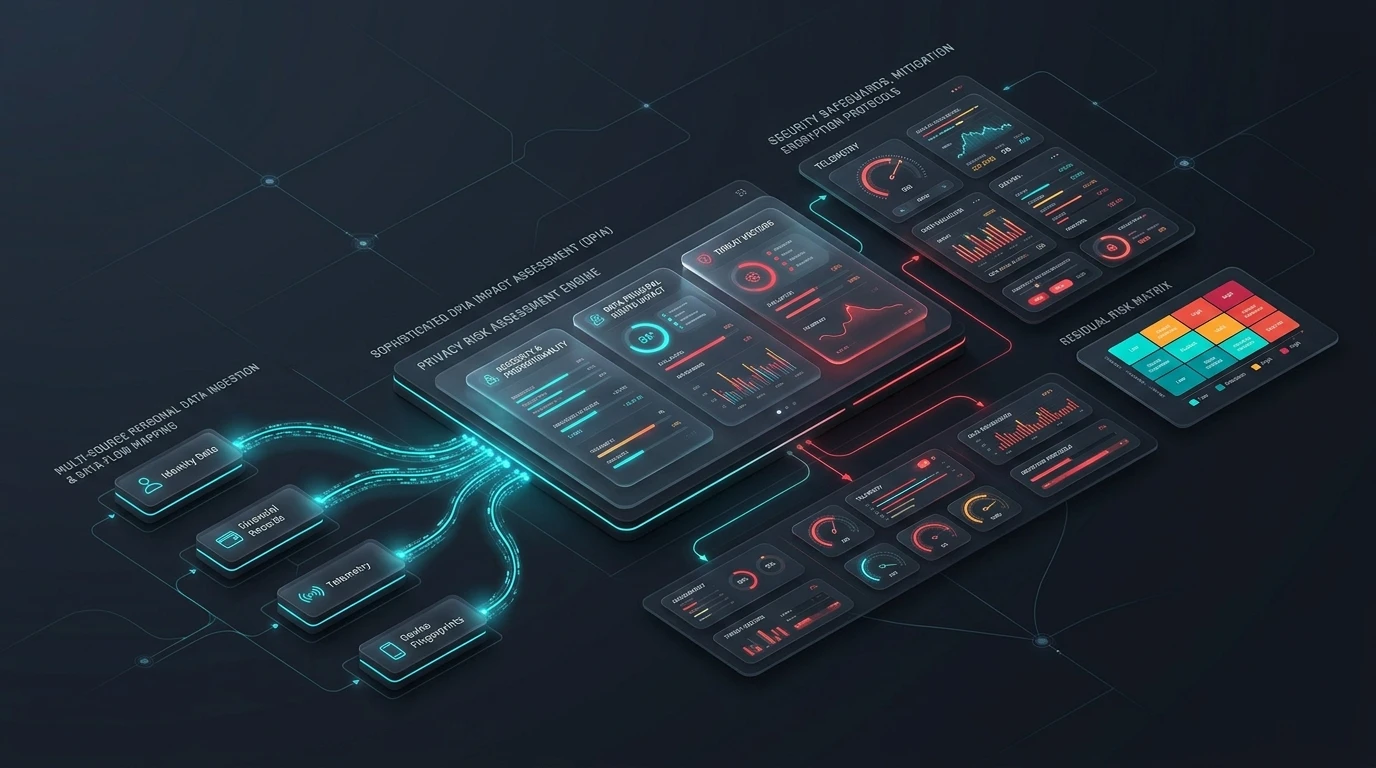
A lending team is three weeks from launch. The platform scores applicants using identity data, bank statement analysis, bureau pulls, device fingerprints and in-app behaviour. Security has signed off a penetration test. Legal has approved the privacy notice. Nobody has yet answered the question a Data Protection Impact Assessment exists to answer: what happens to a real person if this system is wrong, breached, or simply over-collects?
That question is not rhetorical, and it is not answered by a clean VAPT report. A DPIA asks a different set of things, and asks them before the architecture hardens:
- What personal data is actually processed — not what the design document claims?
- Why is each field necessary, and what breaks if it is removed?
- Where does it flow, through which APIs, into which cloud services and vendors?
- Who can read it, export it in bulk, or query it without an audit trail?
- How long is it kept, and does deletion actually delete?
- What is the consequence to the individual — not the company — of breach, error or misuse?
This article is a practitioner's guide to running that assessment properly: what Indian law actually requires, where international practice goes further, and how to operationalise a DPIA so it changes design decisions rather than decorating a compliance folder.
- 01Under the DPDP Act, a periodic DPIA is an obligation of Significant Data Fiduciaries — not of every Data Fiduciary.
- 02The Act's DPIA is framed around risk to the rights of Data Principals, not risk to the organisation.
- 03GDPR Article 35 has explicit triggers and a prior-consultation duty. DPDP does not. Do not conflate them.
- 04A DPIA is not a VAPT. One assesses impact on people; the other finds exploitable defects. You need both.
- 05A DPIA completed after go-live is documentation. Completed before, it is design control.
What a DPIA Is
Plainly: a DPIA is a structured assessment of how a specific processing activity could harm the people whose data it uses, and what you will change to reduce that harm to an acceptable level.
Technically: it is a documented analysis that establishes the purpose and lawful basis of processing, inventories the personal data involved, maps its flow across systems and third parties, tests necessity and proportionality, identifies privacy and security risks to individuals, evaluates existing controls, scores inherent and residual risk, and records an accountable decision to proceed, modify or abandon.
Three things a DPIA is not:
- Not a vulnerability assessment. A DPIA can conclude that a system with zero exploitable vulnerabilities is still unacceptable — because it collects data it does not need, retains it indefinitely, or subjects people to automated decisions they cannot contest.
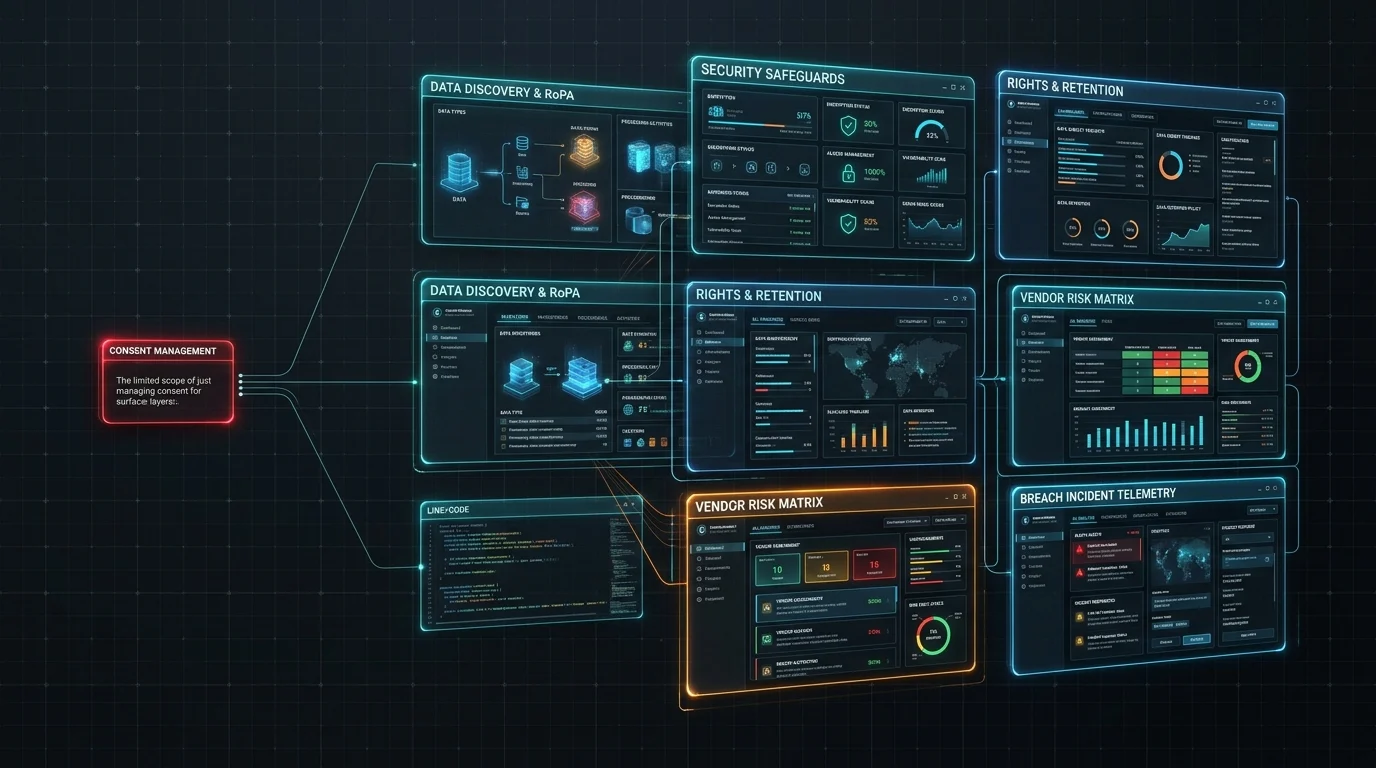
- Not a consent review. Lawful basis is one input. Security, retention, rights fulfilment and vendor governance are separate dimensions. We covered that gap in consent management is not DPDP compliance.
- Not a template. A DPIA whose findings could apply to any organisation has assessed nothing.
DPIA Under India's DPDP Framework — What the Law Actually Says
This section is deliberately precise, because a great deal of published commentary imports GDPR obligations into Indian law where none exist.
The Digital Personal Data Protection Act, 2023 (Act No. 22 of 2023, enacted 11 August 2023) is operational law, with the DPDP Rules, 2025 notified on 13 November 2025 and full compliance expected by 13 May 2027.
First, the vocabulary the Act uses:
| Term | Meaning under the Act |
|---|---|
| Data Principal | The individual the personal data relates to. |
| Data Fiduciary | Whoever determines the purpose and means of processing. Carries the obligations. |
| Data Processor | Any person who processes personal data on behalf of a Data Fiduciary. |
| Significant Data Fiduciary (SDF) | A Data Fiduciary, or class of them, notified as such by the Central Government under Section 10. |
| Data Protection Officer | An individual appointed by a Significant Data Fiduciary under Section 10(2)(a). |
The DPIA obligation sits in Section 10 — and applies to SDFs
Section 10(1) empowers the Central Government to notify a Data Fiduciary, or a class of them, as a Significant Data Fiduciary based on factors it determines, expressly including the volume and sensitivity of personal data processed and the risk to the rights of Data Principals.
Section 10(2) then imposes additional duties on an SDF: appoint a Data Protection Officer based in India who is answerable to the board or similar governing body and acts as the contact point for grievance redressal; appoint an independent data auditor to evaluate compliance; and undertake further measures, the first of which the Act states as:
"periodic Data Protection Impact Assessment, which shall be a process comprising a description of the rights of Data Principals and the purpose of processing of their personal data, assessment and management of the risk to the rights of the Data Principals, and such other matters regarding such process as may be prescribed"
— Digital Personal Data Protection Act, 2023, Section 10(2)(c)(i)
Read that definition carefully, because three things follow from it.
It is periodic, not one-off. The statutory word is "periodic". The Act does not itself fix a frequency; further matters may be prescribed. Waiting for a prescribed cadence before setting your own is a poor risk decision — tie reassessment to material change in processing, and review on a defined interval besides.
The subject of the risk is the Data Principal. The Act frames the exercise as assessment and management of risk to the rights of Data Principals — not to the business. A DPIA that scores only regulatory and reputational exposure to the organisation has not performed the assessment the statute describes.
It is scoped to SDFs. Nothing in the Act imposes a DPIA on every Data Fiduciary. That is a genuine difference from the GDPR model and should be stated plainly rather than blurred.
Why non-SDFs should still do them. Every Data Fiduciary owes duties that a DPIA is the natural way to discharge: Section 8(5) requires reasonable security safeguards to prevent a personal data breach, including for processing carried out on its behalf by a Data Processor; Section 8(6) requires intimation of a breach to the Board and to each affected Data Principal; Section 8(7) requires erasure once consent is withdrawn or the purpose is served, unless law requires retention. You cannot evidence any of those without knowing what you process and where it sits. The DPIA is the instrument that produces that knowledge — obligation or not.
Where the penalties actually fall
The Act's Schedule (referenced by Section 33(1)) sets penalty ceilings per category. The four that matter for this discussion:
| Breach | Penalty may extend to |
|---|---|
| Failure to take reasonable security safeguards to prevent a personal data breach — s.8(5) | ₹250 crore |
| Failure to give the Board or affected Data Principals notice of a breach — s.8(6) | ₹200 crore |
| Breach of additional obligations in relation to children — s.9 | ₹200 crore |
| Breach of the additional obligations of a Significant Data Fiduciary — s.10 (the DPIA, audit and DPO duties) | ₹150 crore |
So for an SDF, failing to run the periodic DPIA is not a paperwork lapse — it sits in a ₹150 crore category of its own, independent of whether a breach ever occurs.
How This Differs From GDPR Article 35
International practice is worth borrowing from. It is not worth misquoting as Indian law. The differences are material.
| Dimension | DPDP Act, 2023 (India) | GDPR (EU) |
|---|---|---|
| Who must do a DPIA | Significant Data Fiduciaries, under s.10(2)(c)(i) | Any controller whose processing is likely to result in a high risk to rights and freedoms — Art 35(1) |
| Statutory triggers | None enumerated; obligation follows SDF notification | Art 35(3) names systematic extensive automated evaluation with legal effect, large-scale special-category processing, and large-scale systematic monitoring of public areas |
| Prescribed content | Rights of Data Principals, purpose, assessment and management of risk to those rights, plus matters as prescribed | Art 35(7) requires description of processing, necessity and proportionality assessment, risk assessment, and safeguards |
| DPO involvement | SDF must appoint a DPO; the Act does not expressly mandate DPO advice on each DPIA | Controller must seek the DPO's advice where one is designated — Art 35(2) |
| Regulator consultation | No prior-consultation requirement | Prior consultation with the supervisory authority where residual high risk remains — Art 36 |
| Frequency | "Periodic"; cadence not fixed in the Act | Review where the risk changes — Art 35(11) |
Two supporting standards are useful regardless of jurisdiction. ISO/IEC 29134 gives guidelines for privacy impact assessment — process, structure and reporting. ISO/IEC 27701 extends an ISO/IEC 27001 information security management system into a privacy information management system, which is where DPIA outputs become auditable controls rather than one-off documents. The NIST Privacy Framework is a voluntary risk-management structure that pairs well with organisations already using NIST security material. Where you already run ISO 27001, treating the DPIA as a documented control input is far cheaper than building a parallel process.
When to Run One
Regardless of SDF status, these characteristics should trigger an assessment before deployment:
| Category | Examples |
|---|---|
| New systems | Customer apps, mobile apps, digital lending and FinTech platforms, healthcare and diagnostics apps, new SaaS adoption |
| Scale | Large-scale processing, data-warehouse and lake consolidation, cloud migration |
| Inference and automation | AI/ML models on personal data, credit or eligibility scoring, behavioural profiling, automated decisions affecting a person |
| Intrusive techniques | Biometrics, facial recognition, location tracking, employee monitoring, session recording |
| Disclosure | Third-party data sharing, new processors or sub-processors, marketing and analytics platforms, cross-border transfer |
| Change | New purpose for existing data, re-architecture, new integration, vendor substitution |
A workable decision path, cheap enough to apply to every change request:
Screening logic
New or changed processing activity
  |
  +-- Personal data involved?                          no  -> record decision, stop
  |     yes
  +-- New purpose, new data, new recipient, new tech?  no  -> light-touch review
  |     yes
  +-- Any high-impact characteristic present?
  |     (scale | inference | biometrics | monitoring |
  |      children | financial or health data |
  |      automated decisions | cross-border)
  |     yes
  +-- FULL DPIA before production deployment
        -> residual risk accepted by a named owner
The Methodology, Step by Step
Fourteen steps, in order. The sequence matters more than the template.
| Step | What it produces | Worked example |
|---|---|---|
| 1. Identify the activity | A scoped, named processing activity | "Underwriting decisions in the retail loan app", not "the lending platform" |
| 2. Purpose and justification | Stated purpose per data set, and the basis relied on | Credit assessment (contract performance) vs cross-sell (consent) — separate purposes |
| 3. Data inventory | Field-level list with sensitivity | Discovery finds device IMEI and full contact list in the app payload; neither is in the design doc |
| 4. Data-flow map | Collection to deletion, including copies | Statements land in S3, are copied to the warehouse, and land again in a BI extract nobody owns |
| 5. System and vendor inventory | Apps, APIs, databases, cloud services, processors | Bureau API, bank-statement aggregator, KYC vendor, SMS gateway, analytics SDK |
| 6. Necessity and proportionality | Justification or removal, field by field | Precise GPS cannot be justified for underwriting; city-level suffices. Field dropped |
| 7. Threats and risks | Harm scenarios expressed against the individual | "Applicant wrongly declined and cannot contest the model's inference" |
| 8. Existing controls | What is actually in place, evidenced | Encryption at rest is on; bulk-export alerting is not |
| 9. Inherent risk | Likelihood x Impact before mitigation | Scored per risk on a documented scale |
| 10. Mitigations | Specific, owned, dated actions | Tokenise PAN; add reason codes to declines; 90-day statement retention |
| 11. Residual risk | Score after mitigation | What the business is actually being asked to accept |
| 12. Approvals | Named acceptance at the right level | High residual risk goes to the risk committee, not the product owner |
| 13. Document | A retrievable, versioned record | Linked to the change ticket and the architecture decision record |
| 14. Review | Trigger-based and periodic reassessment | Model retrained on new features — reassessment required |
The Technical Assessment
This is where DPIAs most often go thin, and where a security team earns its place at the table. Each area below should produce evidence, not an assertion.
| Domain | What to examine | The question that finds problems |
|---|---|---|
| Collection | Minimisation, excessive fields, purpose limitation, client-side collection, SDKs and tracking | Capture the app's actual network payload — does it match the declared fields? |
| Application security | Authentication, authorisation, RBAC, API authorisation, session management, secure coding, vulnerability management | Can user A retrieve user B's record by changing an identifier? |
| Data security | Encryption at rest and in transit, key management, tokenisation, masking, database hardening, secrets management | Who can decrypt, and is that a smaller set than who can read the ciphertext? |
| Cloud | Public storage exposure, IAM, security groups, logging, configuration baseline, backup security, multi-tenancy | Are backups and snapshots inside the same control and retention regime as production? |
| Privacy engineering | Notice and consent mechanics where applicable, deletion, correction, access workflows, retention enforcement | Delete one real record, then hunt for surviving copies in warehouse, backups and vendors |
| Monitoring | Audit logs, administrative activity, data exports, privileged access, bulk downloads, anomalous API use | Would a 50,000-record export at 2am generate an alert anyone sees? |
| Third parties | SaaS, cloud, analytics, payments, processors and sub-processors, data-sharing APIs | Do contracts flow down breach timelines that let you meet your own? |
Findings here should be produced by testing — application and API testing, cloud configuration review, access review — not by questionnaire. A control asserted in a document and a control observed in a test are different evidentiary objects.
A Usable Risk Model
Keep the scoring simple enough that engineers will actually use it. Risk = Likelihood × Impact, both on a 1–5 scale, where impact is measured as consequence to the Data Principal.
Likelihood: 1 Rare, 2 Unlikely, 3 Possible, 4 Likely, 5 Almost certain. Impact: 1 Minimal, 2 Minor, 3 Moderate, 4 Major, 5 Severe. Score 1–6 low, 8–12 medium, 15–25 high. Inherent risk is scored before mitigation; residual risk after the agreed controls are actually implemented — not after they are merely planned.
| Activity | Privacy risk to the individual | L | I | Inherent | Existing controls | Recommended | Residual |
|---|---|---|---|---|---|---|---|
| Bank statement ingestion | Full transaction history retained indefinitely; exposure reveals spending, health and lifestyle inferences | 4 | 5 | 20 High | TLS, encryption at rest | 90-day retention, derive features then discard raw, tokenise account numbers | 8 Med |
| Automated credit decision | Applicant declined on an inference they cannot see or contest | 4 | 4 | 16 High | Manual review on appeal only | Reason codes on every decline, documented human-review path, model change log | 8 Med |
| Analytics SDK in mobile app | Device and behavioural data sent to a third party beyond the stated purpose | 4 | 3 | 12 Med | Vendor contract in place | Disable advertising identifiers, restrict event payload, re-test network capture | 4 Low |
| Support team access to KYC images | Broad internal access to identity documents enabling misuse or identity theft | 3 | 5 | 15 High | Role-based access | Just-in-time access, masked by default, view-level audit log, bulk-export alerting | 5 Low |
| Erasure on withdrawal | Data survives in warehouse, backups and vendor systems after deletion is confirmed to the individual | 5 | 3 | 15 High | Primary record deletion | Propagate deletion downstream, define backup expiry, contractual vendor deletion with confirmation | 6 Low |
| Cross-border processing by a sub-processor | Data processed in a jurisdiction outside the assessed transfer map, without notice | 3 | 4 | 12 Med | Prime vendor DPA | Sub-processor approval rights, maintained transfer map, location assurance in contract | 6 Low |
Note what the residual column is really for: it is the record of what a named person accepted on behalf of the organisation, and of the people whose data it is.
Worked Example: AI-Powered Digital Lending
Activity. Underwriting and servicing for an app-based personal loan, using an ML model for risk scoring.
Data. Name, mobile, email, PAN, bank account and statement data, declared and derived income, bureau credit data, device attributes, IP address, coarse location, in-app behaviour.
On identity data specifically. Aadhaar-related processing is not a free choice. Use of Aadhaar numbers, authentication or eKYC is governed by its own statutory regime and is available only to entities and use cases permitted under that regime, with restrictions on storage. Nothing in the DPDP Act creates a general permission to collect Aadhaar. Treat any Aadhaar-linked flow as requiring separate legal confirmation before design, and prefer alternatives such as OKYC or officially valid documents where the entitlement is unclear. The same caution applies to PAN, which carries its own usage and disclosure rules.
Flow. Mobile app to API gateway; identity to KYC vendor; account data to an aggregator; bureau pull to credit bureau; features to the model service; decisions and documents to core lending; events to analytics; notifications via SMS and email gateways; everything replicated into a warehouse for reporting.
Third parties. KYC provider, statement aggregator, credit bureau, cloud provider, analytics platform, communication gateways, collections agency — each a processor or recipient with its own sub-processors.
Principal privacy risks. Over-collection of transaction-level data far beyond the underwriting need; opaque automated decisions with no reason codes; behavioural data reused for marketing without a matching basis; broad internal access to identity documents; retention with no defined expiry; deletion that stops at the primary record; sub-processors outside the transfer map.
Principal security risks. Object-level authorisation flaws in the loan-status API; over-permissive cloud storage on the document bucket; shared decryption authority; absent alerting on bulk export; long-lived static credentials in the model service; warehouse copies outside the production control baseline.
Outcome. Three findings changed the design before launch, which is the point of doing this early: precise GPS was removed as unjustifiable for underwriting; raw statement data moved to a 90-day expiry with only derived features persisted; and decline reason codes plus a documented human-review path were added. Two risks were accepted with residual medium ratings and dated review commitments. One — bulk-export alerting — was a launch blocker until implemented, because without it a breach could not have been scoped within the Section 8(6) intimation duty, which we discuss alongside CERT-In's six-hour reporting expectation.
DPIA vs VAPT vs Security Risk Assessment
| Area | DPIA | VAPT | Security risk assessment |
|---|---|---|---|
| Primary objective | Reduce harm to individuals from a processing activity | Find and prove exploitable weaknesses | Manage risk to the organisation's assets and operations |
| Focus | Purpose, necessity, data flow, rights, retention | Technical attack surface | Threats, controls, business impact |
| Personal data | Central | Incidental | One asset class among many |
| Technical vulnerabilities | Consumes findings as evidence | Produces them | Aggregates them into risk |
| Privacy impact | Assessed explicitly | Out of scope | Usually implicit at best |
| Compliance role | Section 10 obligation for SDFs; accountability evidence for all | Supports the s.8(5) safeguards claim | Supports ISO 27001 and enterprise risk |
| Output | Risk register, mitigations, residual acceptance, design changes | Reproducible findings with severity | Risk register and treatment plan |
These are complements. A DPIA without technical validation is an opinion; a penetration test without a DPIA tells you the door is locked but not whether you should be holding the contents.
Who Needs to Be in the Room
A DPIA fails when a single function owns it. Privacy alone cannot see the data flows; engineering alone cannot judge proportionality; legal alone cannot verify a control.
- DPO or privacy lead — owns the assessment and the risk framing against Data Principal rights.
- CISO and security — supplies tested control evidence and the threat view.
- Application and product owner — defends necessity, or removes the field.
- Engineering and architecture — describes actual flows, including the ones not in the diagram.
- Cloud and infrastructure — storage, IAM, logging, backups, retention mechanics.
- Legal — basis, notices, contracts, sectoral overlays such as RBI or SEBI requirements.
- Compliance and risk — scoring consistency and the acceptance threshold.
- Vendor management — processor terms, sub-processor control, transfer mapping.
- Internal audit — periodically, to test that the process is real.
Where DPIAs Usually Go Wrong
- 01Run after go-live. Then it documents risk instead of preventing it, and every finding competes with a shipped roadmap.
- 02Consent-only scope. Lawful basis reviewed; security, retention, rights and vendors untouched.
- 03No data-flow diagram. Without one, the copies — warehouse, backups, extracts — are invisible, and they are where the risk lives.
- 04APIs and logs ignored. Object-level authorisation flaws and personal data written into application logs are two of the most common real findings.
- 05Processors treated as out of scope. Section 8(5) expressly covers processing carried out on your behalf. Their weakness is your obligation.
- 06No technical validation. Controls recorded as present because someone said so.
- 07Never reassessed. The model is retrained, a vendor is swapped, a region is added — and the assessment still describes last year's system.
Operationalising It
A DPIA becomes real when it is a gate in a process someone already has to pass through. The lifecycle is Discover → Map → Assess → Mitigate → Approve → Monitor → Reassess, and it should be wired into existing controls rather than run beside them:
| Existing process | Where the DPIA attaches |
|---|---|
| SDLC and DevSecOps | Screening question at intake; DPIA required before release for flagged changes |
| Architecture review | Data-flow map is a review artefact, not an afterthought — see threat modelling |
| Vendor onboarding | Processor assessment and transfer mapping before contract signature |
| Change management | Material change to processing triggers reassessment automatically |
| Cloud governance | Retention, logging and IAM baselines inherited by new workloads |
| AI governance | Model and feature changes as reassessment triggers — see ISO/IEC 42001 and NIST AI RMF |
| Launch approval | Residual risk acceptance recorded by a named owner at the right level |
This is Privacy by Design and Secure by Design expressed as workflow rather than principle: the assessment happens where decisions are still cheap to change.
Pre-Production DPIA Checklist
- 01Processing purpose documented per data set, and the basis relied on identified
- 02Field-level personal data inventory complete, produced by discovery not interview alone
- 03Data-flow map covers collection to deletion, including warehouse copies and backups
- 04Minimisation applied — every field justified or removed
- 05Privacy notice reviewed against what the system actually does
- 06Retention period defined per category and enforced by machinery, not intention
- 07Access controls reviewed; privileged and bulk access constrained and logged
- 08Encryption validated in transit and at rest, with key access narrower than data access
- 09APIs tested for object-level authorisation, not just authentication
- 10Cloud configuration assessed, including storage exposure and backup scope
- 11Logging enabled and monitored — exports and privileged actions actually alert
- 12Processors and sub-processors inventoried, contracted and transfer-mapped
- 13Deletion tested end to end on a real record, downstream copies verified gone
- 14Breach detection and intimation path rehearsed, with the RoPA wired into it
- 15Residual risks documented and accepted by a named owner at the appropriate level
The Point of the Exercise
A DPIA is not a regulatory document that happens to involve engineers. It is the one artefact that forces privacy, security, architecture, legal, compliance and the business to agree — in writing, before deployment — on what a system does to people and what the organisation is prepared to accept.
Under the DPDP Act the periodic DPIA is a Section 10 duty for Significant Data Fiduciaries, sitting in a penalty category of its own. For everyone else it remains the most efficient way to produce the evidence that Sections 8(5) to 8(7) assume you already have. Treated as a gate, it changes designs. Treated as a form, it changes nothing — and the risk it was meant to catch simply becomes a production risk instead.
How Adayptus Helps
Most organisations do not need a DPIA template; they need the technical work that makes one credible. We run DPDP readiness and DPIA engagements that start with data discovery and a Record of Processing Activities, then substantiate the control claims through actual testing — penetration testing, cloud security assessment, database review — and finish with a scored register and a remediation plan phased to your deadline.
Related capability: GRC advisory, ISO 27001 implementation, third-party risk management, AI governance and virtual CISO support. Related reading: why consent management is not DPDP compliance and the DPDP Rules 2025 roadmap to May 2027.
Frequently Asked Questions
Click any question to expand the answer.
QIs a DPIA mandatory under India's DPDP Act?
For Significant Data Fiduciaries, yes. Section 10(2)(c)(i) of the Digital Personal Data Protection Act, 2023 requires a periodic Data Protection Impact Assessment. SDF status arises when the Central Government notifies a Data Fiduciary or class of them under Section 10(1), on factors including the volume and sensitivity of personal data processed and the risk to the rights of Data Principals. The Act does not impose a DPIA on every Data Fiduciary. Other Fiduciaries still owe duties — security safeguards, breach intimation, erasure — that are difficult to evidence without the same analysis, so most run DPIAs as a matter of practice rather than obligation.
QHow is a DPIA different from a Privacy Impact Assessment?
In practice the terms overlap heavily. "DPIA" is the term used in the DPDP Act and in GDPR Article 35, and carries a specific legal meaning in each. "Privacy Impact Assessment" is the broader, jurisdiction-neutral term used in guidance such as ISO/IEC 29134. A useful working distinction: a PIA is the general method, while a DPIA is that method performed to satisfy a particular statutory obligation, with the content and approvals that obligation requires. If you are an SDF, what you produce needs to satisfy Section 10 — call it whichever you prefer.
QDoes a penetration test satisfy a DPIA requirement?
No, and the two answer different questions. A penetration test asks whether the system can be broken into; a DPIA asks whether the processing should happen in that form at all, and what it does to the individual if it goes wrong. A system can pass a penetration test cleanly while collecting data it does not need, retaining it indefinitely, and subjecting people to automated decisions they cannot contest — none of which a test would report. They are complementary: test results are among the strongest evidence a DPIA can cite for its control assessment, and for the reasonable security safeguards obligation under Section 8(5).
QHow often should a DPIA be repeated?
The Act's word is "periodic" and it does not itself fix an interval; further matters regarding the process may be prescribed. Rather than wait for a number, run reassessment on two tracks: event-driven, where any material change to processing triggers it — new purpose, new data category, new processor or sub-processor, new jurisdiction, model retraining, significant re-architecture — and calendar-driven, on a defined cycle for high-risk activities so nothing drifts unexamined between changes. Record the cadence you chose and the reasoning, so the decision itself is auditable.
QWho signs off a DPIA, and what happens to high residual risk?
Sign-off should sit with someone who can actually accept the consequence. A low residual risk can reasonably be accepted by the product or system owner; a high residual risk belongs at risk-committee or executive level, and in an SDF the Data Protection Officer — who under Section 10(2)(a) is answerable to the board or similar governing body — should be involved in framing it. Note a jurisdictional difference: under GDPR, Article 36 requires prior consultation with the supervisory authority where high residual risk remains. The DPDP Act contains no equivalent prior-consultation duty, so unresolved high risk is an internal governance decision — which makes recording who accepted it, and on what basis, more important rather than less.
References & Further Reading
- Digital Personal Data Protection Act, 2023 (Act No. 22 of 2023) — full text, MeitY
- Ministry of Electronics and Information Technology (MeitY)
- Regulation (EU) 2016/679 (GDPR) — consolidated text, EUR-Lex
- GDPR Article 35 — Data protection impact assessment
- Article 29 Working Party — Guidelines on DPIA and determining whether processing is "likely to result in a high risk" (WP248 rev.01, endorsed by the EDPB)
- European Data Protection Board — guidelines and recommendations
- ICO — Data protection impact assessments
- ISO/IEC 29134 — Guidelines for privacy impact assessment
- ISO/IEC 27701 — Privacy information management system
- ISO/IEC 27001 — Information security management systems
- NIST Privacy Framework
- NIST SP 800-53 Rev. 5 — Security and Privacy Controls
- CERT-In — directions and advisories
- Reserve Bank of India — regulatory framework
Statutory references in this article were taken from the text of the Digital Personal Data Protection Act, 2023 as published by MeitY. This article is provided for general information and does not constitute legal advice; obtain qualified counsel on the application of the Act, the Rules and any sectoral regulation to your specific processing.

Peyush Baranwal
Senior Delivery Manager - Cyber Security, Adayptus
Peyush Baranwal is a Senior Delivery Manager at Adayptus Consulting with 11+ years of experience designing, implementing, and managing enterprise security programmes. His core expertise spans Vulnerability Assessment & Penetration Testing (VAPT), Application Security, and Security Operations - leading web, mobile, API, and infrastructure security assessments for CISOs and security teams across BFSI, healthcare, and SaaS. He focuses on measurable risk reduction, governance maturity, and operationalising detection-and-response capability. Outside work, Peyush is a passionate biker and part-time photographer.
Connect on LinkedInOn This Page
- What a DPIA Is
- DPIA Under India's DPDP Framework — What the Law Actually Says
- How This Differs From GDPR Article 35
- When to Run One
- The Methodology, Step by Step
- The Technical Assessment
- A Usable Risk Model
- Worked Example: AI-Powered Digital Lending
- DPIA vs VAPT vs Security Risk Assessment
- Who Needs to Be in the Room
- Where DPIAs Usually Go Wrong
- Operationalising It
- Pre-Production DPIA Checklist
- The Point of the Exercise
- How Adayptus Helps
- Frequently Asked Questions
- References & Further Reading