MDR vs MSSP vs SOC: Which Does Your Business Need?
MDR vs MSSP vs SOC explained — what each model actually delivers, where they overlap, cost and outcome differences, and a clear decision framework to choose the right one in 2026.
Three acronyms dominate every security-operations buying conversation — MDR, MSSP, and SOC — and vendors use them almost interchangeably. They are not the same thing. Confuse them and you can end up paying a premium for a stream of alerts nobody actions, or building an in-house team you didn't need.
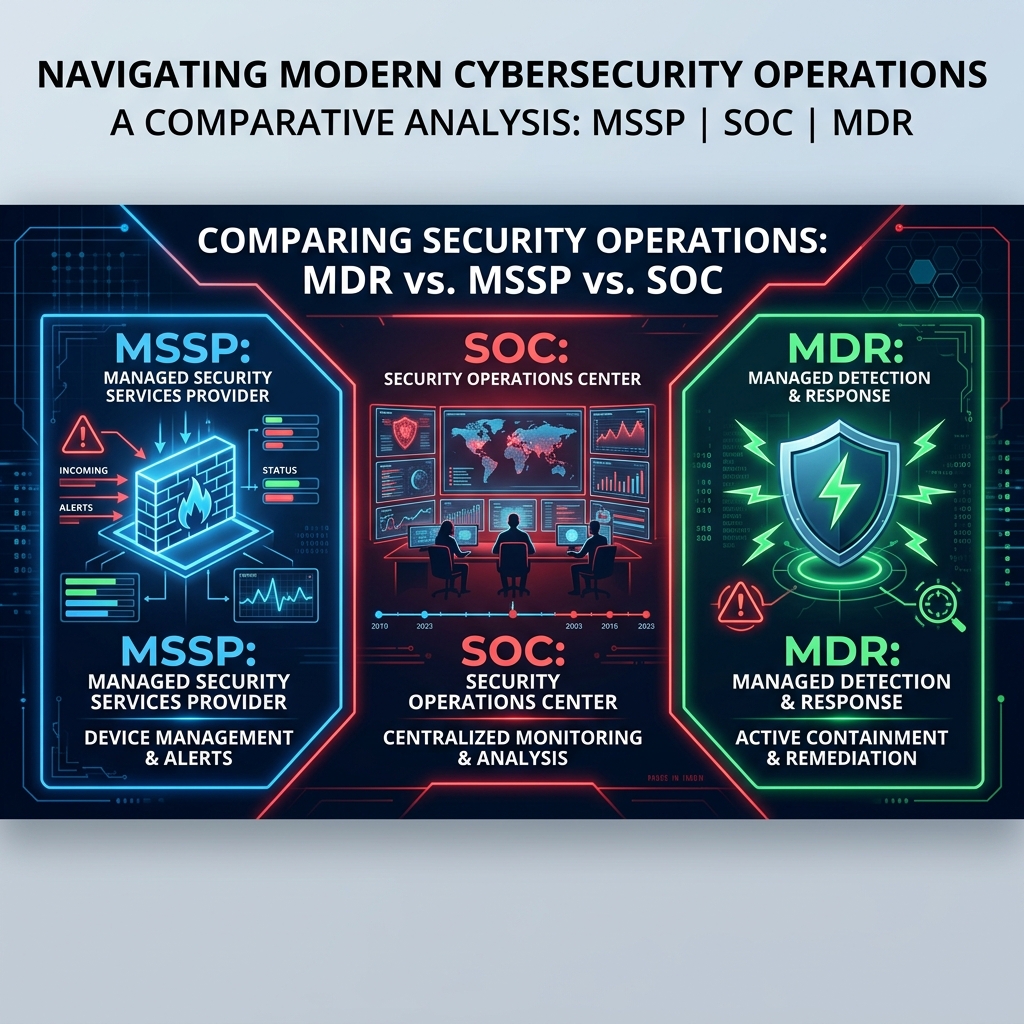
The distinction matters because it decides who does what when an attack happens. A SOC is the capability. An MSSP is a provider that manages your security tooling. MDR is an outcome — detection and active response, delivered as a service. Getting the framing right is the difference between "we got an email alert at 2 a.m." and "the threat was contained before it spread."
This guide defines each model precisely, shows exactly where they overlap and differ, compares them on cost, coverage, and response, and gives you a decision framework to pick the right fit for your size, risk, and in-house maturity in 2026.
- 01 SOC is the capability (people + process + tech); MSSP and MDR are two ways to source it.
- 02 MSSP manages your security tools and forwards alerts; MDR owns the outcome and actively responds to threats.
- 03 They're not mutually exclusive — many organisations run a hybrid (in-house SOC + MDR, or co-managed SOC).
- 04 Choose by in-house maturity, risk profile, budget, compliance, and how fast you need response.
- 05 For regulated Indian entities, monitoring is increasingly mandatory (RBI, SEBI) with tight CERT-In reporting deadlines — response speed is the deciding factor.
MDR vs MSSP vs SOC — The 30-Second Answer
SOC (Security Operations Center) is the function that monitors, detects, investigates, and responds to threats — a combination of analysts, processes, and tooling (SIEM, EDR, threat intel). It can live in-house, be fully outsourced, or run as a hybrid.
MSSP (Managed Security Service Provider) is a vendor that remotely manages security devices and systems — firewalls, SIEM, endpoint tools — at scale, and typically alerts you when something looks wrong. Broad coverage; you usually own the response.
MDR (Managed Detection & Response) is an outcome-focused service: expert-led threat detection plus active response (containment, remediation guidance, sometimes hands-on eviction), usually built on EDR/XDR and 24×7 analysts. You buy the result, not just the monitoring.
What Is a SOC?
A Security Operations Center is the nerve centre of security monitoring and response. It's not a product you buy — it's a capability made of three things: people (analysts, threat hunters, incident responders), process (playbooks, escalation, shift coverage), and technology (SIEM, EDR/XDR, SOAR, threat intelligence).
Crucially, "SOC" describes the function regardless of who runs it. You can build one in-house, consume it as a fully managed SOC / SOC-as-a-Service, or split responsibilities in a co-managed SOC. So "MDR vs MSSP vs SOC" is slightly a category error: MDR and MSSP are two delivery models for the SOC capability. For the deeper build-vs-buy economics, see our Managed SOC vs In-House SOC guide.
What Is an MSSP?
A Managed Security Service Provider is the traditional outsourcing model. MSSPs run large, multi-tenant operations that manage security devices and systems for many clients — device configuration and health, log collection, SIEM management, vulnerability scanning, and alerting.
- ✔ Broad coverage across many device/tool types
- ✔ Cost-efficient at scale; predictable managed service
- ✔ Good for device management, compliance logging, and volume alerting
- ✔ Often bundles firewall, IDS/IPS, VPN, and SIEM management
- ✘ Typically alert-and-notify — response is left to you
- ✘ Can generate high alert volume with limited triage depth
- ✘ Less focus on proactive threat hunting
- ✘ SLAs measure uptime/notification, not threat containment
What Is MDR?
Managed Detection & Response emerged precisely to fix the MSSP "here's an alert, good luck" gap. MDR is outcome-led: a provider combines EDR/XDR telemetry, threat intelligence, and 24×7 human analysts to detect threats with high fidelity and then respond — isolating a host, killing a process, blocking an indicator, and guiding (or performing) remediation.
What sets MDR apart:
The trade-off: MDR is often scoped around endpoints/identities and the provider's chosen stack, so coverage can be narrower than a broad MSSP — but far deeper on what matters most. Adayptus delivers this as a dedicated MDR service and integrates threat hunting and incident response into it.
MDR vs MSSP vs SOC — Side by Side
| Dimension | In-house SOC | MSSP | MDR |
|---|---|---|---|
| Primary outcome | Full control of detect + respond | Tool management + alerting | Detection + active response |
| Who responds? | Your team | Usually you | The provider (with you) |
| Coverage breadth | Whatever you build | Broad (many tools) | Deep (endpoint/identity/XDR) |
| Threat hunting | If resourced | Limited | Core |
| Speed to value | Slow (months) | Medium | Fast (days–weeks) |
| Cost model | High fixed (people+tools) | Predictable subscription | Subscription (outcome-priced) |
| Best for | Large, mature orgs | Broad device/compliance needs | Fast response with lean teams |
Generalised comparison — real offerings vary by provider. Many MSSPs now offer MDR tiers, and many MDR providers manage broader tooling, so scrutinise the actual scope and SLAs, not the label.
Where the Lines Blur
In 2026 the categories overlap heavily. MSSPs have launched MDR tiers; MDR providers manage more of the stack; and "SOC-as-a-Service" is marketed by both. The useful questions cut through the branding:
Which Does Your Business Need? — A Decision Framework
The India Angle — Compliance Changes the Calculus
For Indian organisations, the choice isn't purely commercial. RBI requires banks and NBFCs to operate a SOC; SEBI's CSCRF mandates SOC-based monitoring (own or Market-SOC) for regulated entities; and CERT-In requires incident reporting within 6 hours plus 180-day in-India log retention. That reporting deadline is decisive: you can only report in six hours what you detect in minutes — which pushes regulated entities toward response-capable models (MDR or a managed/co-managed SOC), not alert-only services. Whatever you choose must retain logs in India and support fast, evidenced reporting.
Common Buying Mistakes
1. Buying "MDR" that's really alert-only
Confirm the provider actually responds (contain/isolate/remediate), not just relabels MSSP notifications. Read the response SLA.
2. Judging on price per log/endpoint, not outcomes
The cheapest alert feed is expensive if it never stops an incident. Compare MTTD/MTTR and hunting depth.
3. Ignoring who owns response & forensics
If the provider only notifies, you still need DFIR and an IR retainer. Close that gap before an incident, not during one.
4. Overlooking log location & retention
For India, 180-day in-India retention is non-negotiable. Confirm data residency and retention in the contract.
5. Outsourcing monitoring but not reducing risk
Detection is not prevention. Pair any model with VAPT, red teaming, and continuous validation to shrink the attack surface.
How Adayptus Helps
Adayptus is model-agnostic — we recommend the fit that matches your risk and maturity, not a fixed product. We deliver outcome-led MDR; fully managed SOC and SOC-as-a-Service; co-managed SOC for teams that want shared control; and SOC implementation, optimization, and maturity assessment for organisations building their own. Around the SOC we add threat hunting, DFIR, IR retainers, and prevention through VAPT, red teaming, and purple teaming — all with India-resident log retention and CERT-In / RBI / SEBI-aligned reporting, governed by a GRC / vCISO wrapper. For the operational detail, see our SOC incident-management playbook and Traditional vs Advanced SOC guide.
Conclusion
Don't shop for an acronym — shop for an outcome. A SOC is the capability you need; MSSP and MDR are two ways to source it, differing most in who responds when it matters. Lean teams that need real protection fast lean MDR; complex estates with broad tooling and compliance logging lean MSSP or managed SOC; mature organisations run hybrid or co-managed. In India, compliance and the six-hour reporting clock tilt the decision toward response-capable models. Define your risk, assets, and in-house maturity first — then pick the model (or blend) that closes the gap.
Disclaimer: This article is a general, informational comparison of security-operations delivery models and reflects common market practice in 2025-2026. Specific capabilities, scope, and SLAs vary by provider and contract. It is not a substitute for a tailored assessment of your organisation's requirements.
Frequently Asked Questions
Click any question to expand the answer.
Q What is the difference between MDR and MSSP?
An MSSP manages your security tools and typically notifies you when it detects something, leaving the response to you. MDR is outcome-focused: it detects threats with expert analysts and then actively responds — isolating hosts, blocking indicators, and guiding or performing remediation. In short, MSSP manages tooling and alerts; MDR owns detection and response.
Q Is a SOC the same as MDR or MSSP?
No. A SOC (Security Operations Center) is the capability — people, process, and technology for monitoring and response. MSSP and MDR are two delivery models for that capability. You can run a SOC in-house, consume it as a managed SOC/SOC-as-a-Service, or split it in a co-managed SOC; MDR and MSSP are specific ways to source SOC outcomes.
Q Which is better for a small or mid-size business?
For most SMEs and mid-market organisations without a large in-house team, MDR usually offers the best protection per rupee because it delivers 24×7 detection and active response without hiring and retaining analysts. A managed or co-managed SOC suits organisations with broader tooling or some in-house capability. The right answer depends on your risk, assets, budget, and compliance needs.
Q Can you use MDR and an MSSP together?
Yes, and many organisations do. A common pattern is an MSSP (or managed SOC) for broad device management and compliance logging, combined with MDR for deep detection and active response on endpoints and identities. A co-managed SOC is another hybrid, where your team and a partner share responsibilities. The key is clear ownership of who responds during an incident.
Q Does MDR or MSSP help with CERT-In and RBI/SEBI compliance?
Both can, if configured correctly. RBI and SEBI require SOC-based monitoring for regulated entities, and CERT-In requires 6-hour incident reporting and 180-day in-India log retention. A response-capable model (MDR or a mature managed/co-managed SOC) makes the six-hour deadline realistic, and the provider must store logs in India. Confirm data residency, retention, and reporting support in the contract.
Q How can Adayptus help me choose?
Adayptus is model-agnostic. We assess your risk, assets, in-house maturity, and compliance obligations, then recommend the right fit — MDR, managed SOC, co-managed SOC, or an in-house build — and deliver it with threat hunting, DFIR, IR retainers, India-resident log retention, and CERT-In/RBI/SEBI-aligned reporting, wrapped in GRC and virtual CISO governance.

Peyush Baranwal
Senior Delivery Manager — Cyber Security, Adayptus
Peyush Baranwal is a Senior Delivery Manager at Adayptus Consulting with 11+ years of experience designing, implementing, and managing enterprise security programmes. His core expertise spans Vulnerability Assessment & Penetration Testing (VAPT), Application Security, and Security Operations — leading web, mobile, API, and infrastructure security assessments for CISOs and security teams across BFSI, healthcare, and SaaS. He focuses on measurable risk reduction, governance maturity, and operationalising detection-and-response capability. Outside work, Peyush is a passionate biker and part-time photographer.
Connect on LinkedIn