Managed SOC vs In-House SOC: The 2026 Cost & ROI Guide
Managed SOC vs in-house SOC compared: real cost models, 3-year TCO, MTTD/MTTR benchmarks, and a clear build-vs-buy framework for CISOs in 2026.
Managed SOC vs in-house SOC is no longer a back-office IT debate. It is a board-level financial and operational decision. With 24x7 detection now mandated by RBI, SEBI, IRDA, NIS2, and almost every cyber-insurance underwriter, the question is no longer "do we need a SOC?" but "how do we run one in a way that is affordable, compliant, and effective enough to actually catch a real attack?"
The math has shifted dramatically in 2026. Skilled SOC analysts are scarce and expensive. Tier 1 attrition is brutal. Cloud-native SIEM, EDR, and SOAR platforms have democratised the tooling layer, but operating them around the clock still costs millions. Meanwhile, mature managed SOC providers can land detection and response coverage in weeks at a fraction of the cost of an internal team — but the wrong vendor, the wrong scope, or the wrong contract terms can leave you blind exactly when it matters.
This guide compares managed SOC vs in-house SOC across every dimension that matters: people, tooling, infrastructure, total cost of ownership, MTTD and MTTR, regulatory fit, and ROI over a realistic 3-year horizon. By the end you will have a defensible decision framework — pure managed, co-managed, or in-house — sized to your risk profile, your regulator, and your budget.
Managed SOC vs In-House SOC — The 30-Second Answer
An in-house SOC is a security operations centre staffed and operated by your own employees, running on tools you license, in infrastructure you control. It typically takes 12-24 months to mature and costs $1.5M-$4M+ in Year 1 for a 24x7 mid-market team.
A managed SOC is a 24x7 detection and response service delivered by an external provider — sometimes purely subscription-based (SOC-as-a-Service), sometimes with deep co-managed integration into your environment (Co-Managed SOC, MDR). Year 1 cost typically lands between $50k and $500k for a mid-market estate.
The fast rule: if you are below 5,000 endpoints or moving fast, a managed SOC almost always wins on cost, time-to-coverage, and detection performance. If you are a regulated enterprise with 10,000+ endpoints, sensitive IP, or unique architecture, a co-managed model usually beats both pure-managed and pure in-house. Pure in-house only makes financial sense at the very largest end of the market.
What Is an In-House SOC?
An in-house SOC (sometimes called an internal SOC or enterprise SOC) is a dedicated security operations function built and run inside your own organisation. You hire the analysts, license the SIEM, deploy the EDR, write the playbooks, and own the entire detection-and-response lifecycle.
A 24x7 in-house SOC typically requires three operating tiers:
- Tier 1 (Triage): Continuous alert monitoring, initial enrichment, false-positive filtering. The highest-volume, lowest-paid, highest-attrition role.
- Tier 2 (Investigation): Deep alert investigation, host and network forensics, lateral-movement chasing.
- Tier 3 (Hunt and Engineering): Threat hunting, detection engineering, SIEM/SOAR rule development, purple teaming.
A realistic 24x7 staffing model — accounting for shift coverage, leave, and on-call — needs 10 to 12 analysts minimum, plus a SOC manager. The tooling stack adds another six-to-seven figure annual bill: SIEM, EDR/XDR, SOAR, threat intelligence, vulnerability management, network detection, and identity analytics.
What Is a Managed SOC?
A managed SOC is a 24x7 detection and response service delivered by an external provider. The provider supplies the analysts, the platform, the playbooks, and the operational discipline. You consume the outcome — alerts, incidents, response actions — through a portal, a Slack/Teams integration, or a ticketing handoff.
The market splits into three commercial models:
Fully Managed SOC
Provider runs detection end-to-end on their tooling stack. You forward logs and telemetry, they triage, investigate, and respond. Lowest operational burden, lowest visibility into the underlying mechanics. Best fit for mid-market and below.
Co-Managed SOC
Provider operates on YOUR SIEM, with YOUR data sovereignty. Tier 1 and 2 are outsourced; Tier 3 / detection engineering can be shared or in-house. See how detection engineering keeps SIEM use cases working. Best fit for regulated enterprises that want managed economics without losing tool ownership.
Managed Detection and Response (MDR)
An EDR/XDR-anchored, response-led variant of managed SOC. Provider can take active containment actions (host isolation, account disable, kill process). Best fit when you need fast containment but lack a 24x7 IR team.
"MSSP" — Managed Security Services Provider — is the older umbrella term covering all of the above. Modern MDR providers usually outperform legacy MSSPs on detection efficacy and response speed; MDR is what enterprise procurement teams demand in 2026.
Managed SOC vs In-House SOC — The 10 Differences That Matter
Side-by-side, here is what changes when you move between the two operating models.
| Dimension | In-House SOC | Managed SOC |
|---|---|---|
| Year 1 cost (mid-market) | $1.5M – $4M+ | $50k – $500k |
| Time to 24x7 coverage | 12 – 24 months (hire, train, tune) | 2 – 8 weeks onboarding |
| Headcount required | 10–12 analysts + manager | 1–3 internal liaisons |
| Typical MTTD | Days to weeks (immature) → hours (mature) | Minutes to < 1 hour (top-quartile MDR) |
| Typical MTTR | Days (without retainer) | < 4 hours (MDR with active response) |
| Threat intel coverage | Limited to what you license + harvest | Cross-tenant signal across hundreds of customers |
| Talent risk | Tier 1 attrition 30-50% annually | Provider absorbs hiring & retention |
| Data sovereignty | Full control of telemetry and ownership | Contractual; co-managed mitigates concern |
| Customisation depth | Unlimited; can model unique business logic | Bounded by provider playbook catalogue |
| Best for | Very large or highly regulated enterprises | SMB through upper mid-market; rapid scale |
What an In-House SOC Actually Costs in 2026
Here is the honest line-item breakdown for a 24x7 in-house SOC covering ~1,000-3,000 endpoints in a mid-market enterprise. Numbers reflect 2026 market rates; India anchors are roughly 35-50% lower on people, similar on tooling.
$1.0M – $2.0M / yr
10–12 analysts across Tier 1/2/3 + a SOC manager. Loaded cost with benefits, training, certifications, and shift differentials.
$200k – $500k / yr
Splunk, Sentinel, QRadar, Elastic, or Chronicle — priced on ingestion volume (GB/day or events/sec). Hot-storage retention adds 30-50%.
$50k – $150k / yr
CrowdStrike, SentinelOne, Defender for Endpoint, Cortex XDR. Per-endpoint licensing, typically $50–$120 per endpoint per year for enterprise tiers.
$100k – $300k / yr
Splunk SOAR, Tines, Torq, Palo Alto XSOAR. Required to keep Tier 1 from drowning. Significant engineering cost to build and maintain playbooks.
$80k – $250k / yr
Recorded Future, Mandiant, Anomali, Intel 471, plus Network Detection (Vectra, Darktrace, ExtraHop). Both are non-negotiable for credible coverage.
$50k – $150k / yr
Recruiting, training, certifications (GIAC, OSCP, CISSP), tabletop exercises, internal audit, IR retainers, runbook tooling.
Realistic Year 1 total for a US mid-market 24x7 in-house SOC: $1.5M – $4.0M. India-anchored teams with the same tooling stack typically land $0.9M – $1.8M because people cost is lower while licensed software is priced globally.
What a Managed SOC Actually Costs in 2026
Managed SOC pricing is usually a function of telemetry volume, endpoint count, or assets monitored. Modern providers price three primary ways:
- Per endpoint: $80–$300 per endpoint per year for fully managed coverage. MDR-led providers anchor here.
- Per ingestion volume: $50–$150 per GB/day of log ingestion. SIEM-led providers and co-managed models favour this.
- Per asset / per service: Hybrid pricing for cloud workloads, identity stores, or specific regulatory scopes.
For the same 1,000-3,000 endpoint mid-market estate, expect:
$20k – $80k
Connector setup, log shipping, baseline use-case enablement, knowledge transfer. Mature providers complete in 4-8 weeks.
$80k – $400k
24x7 monitoring, triage, investigation, response. Tooling licensing typically included or pass-through at preferred rates.
$15k – $60k / yr
Pre-paid incident response retainer for major breach surge. Often bundled into MDR contracts.
Realistic Year 1 total for a fully managed 24x7 SOC: $100k – $500k across mid-market estates. Co-managed models that consume your existing SIEM/EDR licences land closer to $80k – $250k because the provider isn't carrying tooling cost.
3-Year Total Cost of Ownership Comparison
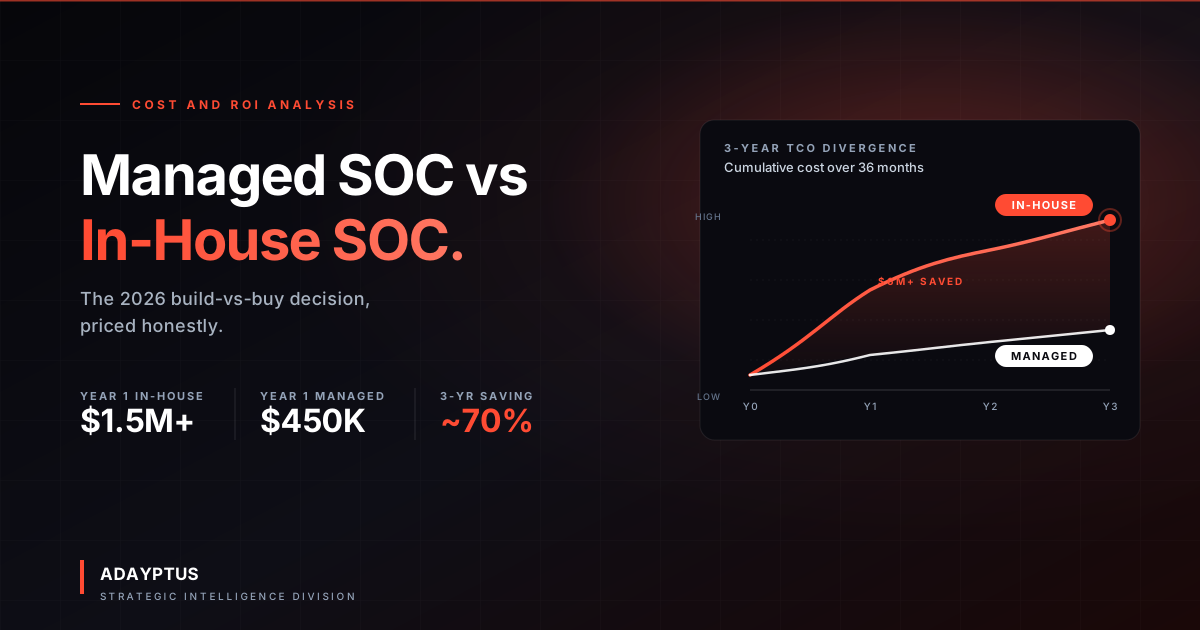
Here is the side-by-side 3-year total cost of ownership for a mid-market enterprise (~2,000 endpoints, 24x7 coverage, US/Europe people pricing). Year 1 includes ramp; Year 2 and 3 reflect steady-state.
| Cost Element | In-House Yr 1 | In-House Yr 2-3 (each) | Managed Yr 1 | Managed Yr 2-3 (each) |
|---|---|---|---|---|
| People | $1.4M | $1.5M | $120k | $120k |
| SIEM + EDR + SOAR | $650k | $700k | included | included |
| Threat intel + NDR | $200k | $200k | included | included |
| Subscription / onboarding | $0 | $0 | $300k | $280k |
| Operations + training | $120k | $100k | $30k | $30k |
| Annual total | $2.37M | $2.50M | $450k | $430k |
| 3-year TCO | $7.37M | $1.31M | ||
Net 3-year saving: ~$6M, or 82% TCO reduction for the same coverage scope. The crossover point at which an in-house SOC becomes financially comparable is roughly 10,000+ endpoints with mature internal IR capability. Below that scale, the math almost always favours managed or co-managed.
Detection and Response Performance — The Real Differentiator
Cost is only half the question. The other half is whether the SOC actually catches and stops attackers. The honest answer in 2026: top-quartile managed SOC providers consistently outperform mid-market in-house SOCs on MTTD and MTTR, because they pool detection signal across hundreds of customers and amortise detection-engineering investment.
- Industry average (IBM CODB): ~204 days.
- Mid-market in-house: 7-30 days for stealthy attacks.
- Top-quartile managed/MDR: minutes to under 1 hour for high-fidelity alerts.
- Industry average (IBM CODB): ~73 days.
- Mid-market in-house: 1-14 days, often without active containment authority.
- Top MDR with active response: < 4 hours from alert to containment.
- In-house Year 1: 30-50% of relevant ATT&CK techniques covered.
- In-house Year 3: 60-75% with detection engineering investment.
- Mature managed SOC: 75-90% out of the box, validated continuously.
Decision Framework — When to Pick Which
The "managed vs in-house" framing is incomplete. Most mature security programmes end up in one of three operating models. Use this framework to choose yours.
MGD
Pure Managed
- SaaS, fintech, healthtech under 5,000 endpoints.
- Need compliance signal in < 90 days.
- No internal SOC team or one too small to matter.
- Generic regulatory regime (SOC 2, ISO 27001, GDPR).
MGD
Co-Managed (sweet spot)
- Regulated enterprise (BFSI, healthcare, OT) with 5k-50k endpoints.
- Want managed economics + your own SIEM data sovereignty.
- Have a small internal team (2-4 engineers) but cannot staff Tier 1 24x7.
- Indian RBI / SEBI / IRDA regulated entities.
I/H
Pure In-House
- Very large enterprise (> 50k endpoints).
- Highly bespoke architecture, IP, or insider-threat profile.
- Defence, government, or sovereign-data regulators.
- Mature Tier 3 detection-engineering capability already in place.
Hidden Costs and Overlooked Factors
Tier 1 attrition is the silent killer of in-house SOCs
Industry attrition for Tier 1 analysts runs 30-50% annually. Re-hiring and re-training a single analyst costs $30k-$80k loaded, and the new hire takes 6-9 months to reach full productivity. Across 6 Tier 1 seats, that is a $200k+ recurring tax most TCO models ignore.
Detection engineering is a permanent capability, not a one-off
SIEM and EDR rules drift. Adversary tradecraft evolves. Without dedicated detection engineering (Tier 3 + automation), in-house SOCs slowly degrade to alert fatigue and false-positive paralysis. Managed providers run detection engineering as a shared service — that is most of the gap in MTTD performance.
"Managed" does not equal "set and forget"
Even the best provider needs 1-3 internal liaisons to triage business context, validate suppressions, run tabletop exercises, and own the executive narrative. Budget for these roles or your managed SOC will underperform, no matter who you pick.
The provider's response authority matters more than the alert volume
A provider that can only notify you at 03:00 has limited value. A provider that can isolate the host, disable the user, and contain the blast radius — under pre-agreed Rules of Engagement — is a fundamentally different (and more valuable) service.
SOC Strategy for Indian Regulators — RBI, SEBI, IRDA, DPDP
For Indian banks, NBFCs, payment aggregators, and capital-market intermediaries, 24x7 SOC capability is no longer optional. RBI's Master Direction on Cyber Security, SEBI's Cyber Security and Resilience framework, and IRDAI's information and cyber security guidelines all explicitly require continuous monitoring with documented MTTD/MTTR targets.
In practice, the dominant model for Indian regulated entities is co-managed SOC:
- Telemetry stays inside Indian data sovereignty boundaries (RBI cloud guidelines, DPDP-compliant storage).
- Tier 1 and Tier 2 are outsourced to a 24x7 managed provider for cost efficiency.
- Tier 3 / detection engineering / threat hunting are retained or co-developed for institutional knowledge.
- Audit trail of detections, response, and SLA evidence is generated for the regulator's annual cyber audit.
The SOC Maturity Assessment programme should be the first step — it lets you demonstrate compliance maturity to the regulator while informing whether managed, co-managed, or in-house is the right next move for your specific risk register.
Frequently Asked Questions
Click any question to expand the answer.
Q Is a managed SOC really cheaper than an in-house SOC?
For mid-market organisations (under 10,000 endpoints) the answer is consistently yes — typically 60-85% cheaper across a 3-year TCO horizon. The economics shift at very large scale (50,000+ endpoints) where in-house can become competitive on a per-endpoint basis. The most expensive option is usually a poorly-staffed in-house SOC that misses real attacks.
Q What's the difference between Managed SOC, MSSP, and MDR?
MSSP is the legacy umbrella term covering all outsourced security operations — historically focused on alert forwarding from SIEM. Managed SOC is a more specific, modern label for 24x7 detection delivered as a service. MDR (Managed Detection and Response) is an EDR-anchored, response-led variant where the provider can take active containment actions. In 2026, top providers blur all three labels — what matters is detection efficacy, response authority, and SLA evidence.
Q How many SOC analysts do I need for a 24x7 in-house SOC?
A realistic staffing model for 24x7 coverage including leave, training, and on-call rotation needs 10-12 analysts plus a SOC manager. Specifically: 4-6 Tier 1, 3-4 Tier 2, 2-3 Tier 3 / detection engineers. Anything less and you have either gaps in coverage or analyst burnout, both of which materially degrade detection.
Q Will a managed SOC cause data sovereignty or compliance issues?
Only if you pick the wrong model. Pure managed SOCs typically host telemetry on the provider's platform, which can create issues for RBI cloud guidelines or sectoral data localisation. Co-managed SOC mitigates this completely: the provider operates on YOUR SIEM in YOUR cloud tenancy, so log data never leaves your sovereignty boundary. Most regulated Indian and European enterprises run co-managed for exactly this reason.
Q How long does it take to onboard a managed SOC?
Mature providers complete baseline onboarding (log shipping, identity integration, endpoint coverage, baseline detection use cases enabled) in 4-8 weeks. Full ATT&CK coverage tuned to your environment takes another 8-12 weeks. Compare with 12-24 months to mature an in-house SOC from scratch — the time-to-coverage gap alone often justifies the decision.
Q Can I start in-house and switch to managed later, or vice versa?
Yes, and most enterprises end up doing both. The common path is: start managed for fast time-to-coverage and budget predictability, build internal Tier 3 (detection engineering, threat hunting) over years 2-3, then transition to co-managed once internal capability is mature. Going the other way — in-house first, managed second — is rarer because it usually follows a budget cut or breach event rather than a planned strategy.
Q What questions should I ask a managed SOC vendor before signing?
Five non-negotiables. (1) What is your committed MTTD and MTTR, contractually? (2) What active response actions can you take, under what Rules of Engagement? (3) What MITRE ATT&CK coverage do you provide out of the box? (4) Where does our log data live, and what is your data retention and deletion policy? (5) How do you measure and report detection efficacy — and what happens if a breach is missed? Vendors that cannot answer all five in writing should be eliminated.
How Adayptus Helps with Managed SOC and SOC Strategy
Adayptus designs, builds, and operates SOC capability for BFSI, healthcare, SaaS, and critical-infrastructure clients across India and global markets. Whether you need a fully managed service, a co-managed model that respects your data sovereignty, or an honest assessment of whether to keep your in-house team — our security operations practice has done it before.
Fully Managed SOC
24x7 detection, triage, investigation, and response on our cloud-native platform. Onboarding in 4-6 weeks. Predictable per-endpoint pricing. Full ATT&CK coverage out of the box.
Co-Managed SOC
Operate on your SIEM, your cloud, your data sovereignty. We deliver Tier 1 and Tier 2; your team retains Tier 3. Built for regulated Indian and European enterprises.
MDR with Active Response
EDR/XDR-anchored detection with contractual authority to isolate hosts, disable accounts, and contain blast radius — under pre-agreed Rules of Engagement.
SOC Maturity Assessment
Independent benchmark of your existing SOC against NIST CSF, MITRE ATT&CK coverage, and SOC-CMM. Output: a prioritised roadmap and a defensible build-vs-buy recommendation.
SOC Implementation
Greenfield SIEM, EDR, and SOAR rollout. Detection-engineering programme, playbook library, RBI / SEBI / IRDA / DPDP audit-ready evidence. Hand-off to internal team or to our managed service.
Threat Hunting + DFIR
Proactive hunting integrated with the managed service. Digital forensics and incident response retainer for breach surge. Single contract, single accountable team.
Stop guessing. Get the build-vs-buy answer in writing.
A 60-minute scoping call with our SOC architects. We'll model your real cost of in-house, managed, and co-managed against your actual endpoint count, regulator, and risk register — and tell you which model fits.
Conclusion: The Honest Build-vs-Buy Answer
For most mid-market organisations, in 2026, the math is unambiguous: managed or co-managed SOC will deliver better detection, faster response, and 60-85% lower TCO than building an in-house team from scratch. The exceptions — very large scale, bespoke architecture, defence-grade regulators — are real, but rarer than the marketing suggests. Most "we need our own SOC" decisions are downstream of identity, not economics, and a co-managed model gives you the identity outcome at managed-economics pricing.
The biggest mistake we see is procurement teams treating SOC selection as a tooling RFP rather than an outcome contract. Pick the operating model first, then pick the provider, then pick the tools — in that order. And demand contractual MTTD, MTTR, and detection-coverage commitments from any partner, managed or in-house. If you want help running that build-vs-buy analysis honestly, that is exactly what our security operations practice does, every quarter.

Peyush Baranwal
Senior Delivery Manager — Cyber Security, Adayptus
Peyush Baranwal is a Senior Delivery Manager at Adayptus Consulting with 11+ years of experience designing, implementing, and managing enterprise security programmes. His core expertise spans Vulnerability Assessment & Penetration Testing (VAPT), Application Security, and Security Operations — leading web, mobile, API, and infrastructure security assessments for CISOs and security teams across BFSI, healthcare, and SaaS. He focuses on measurable risk reduction, governance maturity, and operationalising detection-and-response capability. Outside work, Peyush is a passionate biker and part-time photographer.
Connect on LinkedInOn This Page
- Managed SOC vs In-House SOC
- What Is an In-House SOC?
- What Is a Managed SOC?
- Managed SOC vs In-House SOC — The 10 Differences That Matter
- What an In-House SOC Actually Costs in 2026
- What a Managed SOC Actually Costs in 2026
- 3-Year Total Cost of Ownership Comparison
- Detection and Response Performance — The Real Differentiator
- Decision Framework — When to Pick Which
- Hidden Costs and Overlooked Factors
- SOC Strategy for Indian Regulators — RBI, SEBI, IRDA, DPDP
- Frequently Asked Questions
- How Adayptus Helps with Managed SOC and SOC Strategy
- Conclusion: The Honest Build-vs-Buy Answer