Autonomous Penetration Testing: Market Trends, Real Limits, and Where It Fits
What autonomous penetration testing actually means, the market forces pushing validation continuous, the five finding classes it will never produce, and how to evaluate a platform.
Most organisations still buy penetration testing the way they buy a fire inspection: once a year, scheduled, scoped to what was standing when the purchase order went out. Meanwhile, CISA added a new confirmed-exploited vulnerability to its catalogue roughly every 1.3 days over the past twelve months, and the environment being tested changed on almost every one of those days. Autonomous penetration testing exists because that arithmetic stopped working. This article covers what the term actually means, what is driving the market toward it, where it genuinely outperforms a human tester, and — just as importantly — the classes of finding it will not produce no matter how good the platform gets.
In this article
- — What autonomous penetration testing means, and how it differs from scanning, BAS and PTaaS
- — The four forces moving the market, with the underlying data
- — What autonomous testing does well, and the five things it does not do
- — How to evaluate a platform without buying a scanner in new packaging
- — The layered operating model, and the metrics worth reporting
What "autonomous penetration testing" actually means
The term is used loosely enough to be nearly meaningless in vendor marketing, so it is worth being precise. An autonomous penetration test is an automated system that chains weaknesses together without a human driving each step, attempts real exploitation in the target environment, and produces evidence that a specific attack path works — not a list of things that might be exploitable.
The operative words are chains and evidence. A vulnerability scanner tells you a host is missing a patch. An autonomous pentest tool takes that missing patch, uses it to obtain a credential, replays the credential laterally, finds that it grants access to a file share holding a service account password, and stops at domain administrator — then hands you the path with the artefacts that prove each hop. The distinction matters commercially, because a great many products described as autonomous pentesting are scanners with a reporting layer.
| Approach | What it produces | Chains findings? | Proves exploitability? |
|---|---|---|---|
| Vulnerability scanning | Ranked list of known weaknesses | No | No — infers from version/banner |
| Breach & attack simulation (BAS) | Control-efficacy results per technique | Partly — scripted sequences | Tests detection/prevention, not full paths |
| Autonomous penetration testing | Proven attack paths with artefacts | Yes — that is the point | Yes, within its technique library |
| PTaaS | Human testing delivered via a platform | Yes — human-driven | Yes |
| AI-assisted testing | A consultant's output, produced faster | Yes — human decides | Yes |
| Manual pentest / red team | Business-context findings, objectives met | Yes, including logic abuse | Yes, with impact reasoning |
Autonomous testing and AI-assisted testing are frequently conflated and are not the same thing. In an AI-assisted workflow a consultant remains the decision-maker and the model accelerates their work; we covered the control loop and safety architecture for that model in building a safe AI-assisted pentesting agent. In an autonomous test the system decides its own next move within a bounded technique library. Those are different risk profiles and different procurement questions.
Market trends: why this category is consolidating now
The clearest signal is that the analyst category itself has been redrawn. Gartner now describes this space as Adversarial Exposure Validation (AEV) — a consolidation that absorbs what were previously treated as two separate segments, breach and attack simulation and automated penetration testing / red teaming. AEV is positioned as the validation stage of Continuous Threat Exposure Management (CTEM): the step that filters a discovered-issues backlog down to what an attacker can actually reach and use, and then retests after remediation to confirm the exposure is genuinely closed.
That framing is the important part, more than any single vendor's positioning. It reflects a shift in what buyers are asking for: not more findings, but proof of which findings matter. Four forces are driving it.
Force 1 — Vulnerability volume has broken the triage model
NIST reports that CVE submissions grew 263% between 2020 and 2025, with early 2026 running nearly a third higher than the same period the previous year. NIST enriched close to 42,000 CVEs in 2025 — 45% more than in any prior year — and still could not keep pace.
The consequence landed in April 2026. NIST changed how the National Vulnerability Database operates: enrichment is now prioritised for CVEs in CISA's Known Exploited Vulnerabilities catalogue, CVEs affecting federal government software, and critical software as defined by Executive Order 14028. Everything else is listed but categorised, in NIST's own words, as "Lowest Priority — not scheduled for immediate enrichment." CVEs published before 1 March 2026 moved to "Not Scheduled" status.
What this means operationally. If your vulnerability management programme depends on NVD severity scores to decide what to fix first, a growing share of your backlog now arrives without them. The authoritative external opinion on "how bad is this" is being rationed. The practical replacement is not a different feed — it is evidence from your own environment about what is actually reachable and exploitable. That is precisely the gap validation tooling is being bought to fill.
Force 2 — Confirmed exploitation arrives faster than annual testing
CISA's Known Exploited Vulnerabilities catalogue is the most conservative public measure of real-world exploitation: an entry means exploitation has been observed, not theorised. We pulled the catalogue directly (version 2026.08.24) and analysed it rather than citing a secondary summary. As of 24 August 2026 it holds 1,675 entries, of which 274 were added in the preceding twelve months — one roughly every 1.3 days. The pace is steady, not spiky: the trailing 90 days and 2026 year-to-date both work out to the same 1.2–1.3 day interval.
Two details in that data matter more than the headline count. First, 21.0% of catalogue entries are linked to known ransomware campaigns. Second — and this is the one that undermines the annual-test model most directly — 62.3% of actively exploited vulnerabilities in the catalogue carry a CVE identifier from 2022 or earlier. Attackers are not predominantly burning novel zero-days against you. They are exploiting things that have been publicly known for years and remain present because nobody proved they were reachable.
CISA KEV catalogue — analysed 25 Aug 2026, catalogue version 2026.08.24
total entries                       1,675
added in trailing 12 months           274   -> one every 1.3 days
added 2026 year-to-date               191   -> one every 1.2 days
linked to known ransomware use        352   (21.0%)
CVE assigned 2022 or earlier        1,043   (62.3%)
listed in same year as CVE assigned   718   (42.9%)
A point-in-time test conducted in March tells you nothing about the 190-odd confirmed-exploited vulnerabilities that will be published before your next one. It also tells you nothing about the ones already in your estate that were not in scope that quarter.
Force 3 — The way attackers get in has shifted toward what changes fastest
Verizon's 2025 Data Breach Investigations Report found that exploitation of vulnerabilities reached 20% of breaches as an initial access vector, a 34% increase year over year, bringing it close to credential abuse as the most common route in.
Where that exploitation lands is the striking part. Edge devices and VPNs accounted for 22% of the exploitation-of-vulnerabilities cases, up almost eightfold from 3% the year before. And organisations struggled to close them: by Verizon's analysis only about 54% were fully remediated across the year, taking a median of 32 days. The same report found the share of breaches involving a third party doubled from 15% to 30%.
Edge infrastructure, remote access and third-party connectivity are exactly the parts of an estate that change between annual tests — and exactly the parts most likely to sit outside a scope agreed months earlier. This is the structural argument for continuous validation: the fastest-moving, most-targeted surface is the one a scheduled engagement is least likely to have covered.
Force 4 — Compliance and commercial pressure now assume re-testing
Regulatory language has quietly moved from "annually" to "annually and after significant change", which is a materially different obligation. Under PCI DSS v4.x, internal and external penetration testing are required at least every 12 months and after any significant infrastructure or application change. Segmentation controls must be tested at least every 12 months, and every six months for service providers. A cloud migration, a new payment API or a firewall rework all trigger the clause — and few organisations can commission a full manual test on each occurrence.
Indian regulated entities face the same directional pressure through SEBI's CSCRF and RBI's master directions, which we cover in detail in the SEBI CSCRF compliance guide and the RBI master direction implementation guide. Cyber insurers have added their own layer, increasingly asking for evidence of validation and remediation rather than a certificate.
Analysts size the resulting market differently enough that any single figure should be treated with caution — 2025 estimates for the overall penetration testing market range from roughly USD 2.4 billion to USD 3.0 billion depending on the firm and what they count. The directional signal is more reliable than the absolute: MarketsandMarkets projects penetration-testing-as-a-service growing from about USD 0.72 billion in 2026 to USD 1.98 billion by 2031, a 22.6% CAGR — roughly double the growth rate attributed to conventional testing. Buyers are shifting spend toward delivery models that repeat.
What autonomous testing is genuinely good at
Set the marketing aside and there is a real, defensible set of jobs this technology does better than a human consultant — not because it is smarter, but because it is tireless, consistent and cheap to repeat.
| Job | Why automation wins |
|---|---|
| Credential and lateral-movement paths at scale | Replaying a recovered credential against thousands of hosts is mechanical work with a combinatorial blowup no human can cover in a two-week window. |
| Active Directory attack paths | ACL and delegation chains are graph problems. Machines traverse graphs exhaustively; people sample them. |
| Regression testing after remediation | Re-running the exact path that worked last month is the single highest-value repeatable test, and the one humans most often skip. |
| Coverage of the parts nobody scoped | Forgotten subnets and shadow assets get tested because the system has no reason to prefer the interesting-looking targets. |
| Consistency over time | The same methodology every run makes trend lines meaningful. Two different consultants produce two different reports from the same estate. |
| Backlog reduction by reachability | Turning 4,000 findings into the 40 that sit on a proven path is the most useful thing you can do for a remediation team. |
That last row is where most of the return sits. The value is not the discovery of new vulnerabilities; it is the demotion of thousands of theoretical ones. When the NVD is no longer scoring most of your backlog, reachability evidence becomes the prioritisation signal you have left.
Five things autonomous testing will not do for you
This is the section most vendor material omits, and the one that determines whether the technology helps or quietly creates false assurance.
1. Business logic abuse
A platform can confirm that an API endpoint requires authentication. It cannot know that a discount code should not be applied twice, that a loan status should not be modifiable after approval, or that a partner tenant should not see settlement data for another tenant. Logic flaws are defined by intent, and intent is not present in traffic. These are consistently among the highest-impact findings in a real engagement and they are essentially invisible to autonomous testing.
2. Authorisation reasoning across roles
Broken object-level authorisation requires knowing which identity should be able to reach which object. Detecting that user A can fetch user B's record demands a model of entitlement that comes from product understanding, not from the response. Automated checks find the crude cases — sequential identifiers, missing checks — and miss the ones that depend on the role hierarchy the business actually operates.
3. Chained abuse that crosses systems and processes
The findings that end up in an executive summary usually chain a technical weakness to a process weakness: a low-severity information disclosure that reveals an employee naming convention, combined with a helpdesk reset procedure that does not verify identity properly. Neither half is a finding on its own. Recognising the combination requires knowing how the organisation works.
4. Judgement about real impact
A proven path to domain administrator in a lab-equivalent segment and the same path in the segment processing settlements are technically identical and commercially unrelated. Severity is a business question. Platforms approximate it with asset tags; those tags are usually stale, and the approximation is where credibility is lost with an audit committee.
5. Novel exploitation and safe operation in production
Autonomous systems operate within a technique library. Genuinely novel exploitation — chaining an undocumented behaviour in your own application into something exploitable — remains human work. Separately, running exploitation against production requires judgement about blast radius that a schedule cannot supply. Any serious deployment needs explicit exclusions, change-freeze awareness and a defined abort path.
The failure mode to avoid. An organisation replaces its annual manual test with a continuous autonomous platform, watches the proven-path count fall to zero, and reports improving security posture. What has actually happened is that every finding class the platform cannot see has become invisible — and those are disproportionately the ones that cause material loss. Autonomous testing changes what you test continuously; it does not change what you need tested deeply.
How to evaluate a platform without buying a scanner
A short set of questions separates genuine validation from repackaged scanning. Ask them during a proof of value, against your own environment, not a vendor demo range.
Does it prove, or does it infer?
Ask for the artefact behind a finding. A validated result carries evidence of the action succeeding — a session obtained, a file read, a token minted. If the evidence is a version banner and a CVE reference, that is a scanner.
What is the false-positive rate on your estate?
Measured on your environment, not their benchmark. Every unverified finding costs engineering hours and erodes trust in the whole programme.
Can it re-run a single path on demand?
Targeted retest of one previously-proven path is the core remediation workflow. If verification means re-running a full assessment, the loop is too slow to be used.
What are the safety controls?
Exclusion lists, rate limits, destructive-technique toggles, an abort mechanism, and a full audit log of actions taken. Insist on the log — you will need it if something breaks during a run.
How does it handle credentialed and post-authentication surface?
Most business risk sits behind a login. Unauthenticated-only coverage tests the smallest and best-defended part of your estate.
Does the output reach your remediation system intact?
Findings that stay in a vendor portal do not get fixed. Evidence, path context and retest status need to land in the tracker your engineers already use.
The operating model that works
The organisations getting value from this are not choosing between autonomous and human testing. They are assigning each to what it is good at, on different clocks.
| Layer | Cadence | Answers the question |
|---|---|---|
| Attack surface discovery | Continuous | What do we actually expose today? |
| Autonomous validation | Continuous / weekly | Which known weaknesses are reachable and chainable right now? |
| Manual application testing | Per release / quarterly | What can be abused in our business logic and authorisation model? |
| Red team / adversary simulation | Annual or on trigger | Would we detect and respond to a competent attacker pursuing an objective? |
| Change-triggered testing | On significant change | Did this release or migration open something new? |
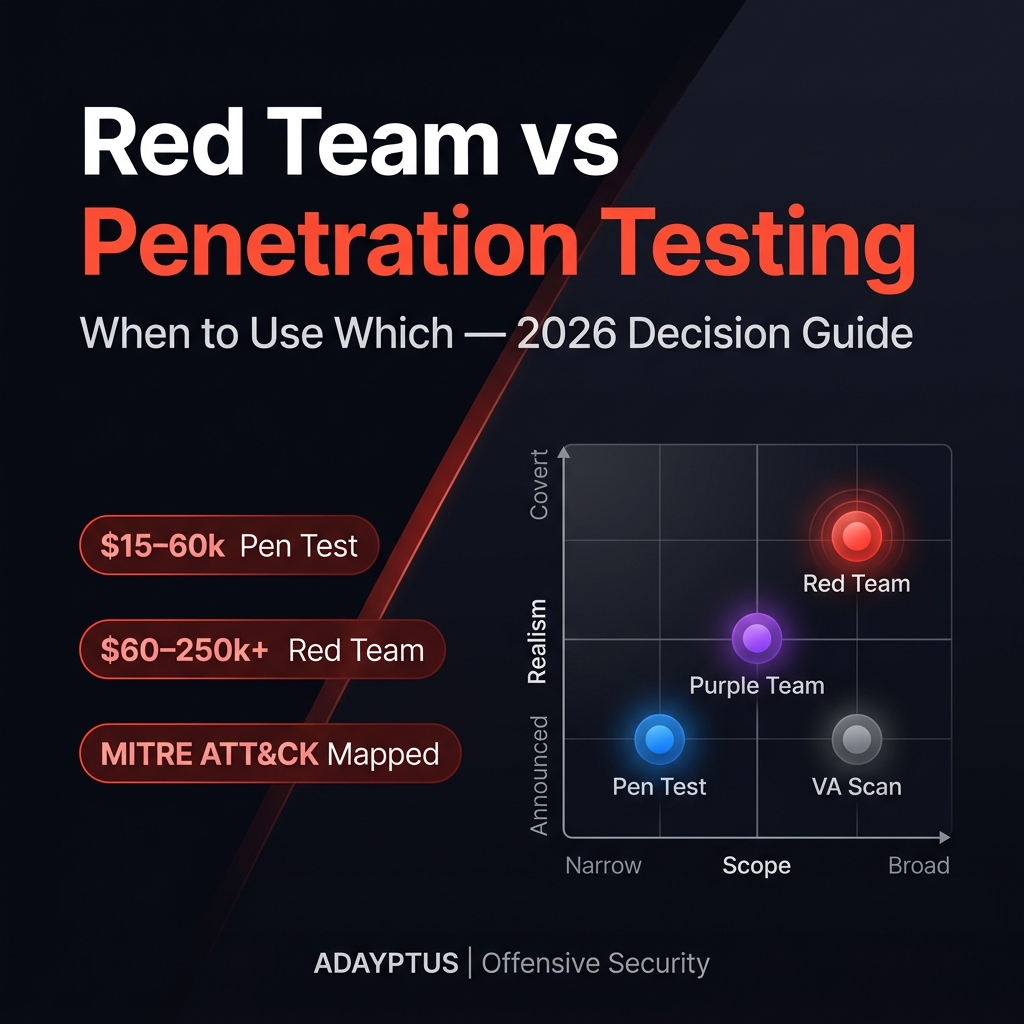
If you are deciding where a red team fits relative to a penetration test, this comparison covers when to use which.
Metrics worth reporting
Continuous validation makes a better class of metric available. Findings-per-quarter is a volume measure that rewards noise; the metrics below measure whether exposure is actually shrinking.
| Metric | Why it is better than "vulnerabilities found" |
|---|---|
| Proven attack paths to a crown-jewel asset | Directly tied to loss. Should trend to zero and stay there. |
| Mean time to remediate validated exploitable findings | Separates real work from backlog grooming. |
| Exposure window on internet-facing change | Time between a change going live and it being validated — the number Force 3 is about. |
| Retest pass rate on first attempt | Measures remediation quality. A low rate means fixes are cosmetic. |
| Percentage of estate validated in the last 30 days | Exposes the scoping gap an annual test hides. |
How Adayptus approaches this
Our position is deliberately unfashionable: automation should expand coverage and cadence, and a consultant should still decide what reaches your report. We use tooling — including autonomous path-finding — to widen what gets touched and how often. We do not ship its raw output as findings.
Concretely, that means every finding we deliver has been reproduced by hand before it appears in your report. It is the reason we are able to commit to zero false positives in delivered findings, and the reason our reports contain the reproduction steps an engineer needs rather than a tool identifier. When you fix something, the remediation retest is included at no additional cost — retesting is the part of the loop that actually reduces risk, and charging for it discourages the behaviour we want.
| If you need to… | Service |
|---|---|
| Validate continuously between scheduled tests | Continuous Security Validation & BAS |
| Know what you actually expose to the internet | Attack Surface Management |
| Test business logic and authorisation properly | Web Application Pentesting · API Pentesting |
| Prove detection and response, not just exposure | Red Team & Adversary Simulation |
| Cover cloud and internal network paths | Cloud Pentesting · Network Pentesting |
Where this is heading
Two things follow from the data above. The first is that validation becomes a continuous control rather than a project — the same transition that monitoring made a decade ago, driven by the same underlying cause, which is that the environment changes faster than the assessment cycle. The second is that the scarce resource shifts. When proving reachability is cheap and repeatable, the differentiating skill is no longer finding the weakness; it is understanding the business well enough to know which proven path actually matters, and testing the abuse cases no library contains.
The organisations that get this wrong will be the ones that read a falling finding count as improving security. The ones that get it right will use automation to make the routine continuous, and spend their human testing budget on the things that only humans currently find.
Frequently Asked Questions
Click any question to expand the answer.
QCan autonomous penetration testing replace manual penetration testing?
No. It replaces the repetitive portion — credential replay, lateral movement enumeration, path chaining across large estates, and regression retesting — and does it far more often than a human could. It does not find business logic abuse, authorisation flaws that depend on role intent, or chained technical-plus-process weaknesses, and it cannot judge business impact. Most compliance regimes that require penetration testing also expect human-led assessment.
QWhat is the difference between autonomous pentesting and breach and attack simulation?
BAS tests whether your controls detect or block specific known techniques, usually along scripted sequences. Autonomous penetration testing attempts to chain real weaknesses into a working attack path and prove exploitation. BAS answers "would we catch this technique"; autonomous testing answers "can an attacker get from here to there". Gartner now groups both under Adversarial Exposure Validation.
QIs autonomous penetration testing safe to run against production?
It can be, with controls. Require exclusion lists for fragile systems, rate limiting, the ability to disable destructive techniques, an abort mechanism, and a complete audit log of every action attempted. Align runs with change freezes, and start in a pre-production environment to calibrate before touching production. Treat the audit log as mandatory — you will need it if a run coincides with an unrelated outage.
QDoes autonomous testing satisfy PCI DSS penetration testing requirements?
Not on its own. PCI DSS v4.x requires internal and external penetration testing at least every 12 months and after significant change, following a defined methodology, with segmentation testing every 12 months and every six months for service providers. Autonomous validation is well suited to the after-significant-change trigger and to interim assurance, but the annual requirement expects a documented methodology and qualified tester. Confirm the approach with your QSA before relying on it.
QHow often should we run autonomous validation?
Tie cadence to change rate rather than the calendar. Internet-facing and edge infrastructure justifies continuous or weekly validation, since that is where exploitation has concentrated. Internal estates commonly settle on monthly, with an additional run triggered by significant change — a migration, a major release, a new third-party connection, or a segmentation change.
QHow does Adayptus use automation in penetration testing?
We use automation, including autonomous path-finding, to widen coverage and increase cadence — and a consultant reproduces every finding by hand before it reaches your report. That verification step is why we commit to zero false positives in delivered findings, and why reports carry reproduction steps rather than tool identifiers. Remediation retesting is included at no additional cost.
References
- Verizon, 2025 Data Breach Investigations Report — exploitation as initial access vector (20%, +34% YoY); edge device and VPN share (3% to 22%); remediation rate (~54%) and median 32 days; third-party involvement (15% to 30%).
- NIST, NIST Updates NVD Operations to Address Record CVE Growth (April 2026) — 263% submission growth 2020–2025; ~42,000 CVEs enriched in 2025; enrichment prioritisation criteria and "Lowest Priority" categorisation.
- CISA, Known Exploited Vulnerabilities Catalog — figures in this article computed by Adayptus from catalogue version 2026.08.24, analysed 25 August 2026.
- Gartner, Adversarial Exposure Validation — category definition and consolidation of BAS with automated penetration testing and red teaming.
- PCI Security Standards Council, PCI DSS v4.x — Requirement 11.4 penetration testing frequency and significant-change trigger; 11.4.5 and 11.4.6 segmentation testing intervals.
- MarketsandMarkets, Penetration Testing as a Service Market — USD 0.72bn (2026) to USD 1.98bn (2031), 22.6% CAGR. Overall penetration testing market estimates cited as a range because published 2025 figures differ materially between research firms.

Peyush Baranwal
Senior Delivery Manager - Cyber Security, Adayptus
Peyush Baranwal is a Senior Delivery Manager at Adayptus Consulting with 11+ years of experience designing, implementing, and managing enterprise security programmes. His core expertise spans Vulnerability Assessment & Penetration Testing (VAPT), Application Security, and Security Operations — leading web, mobile, API, and infrastructure security assessments for CISOs and security teams across BFSI, healthcare, and SaaS. He focuses on measurable risk reduction, governance maturity, and operationalising detection-and-response capability. Outside work, Peyush is a passionate biker and part-time photographer.
Connect on LinkedInOn This Page
- What "autonomous penetration testing" actually means
- Market trends: why this category is consolidating now
- What autonomous testing is genuinely good at
- Five things autonomous testing will not do for you
- How to evaluate a platform without buying a scanner
- The operating model that works
- How Adayptus approaches this
- Where this is heading
- Frequently Asked Questions
- References