Penetration Testing, Red Teaming and Attack Surface Management: What to Use Where
Attack surface management, penetration testing and red teaming answer three different questions. A plain-English map of the terminology, a decision guide by the question you are asking, and the order to buy them in.
Three vendors quote you for "security testing". The first sends a scanner report with 4,000 findings. The second spends two weeks on one application and hands you eleven. The third asks what would hurt most if it were stolen, then spends six weeks trying to steal it without your SOC noticing. All three used the same word. Only one of them was doing what you assumed you were buying. This article maps the vocabulary — attack surface management, penetration testing and red teaming at the centre, plus the dozen adjacent terms that get used interchangeably — and gives you a way to decide which one your situation actually calls for.
The short version
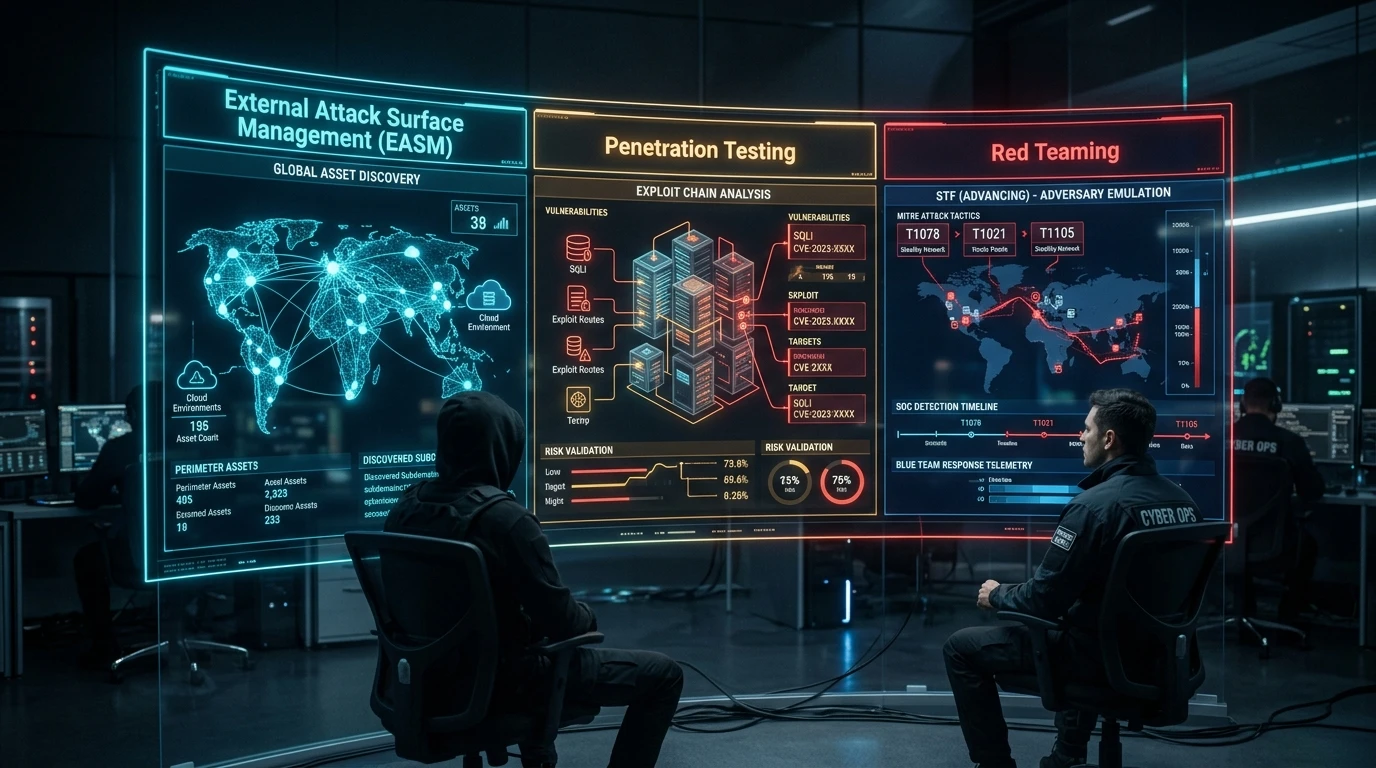
- — Attack surface management answers what do we have exposed? — breadth, continuous
- — Penetration testing answers what can be exploited here? — depth, point-in-time, defined scope
- — Red teaming answers would we detect and stop a real attacker? — objective-driven, tests people and process, not just technology
- — They are sequential, not alternatives. Buying them out of order is the most common and most expensive procurement mistake in this category.
One mental model: inventory, exploitability, detection
Almost every term in offensive security answers one of three questions. Fix the questions in your head and the vocabulary stops being confusing.
| The question | The discipline | What good looks like |
|---|---|---|
| What do we have exposed? | Attack Surface Management (ASM / EASM) | A current inventory of internet-facing assets, including the ones nobody told you about |
| What can actually be exploited? | Penetration testing / VAPT | Reproduced findings with proof, business impact, and a fix that gets retested |
| Would we notice and respond? | Red teaming / adversary simulation | A timeline of what you detected, what you missed, and how long each took |
The order matters. You cannot meaningfully test what you have not inventoried, and there is little value in measuring detection maturity while the front door is unlocked and unknown to you.
Attack Surface Management — knowing what you own
Attack surface management is the continuous discovery and monitoring of everything an attacker can reach from outside, including assets your teams stood up without telling security. External attack surface management (EASM) is the internet-facing subset and the part most organisations buy first.
It is not vulnerability scanning. A scanner tells you about weaknesses on hosts you already listed; ASM's job is finding the hosts that were never on the list — the forgotten staging subdomain, the marketing microsite on a personal cloud account, the S3 bucket from a project that ended two years ago, the API gateway a partner integration left exposed. This is the category where "we didn't know that existed" findings come from, and they are consistently among the most serious.
ASM is continuous by nature. A quarterly inventory of a surface that changes weekly is a historical document. For the discovery lifecycle, the rollout plan and how EASM compares with CAASM and CTEM, see our deep dive on external attack surface management.
Penetration testing — proving what is exploitable
A penetration test takes a defined scope and establishes what an attacker could actually do within it. The defining characteristic is not the tooling — it is that a human attempts exploitation, chains weaknesses together, and reasons about business impact. A finding that says "TLS 1.0 enabled" is scanner output. A finding that says "any authenticated user can retrieve another customer's invoices by changing one identifier, here are the steps" is a penetration test finding.
In India and much of Asia the term VAPT (Vulnerability Assessment and Penetration Testing) is used almost interchangeably with penetration testing, and it appears in regulatory language from RBI and SEBI. Strictly it describes two activities: the assessment identifies weaknesses broadly, the penetration test proves which of them are exploitable. Worth confirming which you are being quoted for, because the price difference is large and the deliverables are not comparable.
Penetration testing is scoped by target rather than by objective. That is its strength — thorough coverage of a defined thing — and its limit: it will not tell you whether your SOC would have noticed, because the testers are usually working with your team's knowledge and cooperation.
The question that separates a real test from a scan. Ask a prospective provider: "for a finding you rate critical, what evidence will the report contain?" A penetration test answers with reproduction steps and proof the action succeeded. A dressed-up scan answers with a CVE reference and a severity score. This single question does more filtering than any certification list.
Red teaming — testing whether you would catch it
A red team engagement is scoped by objective, not by target. The brief is "obtain access to the settlement system" or "exfiltrate a copy of the customer database", and the team may use any reasonable route: phishing, a physical visit, a third-party supplier, an exposed credential. Crucially, most of your organisation does not know it is happening — which is the point, because the thing being measured is your detection and response, not the presence of vulnerabilities.
The deliverable is different in kind. A penetration test gives you a list of things to fix. A red team gives you a narrative timeline: at 14:20 we did this, your EDR generated an alert, nobody triaged it for eleven hours, and by then we had domain admin. That output is aimed at your security operations function and your executive team, and it is uncomfortable in a way a vulnerability list never is.
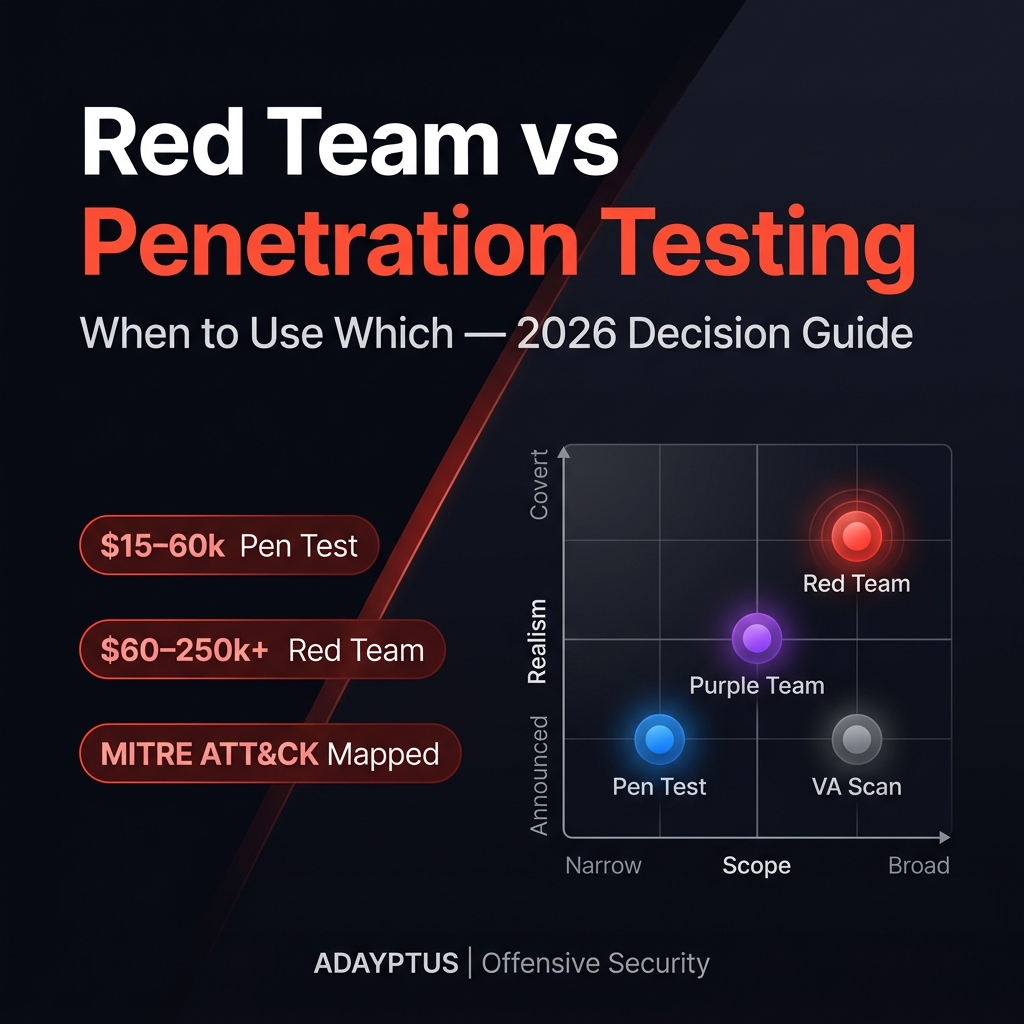
Red teaming is also the most commonly mis-bought service in this category. It is expensive, it takes weeks, and if your basic hygiene is weak the team will reach the objective through the first unlocked door and you will have paid red-team rates to discover something a penetration test would have found for a fraction of the cost. For the full comparison, including cost and regulator fit under frameworks such as TIBER-EU and CBEST, see red team vs penetration testing: when to use which, and for methodology, our guide to adversary emulation.
The adjacent terms, briefly
These are the words that show up in the same conversations and cause most of the confusion in procurement.
| Term | What it actually means | Commonly confused with |
|---|---|---|
| Vulnerability scanning | Automated identification of known weaknesses on known assets | Penetration testing — it is not one |
| Vulnerability management | The ongoing process of triage, prioritisation, fixing and verification | Scanning, which is only its input |
| VAPT | Assessment plus penetration testing; common in Indian regulatory usage | Used loosely for either half |
| Purple teaming | Offensive and defensive teams working together to tune detections | Red teaming — but it is collaborative and announced |
| Breach & attack simulation (BAS) | Automated, repeated testing of whether controls block known techniques | Red teaming — but scripted and continuous |
| Autonomous pentesting | Software that chains weaknesses and proves attack paths without a human driving | Manual penetration testing |
| Adversarial Exposure Validation (AEV) | Gartner's consolidated category covering BAS and automated pentesting | A product; it is a category |
| CTEM | Continuous Threat Exposure Management — the programme these activities sit inside | A tool you can buy |
| PTaaS | Human penetration testing delivered through a platform rather than a PDF | Automated testing — the testing is still human |
| Bug bounty | Ongoing crowd-sourced testing, paid per valid finding | Penetration testing — it has no defined coverage or end date |
Two of these have their own guides worth reading before you buy: purple teaming, and autonomous penetration testing — which covers the AEV consolidation and, importantly, the finding classes automation does not produce. If you are untangling scanning from management specifically, start with vulnerability management vs assessment.
Start from your question, not from the service catalogue
The fastest way to the right engagement is to say out loud what you are actually trying to find out.
| If you are saying… | You need |
|---|---|
| "I'm not confident we know everything we have on the internet" | Attack surface management |
| "We're launching a product and need to know it's safe to ship" | Application or API penetration test |
| "A customer or regulator has asked for a test report" | Scoped penetration test with a formal deliverable |
| "We've invested heavily in a SOC and don't know if it works" | Red team, or purple team if you want tuning rather than a grade |
| "We fix things but never confirm the fix held" | Continuous validation, plus retesting in your test contract |
| "Our board wants to know if we'd survive a ransomware attack" | Red team or scenario-based simulation |
| "We have 4,000 findings and no idea where to start" | Exposure validation to establish what is genuinely reachable |
| "We changed our cloud architecture significantly" | Cloud penetration test plus a fresh surface discovery |
The order to buy them in
If you are building an offensive security programme rather than buying a single engagement, sequence matters more than budget. A workable progression:
1. Know what you have — attack surface discovery
Everything downstream is scoped against this. Skipping it means every later engagement tests only the assets you happened to remember.
2. Fix the obvious — hygiene and vulnerability management
Unsupported software, default credentials, missing patches on internet-facing systems. Paying specialists to find these is poor value.
3. Prove exploitability where it matters — penetration testing
Start with what carries the most business risk: the revenue-generating application, the system holding regulated data, the internet-facing perimeter.
4. Keep it honest between tests — continuous validation
Environments change weekly; annual assurance does not survive contact with a release pipeline.
5. Test the humans and the process — red team
Once there is a detection capability worth measuring. Before that, a red team measures an absence.
The expensive mistake. Commissioning a red team without an asset inventory or a functioning detection capability. The team will succeed quickly through a route you already suspected, the report will tell you things you could have learned far more cheaply, and the engagement will be remembered as security theatre rather than as the maturity checkpoint it is meant to be.
How these fit together across a year
Mature programmes do not choose between these. They run them on different clocks, each answering its own question.
| Activity | Cadence | Trigger |
|---|---|---|
| Attack surface discovery | Continuous | Always on |
| Exposure validation | Weekly to monthly | Change rate of the estate |
| Application penetration test | Per major release, or quarterly | Significant change; customer or regulator request |
| Infrastructure penetration test | Annually, plus after change | Compliance obligation; architecture change |
| Purple team | Quarterly | New detection content; new threat intelligence |
| Red team | Annually or on trigger | Board assurance; post-incident; regulatory scheme |
How Adayptus maps to this
Our services line up against the same three questions. Whichever you start with, every finding we deliver is reproduced by a consultant before it reaches your report — which is why we commit to zero false positives in delivered findings, and why the remediation retest is included at no additional cost. Retesting is the step that actually reduces risk; charging for it discourages the behaviour we want.
| Your question | Adayptus service |
|---|---|
| What do we have exposed? | Attack Surface Management |
| Is this application or API safe to ship? | Web App Pentesting · API Pentesting · Mobile App Pentesting |
| Can our network or cloud be broken into? | Network Pentesting · Cloud Pentesting |
| We need a formal test programme | Penetration Testing & VAPT |
| Would we detect and respond to a real attacker? | Red Team Operations · Advanced Threat Simulation |
| We want detections tuned, not just graded | Purple Team Exercises |
| How do we stay assured between tests? | Continuous Security Validation |
| Who watches this day to day? | Managed SOC & MDR · Threat Hunting |
If you are not sure which of these you need, that is a normal place to start from. Describe what you are worried about and what triggered the question; scoping conversations are more useful than service pages, and we sign an NDA before the first one.
Frequently Asked Questions
Click any question to expand the answer.
QWhat is the difference between penetration testing and red teaming?
A penetration test is scoped by target and aims for thorough coverage of a defined system, telling you what is exploitable within it. A red team is scoped by objective — obtain access to a specific asset — may use any reasonable route including phishing and physical access, and is usually unannounced to most of the organisation. The penetration test measures vulnerabilities; the red team measures detection and response.
QIs attack surface management the same as vulnerability scanning?
No. Vulnerability scanning looks for known weaknesses on assets you have already listed. Attack surface management's primary job is discovering assets that were never on the list — forgotten subdomains, shadow cloud accounts, exposed staging environments, third-party integrations. ASM answers "what do we have?"; scanning answers "what is wrong with what we have?"
QDoes VAPT mean the same thing as penetration testing?
In practice the terms are used interchangeably, particularly in India where VAPT appears in RBI and SEBI regulatory language. Strictly, VAPT covers two activities: a vulnerability assessment that identifies weaknesses broadly, and a penetration test that proves which are exploitable. Confirm which you are being quoted for — the cost and the deliverables differ substantially.
QWhich should we buy first if we have never done any of this?
Attack surface discovery, then basic hygiene, then a penetration test on whatever carries the most business risk. Red teaming comes later — it measures detection and response, so it only produces useful results once you have a detection capability worth measuring. Buying a red team first usually means paying premium rates to discover something far cheaper testing would have found.
QHow can I tell a real penetration test from an automated scan sold as one?
Ask what evidence a critical finding will carry. A genuine test provides reproduction steps and proof the action succeeded — a session obtained, a record retrieved, a privilege gained. A repackaged scan provides a CVE reference and a severity score inferred from a version banner. Also ask whether findings are manually verified before delivery, and whether a retest after remediation is included.
QHow does Adayptus scope these engagements?
We start from what you are trying to find out rather than from a service name, because the right engagement often is not the one first asked for. Every delivered finding is reproduced by a consultant before it reaches your report, which is why we commit to zero false positives in delivered findings, and remediation retesting is included at no extra cost. We sign an NDA before the first scoping conversation.

Peyush Baranwal
Senior Delivery Manager - Cyber Security, Adayptus
Peyush Baranwal is a Senior Delivery Manager at Adayptus Consulting with 11+ years of experience designing, implementing, and managing enterprise security programmes. His core expertise spans Vulnerability Assessment & Penetration Testing (VAPT), Application Security, and Security Operations — leading web, mobile, API, and infrastructure security assessments for CISOs and security teams across BFSI, healthcare, and SaaS. He focuses on measurable risk reduction, governance maturity, and operationalising detection-and-response capability. Outside work, Peyush is a passionate biker and part-time photographer.
Connect on LinkedInOn This Page
- One mental model: inventory, exploitability, detection
- Attack Surface Management — knowing what you own
- Penetration testing — proving what is exploitable
- Red teaming — testing whether you would catch it
- The adjacent terms, briefly
- Start from your question, not from the service catalogue
- The order to buy them in
- How these fit together across a year
- How Adayptus maps to this
- Frequently Asked Questions