SSPM Explained: Securing Your SaaS Stack
SSPM explained — what SaaS Security Posture Management is, how it differs from CSPM and CASB, the risks it fixes (misconfigurations, OAuth abuse, identity sprawl), and how to secure your SaaS stack.
Your most sensitive data no longer lives only in your data centre or even your cloud accounts — it lives in dozens, often hundreds, of SaaS applications: Microsoft 365, Google Workspace, Salesforce, Slack, GitHub, Workday, and more. Each one is a separately-administered system with its own security settings, identity model, and sharing controls. SaaS Security Posture Management (SSPM) is how you regain visibility and control over that sprawling, business-critical layer.
If you've read our CSPM vs CWPP vs CNAPP guide, SSPM is the natural next chapter. CSPM secures your cloud infrastructure (AWS, Azure, GCP); SSPM secures the SaaS applications you consume. It's a fast-growing category precisely because the SaaS layer has quietly become where breaches happen — through misconfiguration, over-privileged OAuth apps, and identity gaps rather than exotic exploits.
This guide explains what SSPM is, how it differs from CSPM and CASB, the specific risks it addresses, how it works, and a practical plan to secure your SaaS stack — plus how Adayptus Consulting helps you operationalise it.
- 01 SSPM secures SaaS apps (M365, Salesforce, Slack…); CSPM secures cloud infrastructure (AWS/Azure/GCP).
- 02 SaaS breaches come from misconfiguration, OAuth abuse, and identity gaps — the customer's side of the shared-responsibility model.
- 03 SSPM continuously checks settings, MFA, privileges, third-party app grants, and data exposure across every app.
- 04 Shadow SaaS and over-scoped OAuth apps are the most overlooked risks — SSPM surfaces both.
- 05 SSPM complements CASB, IdP, and CSPM — together they cover the full cloud + SaaS estate.
What Is SSPM (SaaS Security Posture Management)?
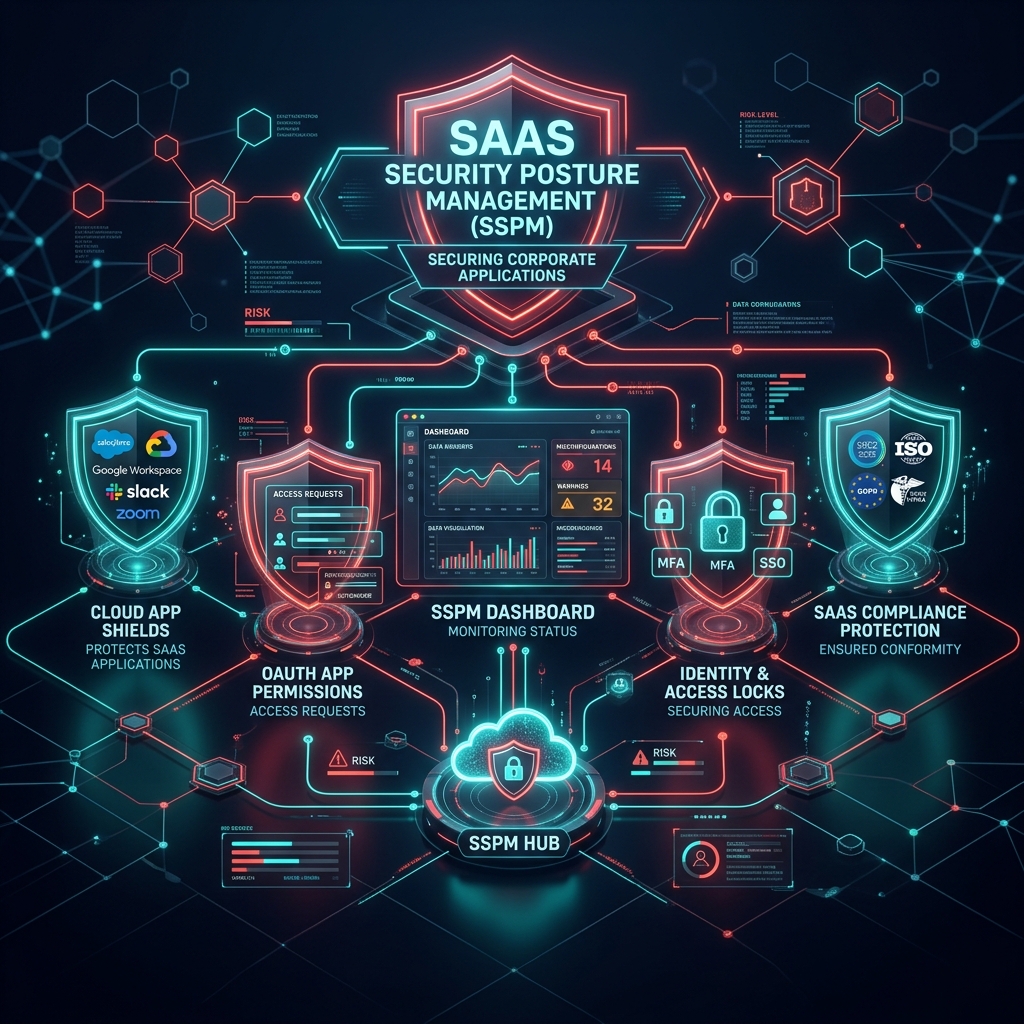
SaaS Security Posture Management (SSPM) is a category of tooling and practice that continuously monitors the security configuration and posture of your SaaS applications, detects misconfigurations and risky settings, and helps you remediate them. Think of it as CSPM for SaaS: where CSPM reads the control plane of your cloud accounts, SSPM connects via API to each SaaS app and evaluates its settings against security best practices and compliance frameworks.
SSPM answers questions no single admin console makes easy across a large estate: Is MFA enforced everywhere? Which users have admin rights they don't need? What third-party apps have been granted access to our data, and what can they do? Is any data shared publicly? Are our tenants configured to the security baseline — and have they drifted?
Under the SaaS shared-responsibility model, the vendor secures the platform — but you own the configuration, identities, data, and app integrations. The overwhelming majority of SaaS security incidents happen on the customer's side of that line, which is exactly the ground SSPM covers.
SSPM vs CSPM vs CASB — Where SSPM Fits
These acronyms overlap in marketing but solve different problems. Getting the distinction right prevents gaps and duplicate spend.
| Capability | Secures | Focus |
|---|---|---|
| CSPM | Cloud infrastructure (IaaS/PaaS) | Misconfig in AWS/Azure/GCP control plane |
| SSPM | SaaS applications | App settings, identity, OAuth apps, data sharing |
| CASB | Traffic to/from cloud & SaaS | Access control, DLP, shadow-IT discovery (inline/proxy) |
| IdP / IGA | Identities & entitlements | Authentication, SSO, access governance |
In practice they're complementary layers. CASB often sits in the network path and discovers/controls usage; SSPM connects via API into each sanctioned app to audit its posture from the inside. A mature cloud security programme runs CSPM for infrastructure and SSPM for SaaS, tied to a strong identity provider. For the infrastructure side of this story, see our CSPM vs CWPP vs CNAPP guide.
The SaaS Risks SSPM Addresses
Assuming "the vendor secures it." SaaS platforms are highly secure — but the breaches almost always trace to your configuration: an admin without MFA, a public share, or an OAuth app with mailbox access nobody reviewed. That's your responsibility, and SSPM is how you keep on top of it.
How SSPM Works
SSPM tools connect to each SaaS application through its native API (usually as a read-only or scoped integration) and continuously evaluate posture:
Start with a cloud & SaaS security assessment that baselines your top apps (usually M365/Google Workspace first), then operationalise continuous SSPM monitoring feeding your managed SOC. Pair it with a cloud identity & access review — most SaaS risk is ultimately an identity problem.
Business Impact — Why SSPM Matters Now
SaaS has become the default operating system of the enterprise, and the data inside it — email, documents, source code, customer records, financials — is exactly what attackers want. Yet the SaaS layer is often the least-governed part of the estate: no two apps are administered the same way, security teams lack a single pane of glass, and adoption outruns review. The result is a large, invisible attack surface that adversaries increasingly target with token theft, OAuth abuse, and adversary-in-the-middle phishing (as covered in our Microsoft 365 hardening guide).
SSPM converts that chaos into a managed, measurable posture — reducing breach likelihood, and producing the continuous evidence auditors want for SOC 2, ISO 27001, and DPDP.
Prioritise by data sensitivity, not app popularity. The SaaS apps holding your crown-jewel data (email, CRM, code repos, HR/finance) deserve the deepest posture management first — even if a chat tool has more daily users.
How to Secure Your SaaS Stack — A Practical Plan
SaaS Security Checklist
- ✓ Phishing-resistant MFA enforced for all users
- ✓ SSO via central IdP; conditional access policies
- ✓ Least-privilege admin & global-admin roles
- ✓ Dormant / offboarded accounts removed
- ✓ Third-party OAuth grants reviewed & restricted
- ✓ Admin consent required for new app access
- ✓ Shadow SaaS discovered & governed
- ✓ Risky / unused integrations revoked
- ✓ Public / "anyone with link" sharing controlled
- ✓ External & guest access governed
- ✓ Security features enabled to baseline
- ✓ Audit logging enabled & retained
- ✓ Continuous posture monitoring & drift alerts
- ✓ SaaS logs integrated with the SOC
- ✓ Mapped to ISO 27001 / SOC 2 / DPDP
- ✓ Posture reported to leadership
Common Mistakes
1. Securing infrastructure but ignoring SaaS
Teams invest heavily in CSPM for AWS/Azure while the CRM and email holding the crown jewels go un-audited.
2. No OAuth-app governance
Standing, over-scoped third-party grants are a silent backdoor. If you've never reviewed them, assume some are dangerous.
3. Point-in-time audits only
SaaS settings drift constantly as admins and users make changes. A quarterly review misses risk introduced last week.
4. Treating each app in isolation
Without a single pane of glass, inconsistent policies across apps create gaps attackers pivot through.
5. Forgetting shadow SaaS
Apps adopted outside IT hold real data with zero governance. Discovery must include the unsanctioned.
How Adayptus Helps
Adayptus secures the SaaS layer as part of a unified cloud security programme. We run SaaS & cloud security assessments that baseline your critical apps (Microsoft 365, Google Workspace, Salesforce, GitHub and more) against security and compliance frameworks; deliver cloud identity & access reviews to fix the root cause of most SaaS risk; govern third-party OAuth apps and third-party risk; and operationalise continuous posture monitoring feeding a 24×7 managed SOC / MDR. We map findings to SOC 2, ISO 27001, and DPDP under a GRC / vCISO wrapper, and reduce user-driven risk with awareness training and phishing simulation. Related reading: CSPM vs CWPP vs CNAPP and securing Microsoft 365.
Do you know your SaaS security posture?
Talk to Adayptus about a SaaS & cloud security assessment — baseline your critical apps, uncover risky OAuth grants and misconfigurations, and get a prioritised plan to secure your SaaS stack.
Conclusion
SaaS runs the modern enterprise, but its security is your responsibility — and it's spread across dozens of separately-administered apps that drift constantly. SaaS Security Posture Management brings that sprawl under continuous control: it audits configuration, identity, third-party OAuth apps, and data sharing across your whole SaaS estate, prioritises the real risks, and proves compliance. Treat SSPM as the natural companion to CSPM — infrastructure and SaaS, secured together — start with your crown-jewel apps and your identity layer, and make it continuous. That's how you stop the SaaS layer from being your quiet, ungoverned back door.
Disclaimer: This article is an original, informational overview of SaaS Security Posture Management as understood in 2025-2026. Statistics are indicative industry figures and vary by source and methodology; validate approaches against your own environment and current vendor and framework guidance.
References
- Gartner — SaaS Security Posture Management (SSPM) market research.
- CSA — Cloud Security Alliance SaaS security guidance & shared-responsibility model.
- OWASP — OWASP Top 10 (access control & misconfiguration categories).
- NIST — Cybersecurity Framework 2.0.
- Microsoft — Microsoft 365 security documentation.
Frequently Asked Questions
Click any question to expand the answer.
QWhat is SSPM (SaaS Security Posture Management)?
SSPM is a category of tooling and practice that continuously monitors the security configuration and posture of your SaaS applications, detects misconfigurations and risky settings, and helps you remediate them. It connects via API to each SaaS app and evaluates settings, identities, privileges, third-party app grants, and data sharing against security best practices and compliance frameworks.
QWhat is the difference between SSPM and CSPM?
CSPM (Cloud Security Posture Management) secures cloud infrastructure — the AWS, Azure, and GCP control plane — flagging misconfigurations like public storage or over-permissive IAM. SSPM secures SaaS applications such as Microsoft 365, Salesforce, and Slack, auditing their settings, identities, OAuth app grants, and data sharing. They cover different layers and are complementary; a full cloud security programme uses both.
QIs SSPM the same as CASB?
No. A CASB (Cloud Access Security Broker) typically sits in the network path to control access, apply DLP, and discover shadow IT as users interact with cloud and SaaS. SSPM connects via API directly into sanctioned SaaS apps to audit their internal security posture and configuration. They complement each other: CASB governs usage and access; SSPM governs the apps' own settings and risks.
QWhy are third-party OAuth apps a SaaS security risk?
Users can grant third-party apps and browser plugins broad, standing access to their mailbox, files, and data via OAuth — often without security review. An over-scoped or malicious app then has persistent, token-based access that bypasses passwords and MFA, making it a leading and under-monitored SaaS attack path. SSPM inventories these grants and flags risky or unused ones for revocation.
QWhich SaaS apps should we secure first?
Prioritise by data sensitivity and business criticality, not user count. Start with the apps holding your crown-jewel data — email and collaboration (Microsoft 365, Google Workspace), CRM (Salesforce), code repositories (GitHub), and HR/finance systems — then expand coverage. An app with fewer users but highly sensitive data warrants deeper posture management than a popular but low-risk tool.
QHow does Adayptus help with SaaS security?
Adayptus runs SaaS and cloud security assessments that baseline your critical apps against security and compliance frameworks, delivers cloud identity and access reviews to fix the root cause of SaaS risk, governs third-party OAuth apps and third-party risk, and operationalises continuous posture monitoring feeding a 24x7 managed SOC. Findings are mapped to SOC 2, ISO 27001, and DPDP under a GRC and virtual CISO wrapper, with awareness training and phishing simulation to reduce user-driven risk.

Peyush Baranwal
Senior Delivery Manager — Cyber Security, Adayptus
Peyush Baranwal is a Senior Delivery Manager at Adayptus Consulting with 11+ years of experience designing, implementing, and managing enterprise security programmes. His core expertise spans Vulnerability Assessment & Penetration Testing (VAPT), Application Security, and Security Operations — leading web, mobile, API, and infrastructure security assessments for CISOs and security teams across BFSI, healthcare, and SaaS. He focuses on measurable risk reduction, governance maturity, and operationalising detection-and-response capability. Outside work, Peyush is a passionate biker and part-time photographer.
Connect on LinkedInOn This Page
- What Is SSPM (SaaS Security Posture Management)?
- SSPM vs CSPM vs CASB — Where SSPM Fits
- The SaaS Risks SSPM Addresses
- How SSPM Works
- Business Impact — Why SSPM Matters Now
- How to Secure Your SaaS Stack — A Practical Plan
- SaaS Security Checklist
- Common Mistakes
- How Adayptus Helps
- Conclusion
- References
- Frequently Asked Questions